MVP friends -
We’re having lots of big internal discussions about the future and would love your input on a big decision we’re trying to make.
Should MVP build a 50-state strategy?
I’m going to lay out the pros and cons and we’d love your quick take!
After reading the pro-and-con arguments, please give us your feedback (below) and be sure to RSVP for our December briefing, where we’ll share a sneak peek at our plans, including our decision on a 50-state strategy.
In short, this election showed that, under the right circumstances, we can win almost anywhere. The historic victory in Mississippi this week provides a powerful new data point for that argument.
It’s funny, MVP has had a “nearly 50” state strategy for a long time (we have funded local partners in 47 states — everywhere except for Delaware, Oklahoma, and Hawaii).
As context, here is a chart of MVP partisan funding by state over the past 8 years:
Pretty interesting, right?
The first thing we should say about this chart is a huge THANK YOU for your investment over the years! This is your money we are investing to win all of these elections and our mandate is to channel your intentions — which is why we wanted to ask for your input on this decision.
(And we’ll report back on this election once we have full results in December!)
Some context before you weigh in …
We are sharing this with you in part for transparency, and also to inspire you to dream big with us. Our partners’ success in the 2028 cycle depends a lot on us being early out the gate with our investments. I know we’re all catching our breath from the last two years (whew!). Frankly, most of us would love to take the next two months off! But the 2028 presidential election cycle is already upon us. The clearer our strategy, the more early money we can raise to fuel our collective success.
In the past, MVP has invested partisan funds in 30-40 states based on their competitiveness (grantmaking process here) — and we occasionally invest in “red” and “blue” state elections that are off the beaten path. For example, we once helped win a competitive U.S. House race in Connecticut. And we invested modestly in a successful sweep of school boards in Wyoming.
Even though MVP has always nominally had a “pretty close to 50 state” strategy, we have never chosen to emphasize it for two reasons:
1. We are overwhelmingly focused on our top priority states — as you can see from the graph above :). And we haven’t wanted to create a false impression that we are focused on anything other than our top priority states.
2. It’s very important to us to invest funds most strategically where they will make the greatest impact. We pride ourselves on our political targeting acumen. (Not to brag, but Nate Silver and Cook Political Report are often months behind us in interpreting the political map).
We take these two mandates very seriously. From our thousands of conversations with MVP donors, we know the vast majority of you give through MVP because you trust us to target resources strategically on your behalf.
At the end of the day, we have a moral imperative to win.
No matter what we decide about a 50-state strategy, we will always keep these two strategic imperatives at the forefront of our targeting. At the end of the day, we have a moral imperative to win.

The case against: Why would we NOT want to run a 50-state strategy?
There is one very big, very important, and very simple reason why MVP might decide not to adopt a 50-state strategy:
Money.
Despite MVP’s relative success in moving money, we estimate that, in partnership with our allied funders, we are currently raising less than one quarter of the funds that our partners need to be sustainable and do their best work at the optimal scale.
With such a scarcity of resources, and existential risks knocking at our door (climate, AI, autocracy, etc.), how does one justify allocating even a modest slice of a finite pie away from a battleground state like Pennsylvania, Georgia, or Arizona to fund a deep “red” or “blue” state like Oklahoma or Massachusetts?
Sure, a “50-State Strategy” might sound good. But is it actually strategic? We have to be careful not to get caught up in smoking too much “hopium” and delusionally overinterpreting last week’s election results as a broad sign that Democrats are on track to win everywhere.
We have to be clear-eyed, focused, and disciplined with a limited resource pie.
We have to be clear-eyed, focused, and disciplined with a limited resource pie. The 2026 political environment was a once-in-a-generation Bluenami — which is unlikely to be repeated in future elections. (Although 2028 has the potential to be a very good year too depending on who the candidates are, no one expects 2030 to be nearly as good). At the end of the day, MVP’s #1 responsibility is to invest your money as strategically as possible where it will make the greatest difference. And in 2027-2028 at least, that is likely not in all 50 states.
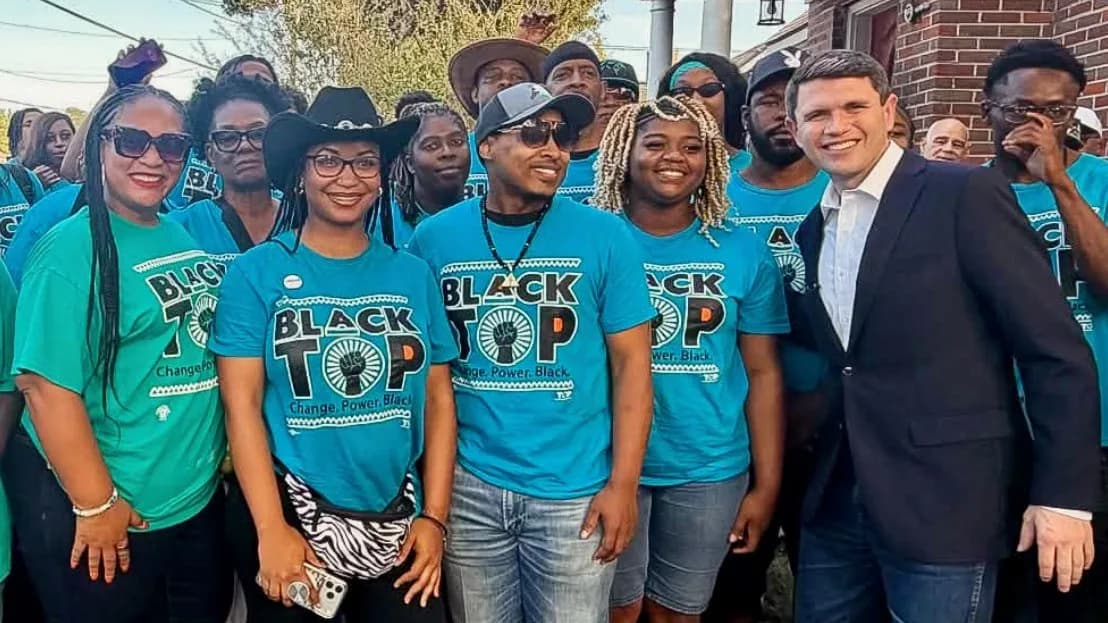
Photo: Texas Organizing Project PAC (TOP PAC) with Texas Senator-elect James Talarico getting out the vote in Houston.
The case for: Why would we want to build a 50-state strategy?
Having acknowledged the potential downsides, there are also good reasons to consider orienting ourselves at least a little bit more around a 50-state strategy.
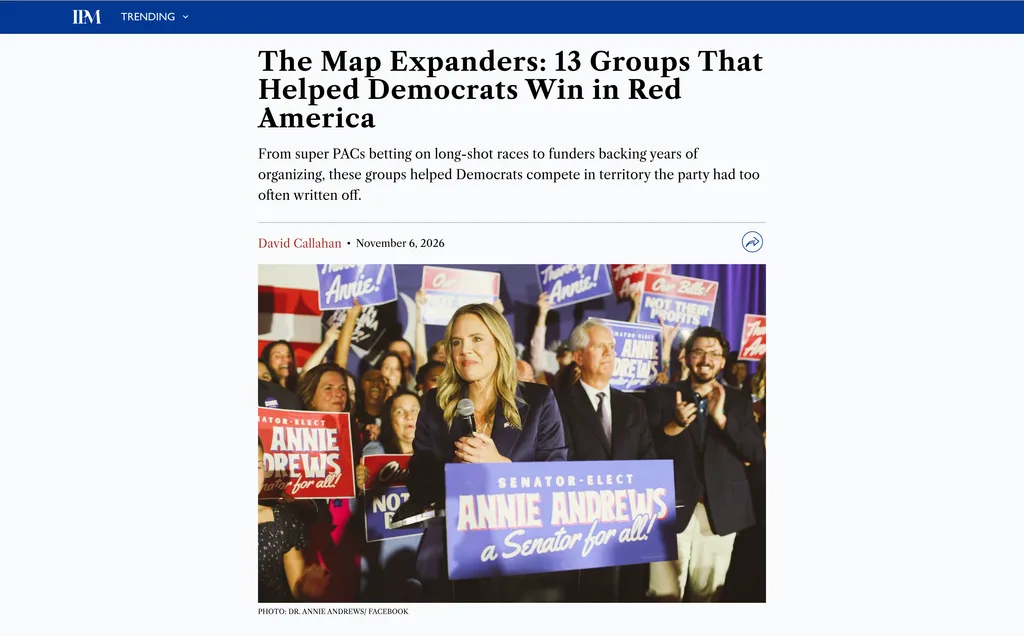
First of all, as we saw last week, we have the potential to win statewide in all sorts of unexpected “red” states like Kansas, Texas, South Carolina, and Mississippi (whoo-hoo!!!!) that were not on many people’s bingo cards a year ago. We also won unexpected House districts in places like Missouri and Indiana. And we won unexpected races in red districts in “blue” states — from southern New Jersey to eastern Colorado (Lauren Boebert!).
We also came excruciatingly close to winning even more. We came within a few thousand votes of winning Democratic trifectas in Georgia and North Carolina. We lost two Senate seats and 14 House seats by under three points. We came less than 26,000 votes (1.8%) away from winning a U.S. Senate seat in Louisiana, which had basically no serious outside investment of any kind, and just 237,000 votes away (2.9%) from winning Florida, which was deeply underinvested in as well!
In short, there is a real chance over time to win meaningful elections in even the reddest “red” states.
In short, there is a real chance over time to win meaningful elections in even the reddest “red” states. In 2018, we won a House race in Oklahoma. After the next census, we might even have a shot at a House seat in Idaho.
There are also a lot of things to win in “blue” states. Not just obvious low-hanging fruit like redistricting in Maryland or a Democratic trifecta in Vermont. There are also very deep problems in deep-blue states like Massachusetts and California, where parochial and corrupt Democratic machines block progress on everything from housing to clean energy to democracy.
In short, from “red” states to “blue” states, there are big things to win everywhere. You never know when you’re going to have the chance to pick up a Senate seat in Alabama (as we did in 2017) or a governor in Kentucky (2019). And you never know when you might be in danger of losing a Senate seat in Massachusetts or a governor’s race in New Jersey, Maryland, California, or Illinois — all of which have happened in recent memory. It turns out that there are important elections everywhere — and we haven’t even talked about ballot measures.
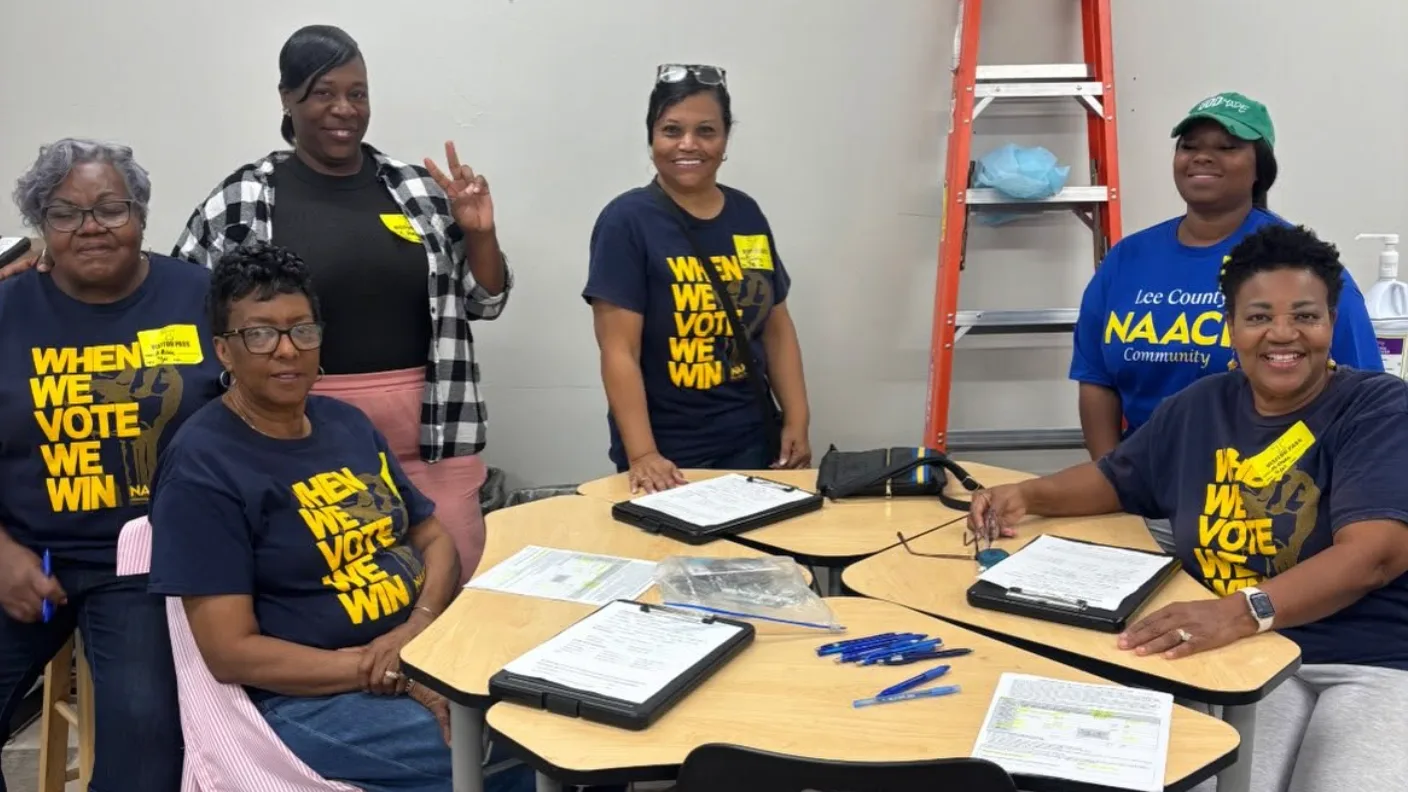
Photo: MS NAACP canvassers preparing to knock doors and talk to voters.
An entirely new reason to think about 50 states
But there is an entirely new reason to consider a 50-state strategy:
You’ve probably heard by now about the (awkwardly named) National Popular Vote Interstate Compact (NPVIC — explainer video here).
There’s been a growing buzz about it since last week’s victories. If enough states pass NPVIC in 2027 (which MVP local partners in MI, WI, PA, AZ, and NV are working hard on!), it could make the Electoral College irrelevant and, for the first time in American history, presidential elections could be decided not by the Electoral College, but by the popular vote in all 50 states.
Suddenly a voter in New York or Tennessee will have just as much power as a voter in Michigan or Arizona to choose who gets to be President.
There are a lot of ifs (will the Supreme Court try to mess with it? Will future Republican trifectas honor it?). But if NPVIC holds, it would be an absolute gamechanger in presidential elections. Suddenly a voter in New York or Tennessee will have just as much power as a voter in Michigan or Arizona to choose who gets to be President. And yes, that includes voters in what we hope will be the 51st State, Washington, D.C. (which we would obviously include in what we hope will one day become a 51-state strategy, and maybe even 52 with Puerto Rico).
Getting ready for a national popular vote is one new reason to begin building toward a 50-state strategy. (It also might require us to build a “Top 100 metro areas” strategy because that’s where most of Democratic voters live! But that’s a topic for another day.) With or without a national popular vote, there is a bigger and deeper reason to consider a 50-state strategy …
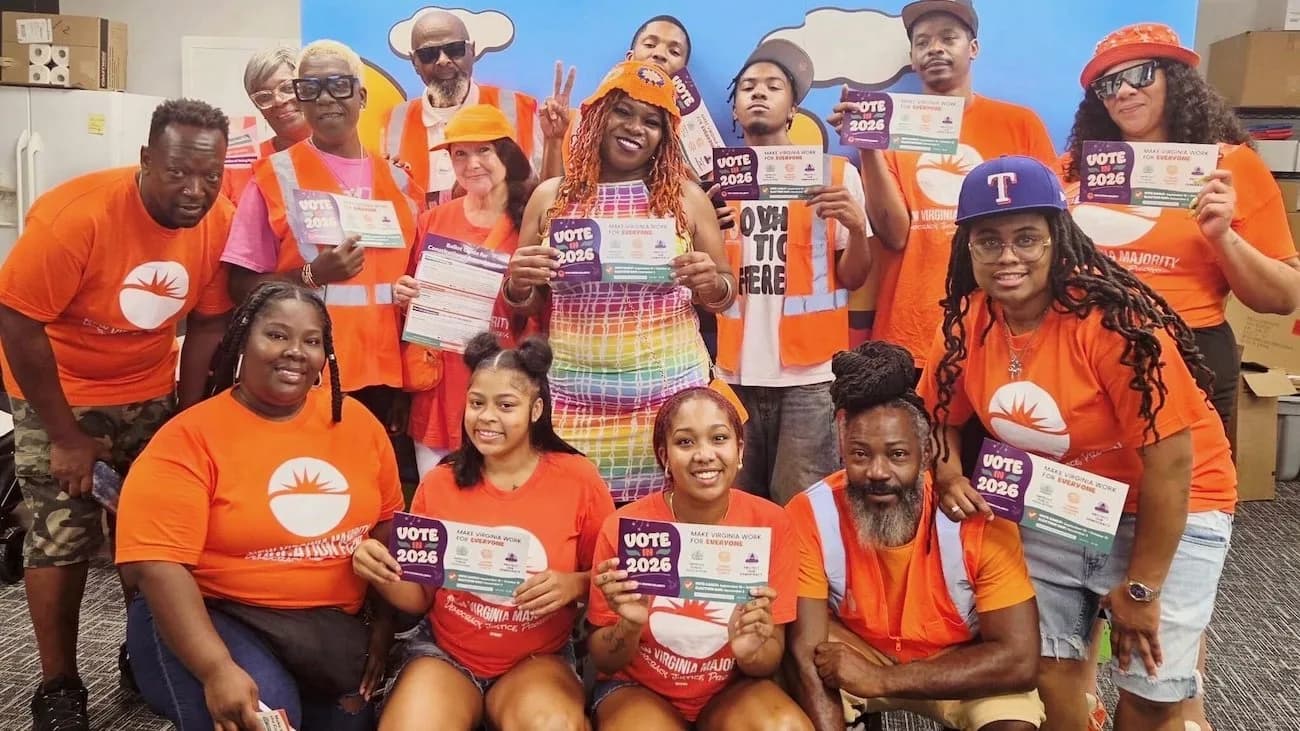
Photo: New Virginia Majority canvassers knocking doors and talking to voters the weekend before Election Day.
Building toward a Democratic supermajority
The bigger and deeper reason to invest in a 50-state strategy is to begin to reorient ourselves away from thinking in terms of a focused and tactical federal battlefield where we fight for the blue team to narrowly defeat the red team every two years in the context of the increasingly limited back-and-forth pendular shifts of a toxically polarized electorate.
The real vision behind a 50-state strategy is to reorient instead toward a bolder, more positive, more majoritarian, and, one might even say, love-based worldview, along the lines of what James Talarico offered to the voters of (the former “red” state known as) Texas.
A 50-state strategy is not just about giving lip service to the idea that every community matters. It’s foundational to building a values- and purpose-driven movement that is long-term and emotionally resonant in a way that builds a sense of moral purpose and belonging that transcends normal partisan politics. It helps us to feel like we all matter, we are all connected, and we can tell a bigger and deeper story about the change we yearn to create in this country.
Fighting for narrow and precarious majorities at the federal level is never going to bring us the level of change we need to see.
Fighting for narrow and precarious majorities at the federal level is never going to bring us the level of change we need to see. As Adam Jentleson argues in his book Supermajority, there is a moral and strategic imperative to orient ourselves toward building a wider governing coalition that can win robust change in a much broader array of states.
The beating heart of a 50-state strategy is this: We need to invest in blue states that can model what is possible and provide bold leadership. And we need to invest in red states to truly transform the country — from the Deep South to the rural West — and win hearts and minds in “red” America.
Of course, we need to continue to invest most deeply in proven and emerging battlegrounds because we know that’s where we are most likely to make an impact at the margins to tip the balance of power. And we need to always be on the lookout for the next emerging opportunity — or threat. If the past 10 years of American politics have taught us anything, it is to expect the unexpected.
That is the case for why investing consistently in all 50 states, and eventually in every corner of America, may ultimately be even more strategic (with limited funds) than only investing tactically in the places that look like they’re the most competitive at the start of any given election cycle.
Tell us what you think!
Now that you have heard the pro argument and the con, we would love you to weigh in and give us your feedback as committed MVP donors on which strategic orientation you would most want to see your money invested in and why.
Take our poll to tell us which approach to targeting you believe is wisest:
- OPTION A: Keep MVP’s current “ultra-flexible” targeting
- OPTION B: Try a “minimalist” version of a 50-state strategy
- OPTION C: Commit to a “medium” version of a 50-state strategy
- OPTION D: Go big with a “maximalist” version of a 50-state strategy
- OPTION E: I’d prefer another approach entirely! (please share)
Thank you for your feedback! Thank you for your investments with us. And thanks for geeking out with us as we wrestle with these big strategic decisions!
See you in December to celebrate and get a sneak peek at our 2027-2028 strategy.
I predict this will be a wild and unpredictable cycle, so it should be interesting!
Billy
Billy Wimsatt, MVP Executive Director
(On behalf of the MVP team)
ps. Fun fact: In September, we surveyed donors about how optimistically to interpret the incoming Blue Wave. Most of you encouraged us to invest in a middle path, focusing on states like Iowa, Ohio, Kansas, and Texas. We agreed and invested most of our late money in these “mid-range” contests, which seemed like the sensible choice at the time. Only seven of you (6% of respondents) encouraged us to be extremely bullish and focus our investments on states like South Carolina, Mississippi, Louisiana, and Florida. To the seven of you who had the most accurate advice for us: Congratulations!
All this to say: We really do listen to your feedback. And for better or worse, the seemingly sensible choice doesn’t always end up being the best one! History is often nonlinear. This is a humbling reminder that we too often end up fighting the last battle. MVP will always try hard to analyze political trends and do our targeting unsentimentally with the freshest of eyes.