View as PDF: Summary • Full Version
Executive Summary
Background
- After the 2024 elections, countless articles sought to explain what went wrong for Democrats.
- By summer 2025, two definitive data analyses were released by Catalist and Pew, respectively.
- At that point, MVP conducted our own analysis of what that data revealed about the voters our grantee partners organize — and the implications for MVP’s strategy going forward.
- Now, in the wake of the November 2025 elections, we are sharing what emerged from that 2024 analysis — and how this year’s electoral results affirm our findings.
Key Conclusions
- In 2024, Trump won because young voters, voters of color, and infrequent voters swung right.
- Importantly, many young voters and voters of color are also infrequent voters who are less politically engaged, informed, and fixed in their convictions.
- This means Democrats can win these voters back — and evidence suggests that independent political organizations (like MVP grantees) are more effective than candidate or party efforts at reaching them, because these groups prioritize warm, person-to-person outreach and year-round engagement over cold text outreach and other superficial forms of voter contact.
- In 2025, youth and voters of color swung back to Democrats (including Trump 2024 voters), supporting the conclusion that 2024 was a temporary shift versus a permanent realignment.
- In 2026, the electorate may be slightly less Democratic-favoring than in 2025 — and then dramatically less so in 2028. To win, MVP asserts that the big-tent Democratic coalition must proactively scale up sustained investment in deep, year-round organizing (both offline and online), rather than relying on impersonal TV ads and traditional, transactional voter outreach.
Part 1: 2024 Election Analysis
Two Definitive Analyses
After each election, it takes several months for states to release the voter file, which shows which individual voters voted and which didn’t. Earlier in 2025, once this data was available, the two most rigorous post-election analyses of voter behavior were released.
- The first was from Catalist, one of the most widely respected data analytics firms in the world of Democratic and progressive politics. In May 2025, they released their report, “What Happened 2024,” which takes public vote data, precinct-level election results, and Census data, and maps it onto their own modeling and polling.
- The second was from the renowned and fully nonpartisan Pew Research Center. In June 2025, Pew came out with their equally respected post-election study, which took panel-based survey data and actually verified participants’ voter turnout records, using publicly available voter files.
So over the summer of 2025, with the most reliable data on the 2024 election finally in hand, MVP took a deep dive to determine the most salient findings and their implications for our work.
Note to Readers: Racial & Ethnic Identity Terms
As a best practice, when citing research and datasets, we use the exact terminology provided by the source. For example, although we broadly use the gender-neutral term Latine rather than Latino or Latina, when citing findings from Catalist and Pew, we will use Latino and Hispanic, respectively.
Factors Beyond Our Control
Before getting into the data, we would be remiss if we did not first acknowledge that the outcome of the 2024 presidential election was primarily determined by a unique set of exogenous factors, such as:
- A sweeping global trend of anti-incumbency sentiment due to pandemic-era inflation
- President Biden’s age, negative voter perceptions, and high rates of disapproval
- The challenges facing Kamala Harris’ unusual 107-day campaign
- The rise and immense spread of mis- and disinformation
- Changes to the media environment
However, because MVP has no control over those factors, our goal was to use this analysis of voter behavior — in particular, the behavior of the voters within the primary constituencies targeted by the groups we fund — to help us learn important lessons going forward.
Shifts in Turnout and Candidate Support
First, the Pew and Catalist reports definitively settled the debate about whether we lost ground with Democratic base voters because they switched to Trump or because they stayed home: We lost ground due to both. Actually, Democrats lost net votes in three distinct categories (according to Pew):
- Drop-off voters: 15% of Biden’s 2020 voters stayed home, compared to 11% of Trump voters.
- New voters: 14% of 2020 non-voters voted for Trump in 2024, while only 12% voted for Harris.
- Defectors: 5% of Biden 2020 voters chose Trump in 2024, while 3% of Trump 2020 voters chose Harris.

Graphic: Pew Research Center
The data also confirmed that voters of color and young voters of all races did swing right in 2024.
But before going deeper into this data, we need to remind ourselves that, despite these rightward swings, the majority of voters of color and youth continued to vote for Democrats over Republicans in 2024.
For instance, according to Pew, while Trump won white voters by 12 points, Harris won voters of color by these margins:
- Black voters by 68 points
- Asian Americans by 17 points
- Hispanic voters by 3 points
Similarly, while voters 50 years and older voted for Trump by 9 points, voters under 30 voted for Harris by 19 points.
And, MVP partners contributed significantly both to these voters’ turnout and to Democratic performance being higher than it would have been otherwise.
As for the rightward shift among voters of color and youth, the data shows again that it was both a matter of voters not turning out on Election Day and voters swinging toward Trump.
According to Catalist: “While shifts in turnout were an important factor in Trump’s victory, some demographic groups also saw significant declines in Democratic support from 2020 to 2024… [Harris’s] losses were substantially larger among Latinos (9 points), young voters (5 to 6 points), men (5 points) and irregular voters (5 points).”
The Primary Factor: Different Voters Turning Out
According to Pew, while many 2020 Biden voters of color and young voters did switch to Trump in 2024, they found that the swing toward Trump was “largely the result of differences in which voters turned out in the 2020 and 2024 elections.”
For instance, among all eligible Hispanic voters, 9% voted in 2020 but not in 2024, and a similar share of eligible Hispanic voters voted in 2024 but not in 2020. The 2024 Hispanic non-voters overwhelmingly favored Biden, while the 2024 new Hispanic voters overwhelmingly favored Trump:
- Hispanic voters who voted in 2020 but not in 2024: Biden 69%, Trump 31%.
- Hispanic voters who voted in 2024 but not in 2020: Trump 60%, Harris 37%.
Correspondingly, Pew found that many more of Biden’s 2020 Hispanic supporters stayed home in 2024 than did Trump’s:
- Of Hispanic voters who voted for Biden in 2020, 33% did not vote in 2024.
- Of Hispanic voters who voted for Trump in 2020, 20% did not vote in 2024.
To simplify: More Trump-supporting Hispanic voters voted, and more Biden/Harris-supporting Hispanic voters stayed home. This dramatic difference in support (between those who voted and those who stayed home in 2024) accounted for most of the Hispanic shift toward Trump since 2020.
Pew found a similar dynamic with Black voters: “Increased shares of Black voters who favored Trump were driven not by individuals shifting their preferences, but by changes in who turned out to vote.”
Takeaway: Turnout and Persuasion Go Hand In Hand
The Pew and Catalist data led us to two important conclusions, both of which affirmed central principles in our theory of change:
- Simply turning out voters of color and youth is not enough. Demographics are not destiny, as many Democratic insider operatives once believed. While this has been increasingly clear since 2016, the 2024 election removed any doubt. While voter turnout efforts are essential, they are insufficient in and of themselves. The work that independent political organizations do to organize, engage, and educate voters – both during election season and year-round – is critical for helping them explicitly connect their interests to their electoral choices.
- Voter turnout and voter persuasion are interrelated, not separate objectives. The same deep year-round engagement necessary to motivate voters to simply turn out also motivates them to vote for candidates who will advance their interests.
The Importance of “Irregular” Voters
When we looked closer at the 2024 Pew and Catalist data, we saw an important set of findings:
Finding #1: “Irregular” voters shifted far more to Trump than frequent voters. This is dramatically evident with the two largest groups of irregular voters — those who voted in only one of the last two presidential elections — both of which shifted from favoring Biden in 2020 to favoring Trump in 2024:
- Eligible voters who stayed home in 2024 favored Trump over Harris by 4 points (44%-40%). By contrast, those who stayed home in 2020 favored Biden over Trump by 11 points (46%-35%) — a 15-point shift to the right from 2020 to 2024 among these non-voters.
- More significantly for the 2024 outcome, eligible non-voters from 2020 who did vote in 2024 favored Trump over Harris by a whopping 12 points (54%-42%). Those who did vote in 2020 but had not voted in 2016 favored Biden by 5 points (51%-46%) – a 17-point shift to the right from 2020 to 2024 among those who voted after skipping the prior election.
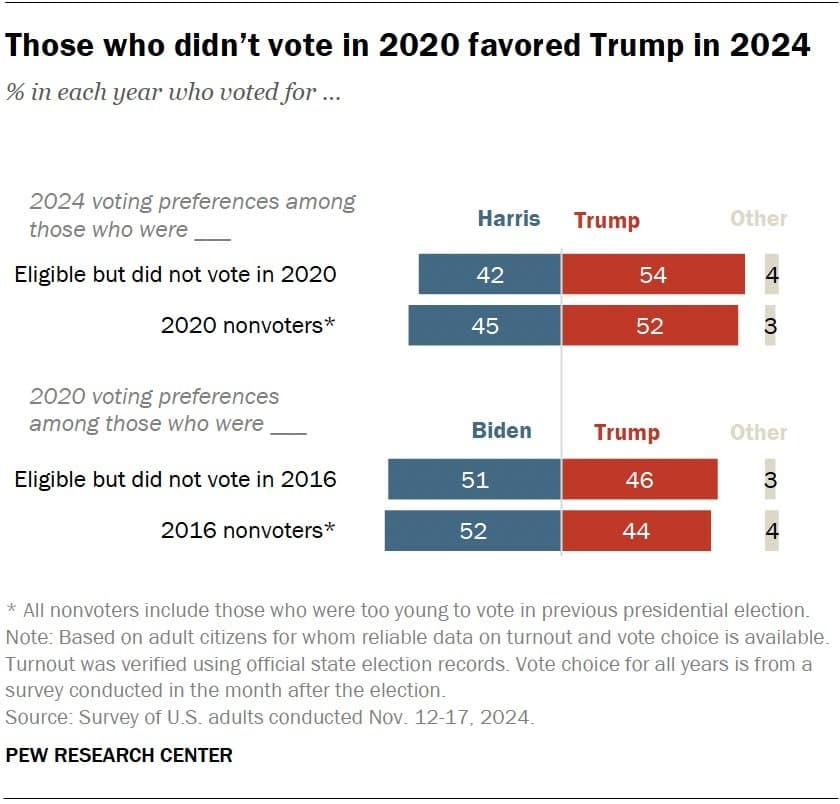
Graphic: Pew Research Center
Finding #2: Voters of color and young voters are much more likely to be irregular voters. Pew data shows the percentages of voting groups who missed at least two of the last three federal elections:
- By race and ethnicity: White: 33%; Asian: 50%; Black: 56%; Hispanic: 57%
- By age: Voters 65+: 22%; Voters 50-64: 31%; Voters 30-49: 48%; Voters 22-29: 64%
Finding #3: Irregular voters are much less fixed in their political convictions. As Catalist puts it, “the lower someone’s vote propensity is, the less likely they are to feel strongly about either party.” Irregular voters — including a large proportion of young voters and voters of color — are, to borrow an economic metaphor, more “elastic,” i.e., more likely to swing back and forth in their political views.
Finding #4: Irregular voters are often “low-information” voters who take in less political information and who favored Trump in 2024. So, more information may move these voters to vote for Democrats.
Takeaway: We can win back the voters we lost. 2024 did not signal a permanent realignment; instead, it showed that a large segment of the electorate — including young people and people of color — is flexible in their voting patterns. Because the irregular voters our partners focus on are the most persuadable – and because they can be turned out and persuaded through year-round engagement – they are the voters we should keep prioritizing. This is how we rebuild our winning coalition.
Early Signs of a Trump Backlash
By summer 2025, polling was already showing that those irregular voters who supported Trump in 2024 — and youth and voters of color in particular — had begun to view him less favorably.
1. Trump Disapproval Among Unlikely Voters
Statistician and analyst Nate Silver, in his average of Trump approval polls, distinguishes between “registered and likely voters” and “all voters” (which includes unregistered and unlikely voters).
According to Silver, as Trump’s net approval sank from the spring into the summer, his support sank much faster among all voters than among registered and likely voters.
- A week into his presidency, Trump’s net approval was +4% among all voters (the same margin by which Pew said he won the irregular voters in 2024).
- By early April 2025, this had flipped to a net approval among all voters of -4%.
- At the time, Trump’s net approval among all voters was virtually the same as among registered/likely voters. However…
- By August 2025, while Trump still had a net -4.5 approval rating with likely and registered voters, his approval had plummeted to -15 with all voters — meaning he was doing even worse than that with only the unregistered and unlikely voters.
- And, this trend continued into fall 2025.
2. Trump Disapproval Among Young Voters and Voters of Color
Polling also showed Trump’s support falling dramatically among voters of color and youth. A late September 2025 New York Times/Siena poll made this shift clear. Below are Trump’s approval ratings from this poll, and the margin by which Trump lost each demographic in 2024, according to Pew:
- Voters under age 30: September 2025 approval -37 (2024 election margin -19)
- Black voters: September 2025 approval -74 (2024 election -68)
- Hispanic voters: September 2025 approval -43 (2024 election -3)
So, long before the November 2025 elections, it was clear that Trump’s support among many unlikely (aka “irregular” or infrequent) voters, youth, and voters of color had already decreased relative to 2024.
And then came the November 2025 elections.
Part 2: 2025 Election Analysis
Trump 2024 Voters Swung Back to Democrats
On November 4, 2025, our conclusions from the 2024 election data were confirmed: Many voters who had swung to Trump in 2024 swung back to Democrats.
Democrats dramatically exceeded their 2024 performance across the country, but the most striking result was that voters of color and young voters in particular swung toward Democrats in massive numbers.
This was attributable to both vote-switching and turnout: Many voters of color and young voters who had voted for Trump in 2024 voted for Democrats in 2025, and many more Harris-supporting voters of color and youth voters turned out in 2025 than Trump-supporting ones.
While we don’t yet have data on the vote propensity of those who voted in 2025, given that turnout was much lower than the presidential election, at least part of the story likely is that many of those 2024 Trump-supporting irregular voters stayed home in 2025, as expected.
But it is also likely that many of those swingy 2024 irregular voters decided it was worth coming out again this year (perhaps the first step in becoming more regular voters), and were among those who swung from Trump 2024 to the Democrats in 2025.
Because of the national focus on the gubernatorial races in Virginia and New Jersey — and because they are the best proxy for national elections (compared, for example, to the unique circumstances of the New York mayoral election or the California redistricting ballot initiative) — the following analysis relies on information from election data experts and journalists who reviewed the results of those two elections.
Youth Voters: High Turnout, Huge Democratic Margins
While comparisons to 2024 are of most concern at the moment, the best comparisons for understanding turnout in 2025 are the 2017 and 2021 elections, the last comparable odd-year elections after a presidential election.
The Center for Information and Research on Civic Learning and Engagement (CIRCLE) — which focuses on voters under 30 — analyzed exit poll data from 2025 and found several remarkable and promising results from this comparison.
First, they found that young voters (age 18-29) voted in much greater numbers in 2025 than in 2021: “Youth turnout increased by 7 percentage points in Virginia and 9 points in New Jersey compared to the 2021 gubernatorial elections.” The big difference between 2021 and 2025 was that Joe Biden was in office in 2021 - as he was in 2024 - and Donald Trump was in office in 2025 - as he will be in 2026.
Second, CIRCLE found that youth supported Democratic gubernatorial candidates by huge margins - voting for Abigail Spanberger in Virginia by 41 points, and for Mikie Sherrill in New Jersey by 39 points. By comparison, Spanberger won Virginia overall by 15 points, and Sherrill won New Jersey by 14 points.
More importantly, CIRCLE found that young voters swung dramatically toward Democrats compared to 2021, returning to the historically high level of support seen in 2017. They reported the following shift from 2017 to 2021 to 2025 in Virginia, and its relationship in each case to the next presidential election:
- “In 2017, youth ages 18-29 favored Democratic candidate Ralph Northam by a 39-point margin (69% vs. 30% for Republican Ed Gillespie), perhaps presaging the strong support from youth for President Biden both in Virginia (+29 from young voters) and nationally (+24) in 2020.
- “In the 2021 gubernatorial election in Virginia, support for the Democratic candidate [Terry McAuliffe] narrowed to 8 points. Three years later, in 2024, youth support for Vice President Kamala Harris also narrowed significantly.
- “In 2025, youth support for Democratic gubernatorial candidates returned to its previous high levels. According to exit polls, 70% of youth supported Spanberger in Virginia…”
Voters of Color: Dramatic Leftward Shifts From 2024
As with young voters, voters of color voted overwhelmingly for Democrats in 2025 and shifted dramatically to the left relative to 2024. Below are the margins by which different demographic groups supported Sherrill in New Jersey and Spanberger in Virginia in 2025, compared to their support for Harris in 2024 (according to Pew):
- Black voters: Sherril by 89%, Spanberger by 86%, Harris by 68%
- Latine voters: Sherrill by 37%, Spanberger by 34%, Harris by 3%
- Asian voters: Sherrill by 65%, Spanberger by 60%, Harris by 17%
Hispanic Voters: Meeting or Exceeding 2020 Biden Margins
Much was made after the 2024 election about the shift to the right among Hispanic voters in particular. As noted earlier, they nationally swung by 9% toward Trump from 2020 to 2024. But in 2025, Democrats were back to winning Hispanic voters by 2020 margins, and in some cases, more.
Analyzing New Jersey’s county results, exit polls, and initial individual-level voting records, Nate Cohn of the New York Times concluded that Hispanic voters swung dramatically toward Democrats as a result of both vote-switching (voters who supported Trump switching back to Democrats) and differential turnout (Hispanic Democrats voting and Hispanic Republicans staying home):
“Many of Mr. Trump’s new Hispanic supporters from 2024 stayed home and many others returned to the Democrats. The exit polls in New Jersey found that Ms. Sherrill won a whopping 18 percent of Mr. Trump’s Hispanic support in the state…
“Ms. Sherrill also seemed to benefit from a much stronger turnout among Democratic-leaning Hispanic voters. In the New Jersey exit poll, Hispanic voters who cast ballots in 2025 reported backing Ms. Harris by 25 points; in the actual 2024 election, Ms. Harris won Hispanic voters by just nine points, according to New York Times estimates.
“Together, it was enough for Ms. Sherrill to win Hispanic voters by 37 points.”
Specific county and city-level results in both Virginia and New Jersey paint a vivid picture of these shifts. Focusing on New Jersey, Geoffrey Skelley of Decision Desk HQ points out that in 2024, the three NJ counties where Trump improved the most on his 2020 showing included the two counties with the largest percentages of Latino voters: Passaic (where 33% of eligible voters are Latino) and Hudson (40% Latino), as well as Middlesex, which is around one-quarter Asian and one-quarter Latino.
From 2020-2024, Passaic swung 19 points to the right (from Biden +16 to Trump +3), Hudson swung 18 points to the right (Biden +46 to Harris +28), and Middlesex swung 14 points to the right (Biden +22 to Harris +8).
But Skelley notes that, “Of New Jersey’s 21 counties, those same three featured the largest swings to the left in [the 2025] election.” In 2025, Sherrill won Passaic by 15 (an 18-point shift to the left), Hudson by 50 points (a 22-point shift), and Middlesex by 25 (a 17-point shift).
And if we zoom in from the county level to two New Jersey cities with especially large Latino majorities, we see even more dramatic results:
- Paterson is a 64% Latino city in Passaic that Trump lost by 61 points in 2020, but by only 28 points in 2024 — a 33-point rightward shift. In 2025, it swung all the way back and more, voting for Sherrill by 71 points — a 43-point leftward shift.
- In Union City, an 82% Latino city in Hudson, Harris won by only 17 points in 2024, but Sherrill won it by 69 — a 52-point shift. Perhaps even more remarkably, Sherrill received more votes in an odd-year election than Harris did in a presidential one, winning 13,304 to 2,402, while Harris won by only 11,316 to 7,940.
Cook Political Report also found “something of a ‘snap-back’ to Democrats in heavily-minority areas where Trump had made inroads in 2024.” Focusing on Virginia, they found that:
“Manassas Park, the most Hispanic locality in the state, shifted 22 points more Democratic between 2024 and now, from Harris +20 to Spanberger +42.”
And they found that:
“The biggest shift of any county was in exurban Northern Virginia’s Prince William County, where the voting population is roughly a quarter Latine. The county shifted 16 points in Spanberger’s direction, giving her a 34-point win after having only voted for Harris by 18 points and for Democrat Terry McAuliffe by 15 points over Republican Glenn Youngkin in the 2021 race for governor.”
MVP Partners’ Role: Turning Out the Voters We Need
While the swing back among voters of color and young voters was a universal phenomenon, MVP partners provided a major boost in the communities where they were organizing. Partners Make The Road Action and Community Change Action were organizing in New Jersey, while New Virginia Majority, CASA in Action, and UNITE HERE were organizing in Virginia.
In New Jersey, Make The Road ran a large-scale outreach operation targeting Latine voters, other voters of color, and working-class voters in three counties: Passaic and Middlesex — two of the three mentioned above, where Trump improved most on his 2020 margins in 2024 but that swung back so dramatically in this election — and Union County, where about 30% of eligible voters are Latine, and which swung from a 24% Harris victory in 2024 to a 35% Sherrill win in 2025. In those three counties, Make The Road reached out to 91,000 voters, knocked on 68,000 doors, and made 272,000 calls, resulting in over 13,000 one-on-one conversations with voters, helping to expand Sherrill’s win margin.
In Virginia, CASA in Action targeted the two heavily Latine areas that saw the largest swings back from 2024: Prince William County, which swung 16 points to Democrats, and Manassas Park (22 points).
Part 3: Implications for Future Elections
The results of the 2025 elections put to rest the question of whether rightward shifts among voters of color and young voters in 2024 were signs of a permanent political realignment. They were not.
Republican Rejection ≠ Democratic Allegiance
That said, the fact that these voters do not like Republicans does not mean they love Democrats. The 2025 elections confirmed that voters of color and young voters — like many other voters — will stay home if they are not motivated to vote, and are susceptible to rightwing appeals if they do not like what they have seen from Democrats in power. However, when conditions are right — such as widespread disapproval of an authoritarian regime that is making life worse, not better — they will vote overwhelmingly for a palatable alternative.
Prospects for 2026: Time to Swing for the Fences
Looking ahead to the 2026 elections, we believe that the conditions that shifted voters of color and youth voters to the left this past November will be similar next November.
The voters of color and youth who turned out in 2025 as an anti-Trump vote are even more likely to turn out in 2026, when flipping the House (and possibly the Senate) will potentially become a direct check on Trump’s power. And, as was surely part of the story in 2025, the more infrequent voters who supported Trump in 2024 may continue to be less likely to vote in 2026.
That said, we believe organizing by MVP partners in 2026 will be key to ensuring and maximizing short-term and long-term electoral gains. Here is why:
- More effective outreach: Recent groundbreaking research suggests that independent political organizations are more effective than candidate or party efforts at reaching the infrequent voters we need, because these groups prioritize warm, person-to-person outreach and year-round engagement over cold text outreach and other superficial voter contact
- Outsized impact in a midterm year: Research has shown that one-on-one voter outreach methods have a far greater effect in midterms versus presidential elections. This is because presidential elections draw much higher turnout, so there are many fewer truly “movable” irregular voters left to mobilize; while in lower-salience elections like midterms, there are many more less-engaged, movable irregular voters, making turnout efforts more effective.
- Political shifts that last: MVP partners’ work in 2026 will move voters not only to turn out for Democrats, but also to connect and engage with a broader political project that is long-term.
Prospects for 2028: “Proper Prior Preparation…”
Relative to 2025–2027, the 2028 elections are likely to be less favorable, swayable, and predictable — which only underscores the need to invest now in scaling up permanent, community-based, year-round organizing infrastructure in all the battleground states.
Challenge #1: Less Favorable Electorate
Here is what we know:
- Presidential elections feature higher turnout than midterm and odd-year elections.
- Higher-turnout elections, almost by definition, bring out more infrequent and new voters.
- For decades, Democrats have won infrequent voters, thus benefiting from high turnout.
- This trend held until 2024, when Trump won infrequent voters by 54%-42%.
In short, our core challenge now is to reach these infrequent voters in 2028 and win them over to the Democratic camp — before Republicans can replicate Trump’s 2024 success.
Challenge #2: Less Swayable Elections
As alluded to earlier, voter outreach has a far smaller effect in presidential elections, because:
- The “higher-salience” nature of the election – i.e., both greater visibility and also greater perceived importance – already makes voters more likely to turn out,
- Any increases in turnout must therefore come from a smaller portion of the electorate, and,
- There are many other efforts – the campaigns, other organizations, etc. – working to mobilize voters, so the effect of any one voter contact is less.
Challenge #3: Less Predictable Environment
You may have noticed that the past ten years in American politics have been extremely unpredictable. This turbulence is likely to continue, if not grow. 2028 is subject to exogenous factors that are both outside our control and impossible to predict — wars, pandemics, natural disasters, economic upheavals, cultural shifts, political backlashes, our global democratic recession, and so on.
Solution: Build Long-Term Capacity Now, for Every Scenario
All of this underscores the urgent need to invest in a long-term approach to winning governing power. It’s time to ramp up multi-year investments in year-round organizing in every battleground state and district, so we can maximize our electoral chances — and both defend and advance progress after Election Day, regardless of who wins. For more on this, read our memo, The Comeback Plan.
Closing: We Can Win, But We Have to Fight for It
We cannot take any voter for granted.
The Catalist and Pew data from 2024 validate that the big-tent Democratic coalition cannot simply look to communities of color and youth to vote for Democrats, nor can we see our job as simply increasing turnout among these voters and taking for granted that they will vote “the right way.”
Rather, 2024 made it clear that we needed to redouble our efforts to deeply engage these communities — not with transactional TV ads and impersonal texts and calls right before Election Day, but with year-round issue organizing, warm-touch voter education and persuasion, and broader digital and cultural strategies to shift narratives and worldviews en masse.
Year-round organizing is how we rebuild our coalition.
Despite the dramatic reversal of our losses from 2024, the 2025 elections did nothing to alter this conclusion. We know now that the electoral pendulum will swing back. But if we want to create a long-term sense of shared belonging, shared worldview, and identification with the Democratic coalition rather than with the MAGA coalition, we need to engage these voters with a deeper, year-round, “hearts and minds” organizing approach.
MVP’s partners have been taking this approach exactly. However, too often funders have incentivized more superficial voter contact metrics over deep voter engagement, drawing groups away from what they know will have the greatest impact. This happens most noticeably in high-stakes elections like presidential elections.
Year-round power building requires year-round investment.
Indeed, one of the greatest impediments to deep, transformative organizing is “boom-and-bust” funding, in which money floods in during the final few months of even-year elections, and swiftly dries up for the subsequent two years in between. In this cyclical, election-driven funding model, the money that flows is “too little too late,” forcing organizing groups to cut back or abandon their most promising year-round programs, and instead run transactional voter-contact operations staffed by temp workers.
As funders, we need to look closely at which voter engagement activities we are incentivizing — what we are measuring, valuing, and rewarding — and, in partnership with our donors and local partners, make sure that we are incentivizing and funding the most strategic organizing approaches that actually change hearts and minds over the long term.