View as PDF: Summary • Full Version
Executive summary
Topline: Organizing groups reach the voters we need to win elections and change policy.
In September 2025, MVP allies at the Pro-Democracy Campaign, Democracy and Power In Action Fund (DPI), and Power Lab released a groundbreaking report, “Civic Power,” examining the role of “independent political organizations” (IPOs) — the organizing groups MVP funds and partners with — in influencing both elections and governance.
Here are the key findings:
- In the 2024 election cycle, IPOs reached 1.3 million younger, more racially diverse, and less frequent, likely Democratic voters in key states that no Party, candidate, or other prominent left-leaning operation reached. These are the kinds of voters we need to win back and who can make the difference in close elections.
- In 2025, IPOs that ended 2024 with robust organizing programs that engaged voters after the election, developed hundreds of leaders, and built broad bases of support were able to successfully influence local and state government to win policies their constituents need.
Background
Who are the researchers and authors?
The primary researchers and authors are Joy Cushman, Senior Strategic Advisor to DPI, and Elizabeth (Liz) McKenna, Assistant Professor of Public Policy at the Harvard Kennedy School. With an extensive research, training, and organizing background, Joy has spent decades helping organize multiracial, multi-faith constituencies to build their own power. Notably, she played a significant role in building the 2008 Obama organizing and training program.
While Joy built key aspects of Obama’s first presidential campaign, Liz literally wrote the book on it — Groundbreakers: How Obama’s 2.2 Million Volunteers Transformed Campaigning in America — along with Hahrie Han, another one of the most prominent modern political scientists studying the role of organizing and social movements in civic life.
What organizations were included?
The study included 26 IPOs across 10 states — the presidential battlegrounds of Arizona, Georgia, Michigan, Nevada, North Carolina, Pennsylvania, and Wisconsin, as well as Minnesota, Missouri, and Ohio — over an 18-month period from 2024 to 2025. Twenty-five of the IPOs included are MVP partners and represent the kinds of organizations we fund and partner with year-round.
How was the research done?
Using a mix of quantitative and qualitative methods, the researchers analyzed voter mobilization, organizing, and power-building data from IPOs, and also compared IPOs’ voter contact data to that of other Party entity and candidate programs — including the Harris-Walz campaign and Democratic Party entities.
Why is this report important for MVP, our donors, and our partners?
At MVP, we have been discussing this report with our team, grantee partners, and donors because:
- The report shows that IPOs — which are precisely the kinds of organizations MVP funds — are key to both creating a more inclusive democracy and winning back governing power. They are expanding the electorate and reaching voters no one else is reaching, and they are actually building the power needed to influence state and local government and win policies for working-class people of all races.
A few research nuggets of IPOs’ success in 2024: - IPOs reached 1.3 million unique voters who were not contacted directly by any other program included in the research.
- IPOs intentionally targeted, contacted, and mobilized racially diverse, young, and less frequent voters and used more effective person-to-person contact methods than Party entity and candidate programs.
- IPOs were then successful in re-engaging many of these voters and providing opportunities for organizing and power building, which was the key to influencing state and local government and winning progressive policies in 2025.
- The report makes the case that, while we need broad-based voter mobilization, we also need long-term organizing to keep voters engaged and build their power to make government actually responsive to regular people. In other words, this report strongly supports MVP’s core grantmaking approach: funding groups that do the crucial, year-round work of organizing and base building.
- The report shows a pathway out of the political cynicism and despondence many voters are experiencing. At a time when elections have major consequences and are often won on razor-thin margins, IPOs engage voters no else is reaching — who are also the very voters who can decide election outcomes. IPOs then organize these voters to influence and hold accountable the leaders they helped put in office, increasing those voters’ sense of power to create real change. This sense of empowerment, then, makes it more likely that they will vote again, creating a “virtuous cycle” of voter mobilization and organizing that helps us win on all fronts.
- The report provides evidence for what the Democratic coalition and progressive movement as a whole need to do differently: prioritize, invest in, and strengthen organizing and power-building programs alongside and linked to voter mobilization, so that we can win elections and also create material change for regular people.
Problem: More participation isn’t translating into more power.
Increased civic participation (e.g., unprecedented levels of voting, participating in protests, one-off volunteering) has failed to translate to government responsiveness and policies that reflect communities’ values, needs, and solutions. As a result, many Americans are feeling a profound sense of powerlessness and desperation — laying the groundwork for cynicism and apathy.
Think about it this way: If a person shows up to vote because they were told that voting will help lower the cost of healthcare and improve their children’s education, but then neither of those things happens, why would they feel motivated to vote again? Millions of voters are not seeing their vote translate to material change in their lives.
Individual civic engagement, like historic voter turnout in 2020, and point-in-time collective mobilizations, like the Women’s March and more recent No Kings rallies have reached unprecedented levels. Unfortunately, prioritizing large-scale mobilization (and the short-term engagement that goes along with it) at the expense of in-depth, sustained organizing has had unintended consequences — both inside and outside of electoral cycles.
- During electoral cycles, mainstream Party entity and candidate political operations pursue short-sighted metrics and tactics that prioritize contacting the highest-likelihood voters at the lowest expense, leaving thousands of voters on the table — mostly voters of color and young voters — and causing increased cynicism within these critical voting blocs and historically undervalued voters.
- Outside of election cycles, IPOs lack the power and strategic capacity necessary to drive meaningful and effective agendas, because such an overwhelming portion of Democratic-aligned funding has gone to short-term voter contact rather than steady, sustained investment in long-term organizing. So, even when we “win” by electing Democrats, we lose, because we do not have the power to enact real change.
Solution: Invest in long-term organizing alongside large-scale mobilization.
To win elections and create durable policy change that makes those electoral wins mean something, we must convert civic participation into civic power — the ability to influence local, state, and federal governing arenas.
Civic power requires that people be organized into collective structures — civic associations, IPOs, unions, etc. — that enable them to wield power strategically over the long haul.
IPOs, including many of MVP’s partners, are already doing this — but at a scale that needs to be swiftly and dramatically ramped up. These organizations are mobilizing large numbers of people to the polls and then re-engaging them after Election Day to create experiences of agency and belonging, build collective power, and advance their interests through state and local policy advocacy.
As opposed to vended, Democratic-establishment political contact programs, these groups are year-round civic associations of regular people, aligned around issues that matter to them, like access to healthcare, good-paying jobs, and affordable childcare. They engage in elections as an opportunity to mobilize a community of voters around a shared agenda through connecting their voter mobilization and organizing efforts.
In other words, as the Civic Power report states (page 19), IPOs treat voter turnout as “an entry point, not an end point.”
From 2024 to 2025, IPOs included in this research engaged and mobilized voters overlooked by traditional campaign vehicles, built durable organizing structures in which voters could participate after an election, and developed leaders and built their bases to create and wield the power needed to influence local and state policy.
Methodology overview
- Using mixed quantitative and qualitative methods, the research team analyzed the programs of 26 organizations — 25 of which are MVP partners — in presidential swing states, including Arizona, Georgia, Michigan, Nevada, North Carolina, Pennsylvania, and Wisconsin, as well as in Minnesota, Missouri, and Ohio over an 18-month period from 2024 to 2025.
- Researchers collaborated with the Democratic Data Exchange (DDx) — an independent platform that gathers and shares voter contact data across a range of Democratic entities, including state parties, campaigns, super PACs, and other independent groups. Researchers analyzed participating IPOs’ voter contact programs and compared them with the Democratic Party entity and candidate programs in DDx, including the Harris-Walz campaign.
- To analyze and evaluate IPOs’ organizing power, researchers developed quantitative metrics (e.g., number of events attended, number of volunteer shifts, etc.) and qualitative parameters (e.g., defining a “leader,” mapping relationships and spheres of influence, assessing opportunities for skills development, etc.) to study 13 IPOs’ organizing programs.
- Using this voter contact and organizing data, researchers set out to answer these questions:
- What unique role, if any, do IPOs play in voter outreach programs, and what is the impact of those efforts?
- How do IPOs grow and wield their civic power during a national election season?
- To what extent are IPOs able to translate their work into power to influence governing?
Summary of findings
Voter mobilization analysis: IPOs expand the electorate more effectively than party or candidate efforts.
In 2024, the 26 IPOs in the study attempted 54 million voter contacts, had more than 5 million live, person-to-person conversations with 3.6 million voters, and turned out 2.5 million voters in the November general election.
Compared to well-funded Party entity and candidate voter contact operations, state-based IPO programs were more likely to target and reach racially diverse, young, and infrequent voters.
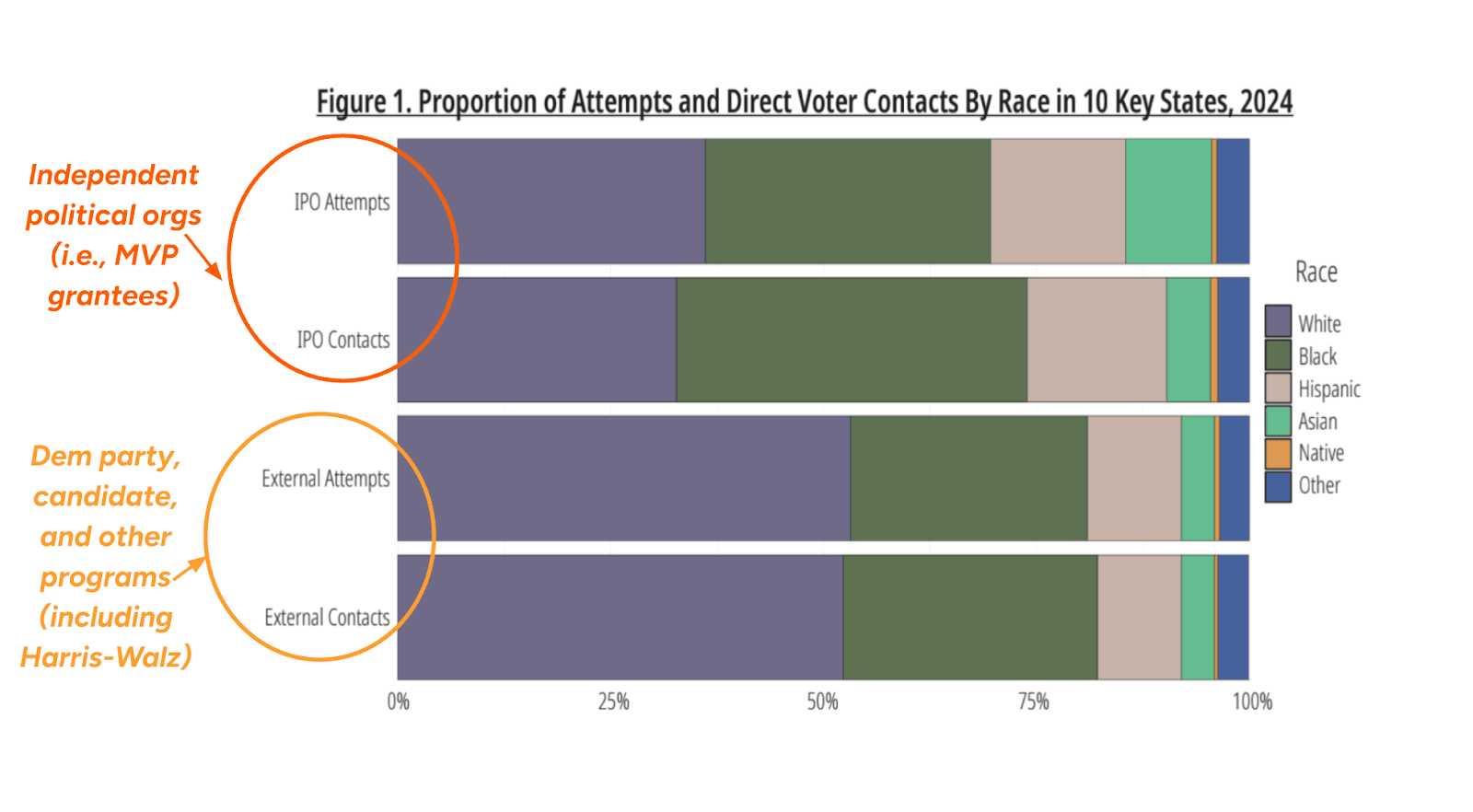
Graphic: Civic Power report, page 11. The top two bars in this chart show that the majority of IPOs’ contact attempts (via door knocks, phones, etc.) and successful contacts were to Black, Hispanic, Asian American, Native, or other non-white voters. Compare this to the bottom two bars showing that the majority of non-IPO groups’ attempts and contacts were to white voters.
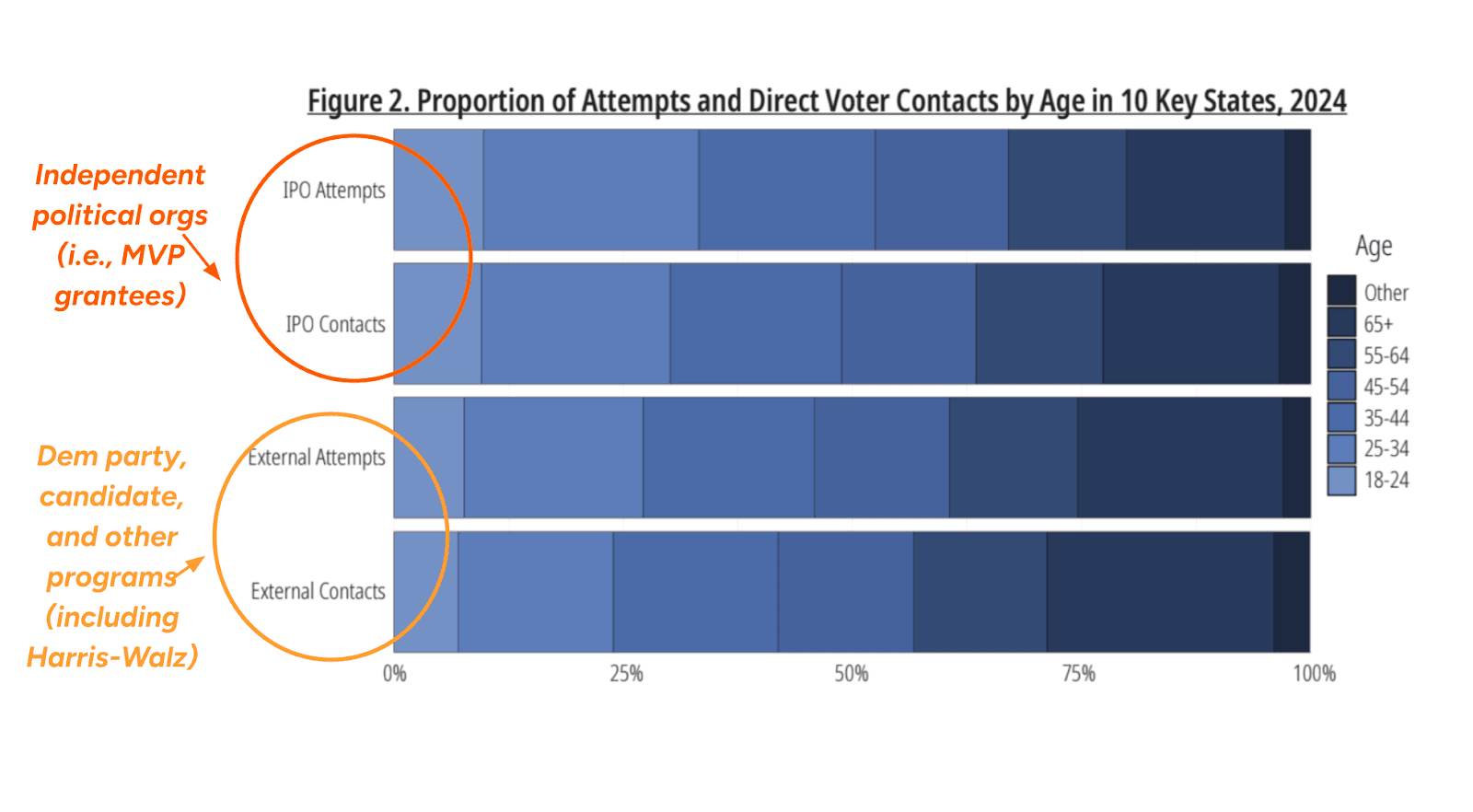
Graphic: Civic Power report, page 11. The top two bars in this chart show that the majority of IPOs' contact attempts and successful contacts were to voters under the age of 44. Compare this to the bottom two bars showing that the majority of non-IPO groups’ attempts and contacts were to voters over the age of 45.
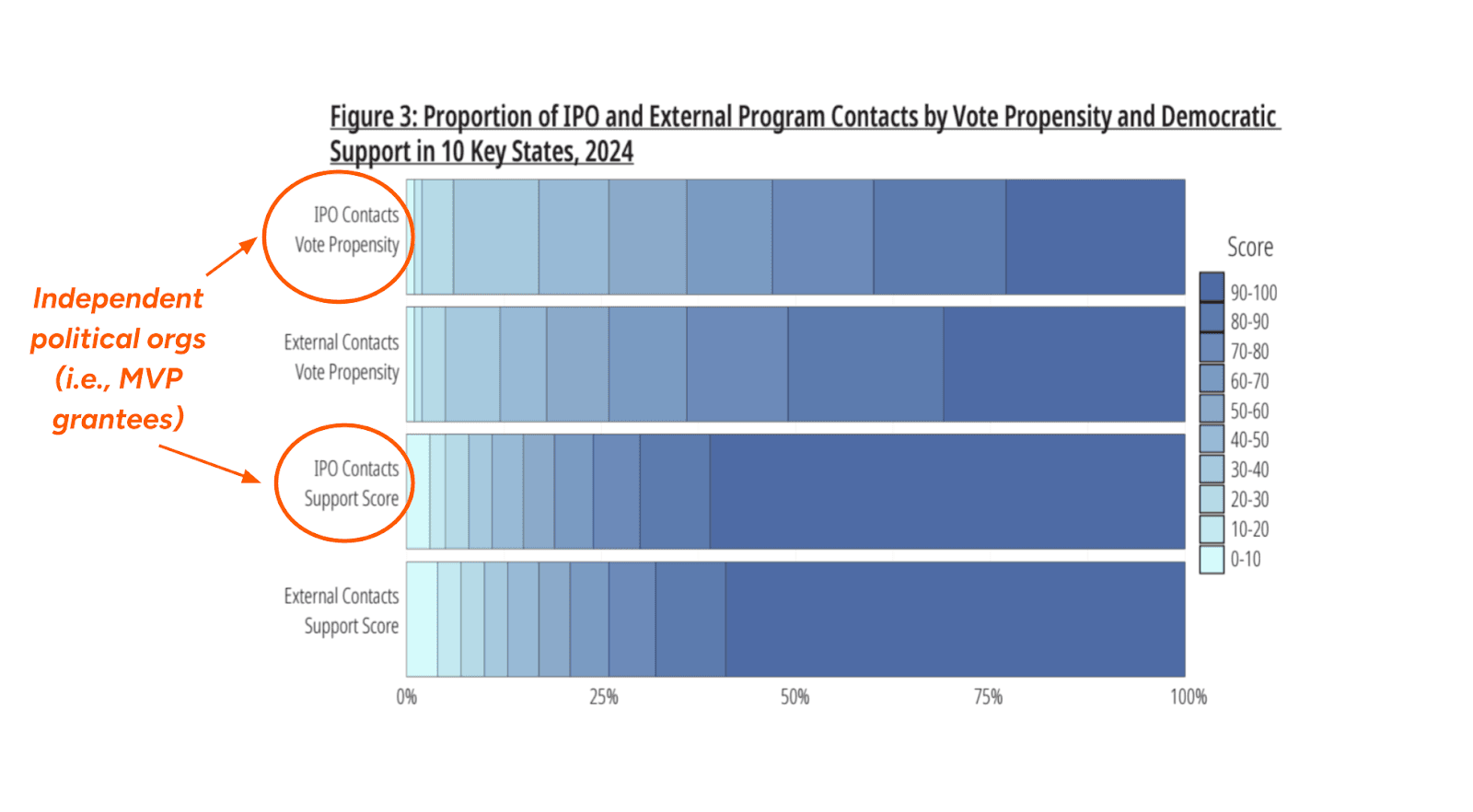
Graphic: Civic Power report, page 12. The first bar of this chart shows that 61% of IPOs’ contacts were to voters with “vote propensity” scores lower than 80 — meaning they are less frequent voters. Compare this to the second bar that shows non-IPO groups focused more heavily on voters with vote propensity scores of 80 and above. Looking at the third and fourth bars, IPOs, compared to non-IPO groups, also targeted voters who were more likely to support Democrats.
The IPOs in this study were also more likely to use direct, person-to-person contact methods like phone calls and door-to-door canvassing over less personal methods like text messages. With this approach, they achieved significantly higher contact rates compared to party and candidate voter contact programs.
In fact, IPOs reached 1.3 million unique voters who were not contacted directly by any other program compared in the research.
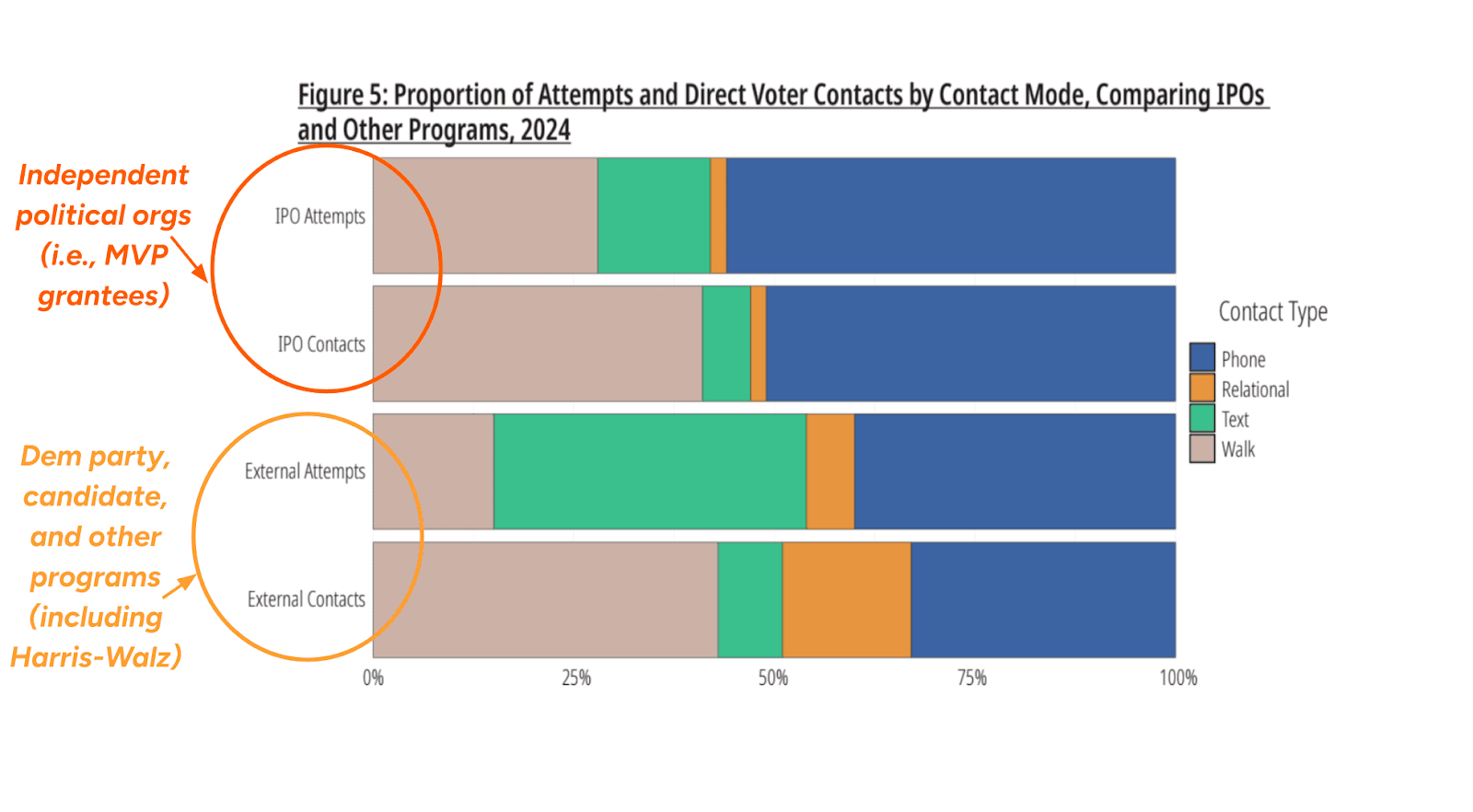
Graphic: Civic Power report, page 14. In this chart, the top two bars show IPOs’ prioritization of person-to-person contact methods via phone and doors (walk) over cold text outreach prioritized by non-IPO groups. According to the Civic Power report, “DDx concluded that it was likely the relentlessness of the person-to-person contact efforts that helped IPOs break through with voters that the rest of the industry failed to reach with live contact.”
How did these contacts translate to voter turnout? The 1.3 million voters contacted only by IPOs had a turnout rate of 64.6% — a relatively high turnout rate for voters who were not bombarded with outreach by multiple groups and who are largely characterized as “infrequent” voters. This translated to an estimated 820,000 voters turning out in November 2024 who only received direct, live contact from IPOs — a significant number, especially at a time when elections are won on very slim margins.
Overall, voters contacted by state IPOs — including voters who may have also been contacted by other groups — turned out at a rate of 67.2% compared to 75.7% for all other programs in the DDx. Why? Because they intentionally contacted less frequent voters whom party and candidate programs were more likely to ignore, and who were, therefore, contacted fewer times overall. What this tells us is that, had IPOs and other Democratic-aligned efforts made more contacts to these more infrequent voters, even more of them would have likely shown up to vote.
Key takeaways
- State IPOs are better at reaching younger, more racially diverse, less frequent voters than traditional Party entity or candidate campaigns.
- State IPOs’ “warm touch” contact methods — door knocking, phones, and other in-person contact — are more effective than less personable contact methods like texting employed by Party entity or candidate campaigns.
- While IPOs in the study had lower overall voter turnout rates than Party entity or candidate campaigns, they were uniquely effective at turning out young, racially diverse, and infrequent voters often ignored or not reached by party and candidate operations.
- Voters targeted by IPOs are the voters who, when turned out, can make the difference in election outcomes. Yet, the progressive movement as a whole, including the Democratic Party and its candidates, does not prioritize these voters to the extent needed to help win elections. In fact, these are the exact voters the Trump campaign engaged and turned out to help win in 2024, taking an interestingly similar approach to IPOs by engaging racially diverse, younger, and less frequent voters.
As the Civic Power report puts it (page 15), “These findings highlight the importance of better understanding more diverse, less frequent voters — who they are, what they value, and the conditions under which they engage. Our research shows that state-based IPOs are effective at reaching these voters, but that the progressive infrastructure as a whole is likely failing to contact them at a volume needed to optimize turnout.”
Organizing analysis: IPOs use voter mobilization to build power and influence policy.
Researchers found that IPOs in the study were intentional about the voter universes they targeted, not only to increase voter turnout among likely Democratic voting blocs — people of color, young people, less frequent voters — but also, and more primarily, to provide on-ramps for longer-term organizing and power building with these constituencies.
As the saying goes, “we measure what we value,” and up until now, the Democratic coalition has done a great job measuring voter mobilization — but less so at quantifying long-term organizing and power building. To address this gap, researchers developed metrics in four main areas:
- Organizing leaders
- Growth in committed leadership
- Activities that move people to committed public leadership
- The interplay between organizing and mobilizing
Organizing leaders
Highly committed leaders who act as volunteer organizers are central to IPOs’ level of power — in other words, their ability to actually influence local and state policy. The Civic Power report (page 21) defines a “highly committed leader” as “someone who participated in at least five events during 2024,” and someone who was “cultivating a base of others rather than simply acting alone.” Albeit imperfect, this definition gave a useful indicator of organizational involvement and commitment to growing that involvement with others.
Growth in committed leadership
To gain power, IPOs must expand their base of committed leaders over time. Many of the IPOs in the study position and rely on existing highly committed leaders as central “nodes” in a network, whose strength lies in their ability to engage and organize other people in that network. In this instance, a network could be their neighborhood, their church, their school — anywhere that they have contacts and relationships.
Having committed leaders who organize other committed leaders is core to building power in ways that relying on short-term participation — voting, singular event attendance, etc. — is not.
Researchers looked at the number of highly committed leaders of each IPO in the study and developed organizational and leader-specific network charts of individual leaders to determine their ability to help build a base rather than act individually.
If you want to visually understand the fundamental difference between short-term voter mobilization and long-term power building, this kind of chart might be one of the single best ways to do so:
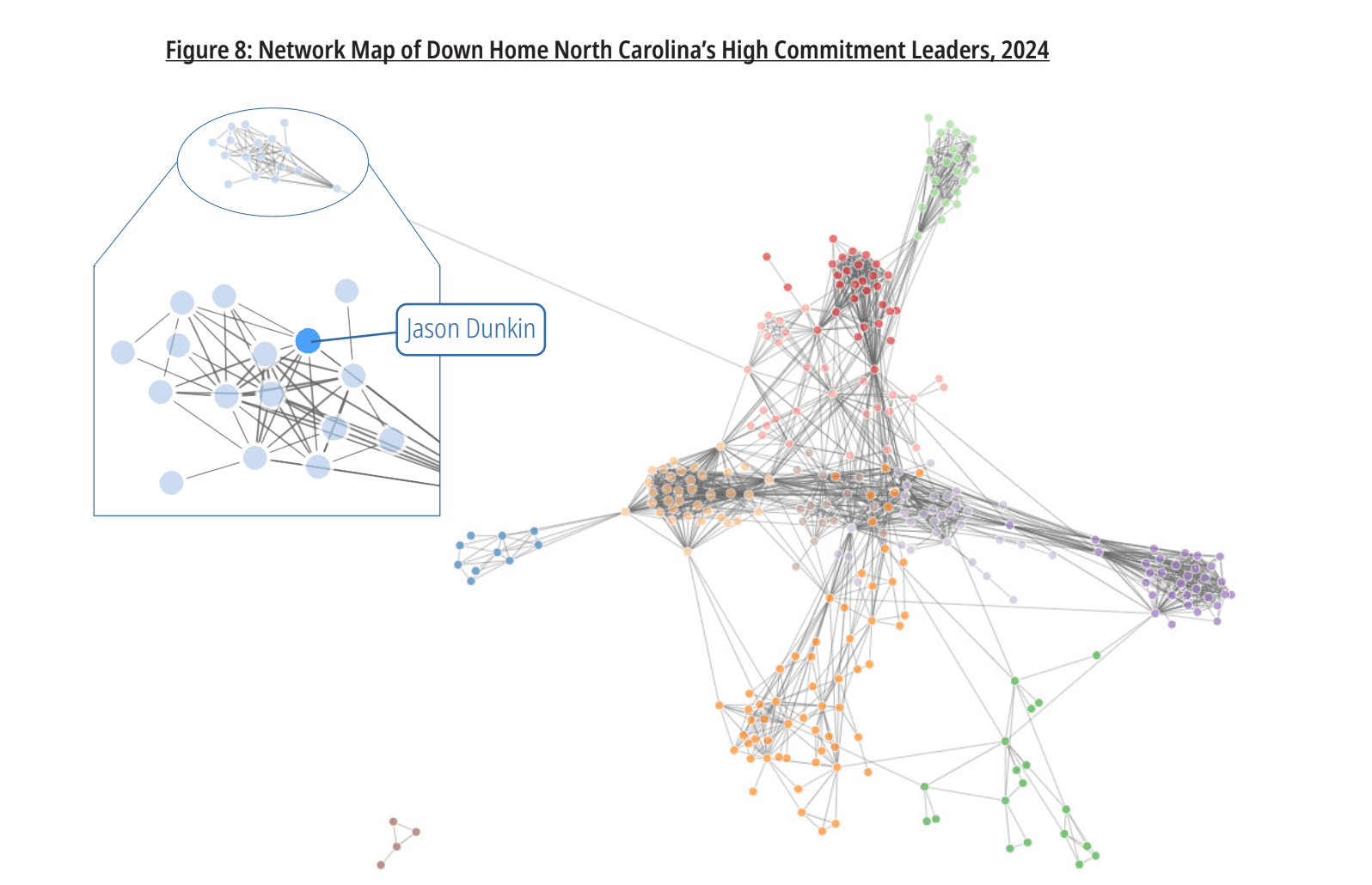
Graphic: Civic Power report, page 22. The web on the right shows the total network map of all the highly committed leaders with IPO and MVP partner Down Home NC. The web on the left is a close-up of the network of one of Down Home NC’s highly committed leaders — Jason Dunkin. The bright blue circle represents Jason, and the lines and connected, multiple light blue dots represent community members in his sphere of influence that he can organize and bring into Down Home NC’s base.
This quote from the report (page 21-22) sums it up well:
“Shaping governance requires of IPOs an unyielding effort to contest in their power arenas to uphold the interests of their communities, respond to setbacks, defend against harmful policies and power grabs, and advance proactive strategies to strengthen the influence of their constituencies. This power cannot be reduced to the number of voters contacted or turned out: its source is in organized local constituent teams of deeply committed and highly strategic leaders.”
Activities that move people to committed public leadership
In the words of author, activist, and artist Toni Cade Bambara, “we must make the revolution irresistible.”
According to the Civic Power report (page 26), to grow a cadre of committed leaders, IPOs — and their already highly committed leaders — must be intentional “about shaping activities and processes that cultivate people’s agency, knowledge, skills, and identity as public actors.”
These activities can include leadership development and training opportunities, one-on-one relationship building, and including constituents in strategy, campaign, and event design. These types of opportunities are “stickier” than tactical mobilizations like phone banks or canvasses. They make a more lasting impact on the volunteers and leaders who engage in them, therefore increasing participants’ involvement, leadership, and sense of power over time.
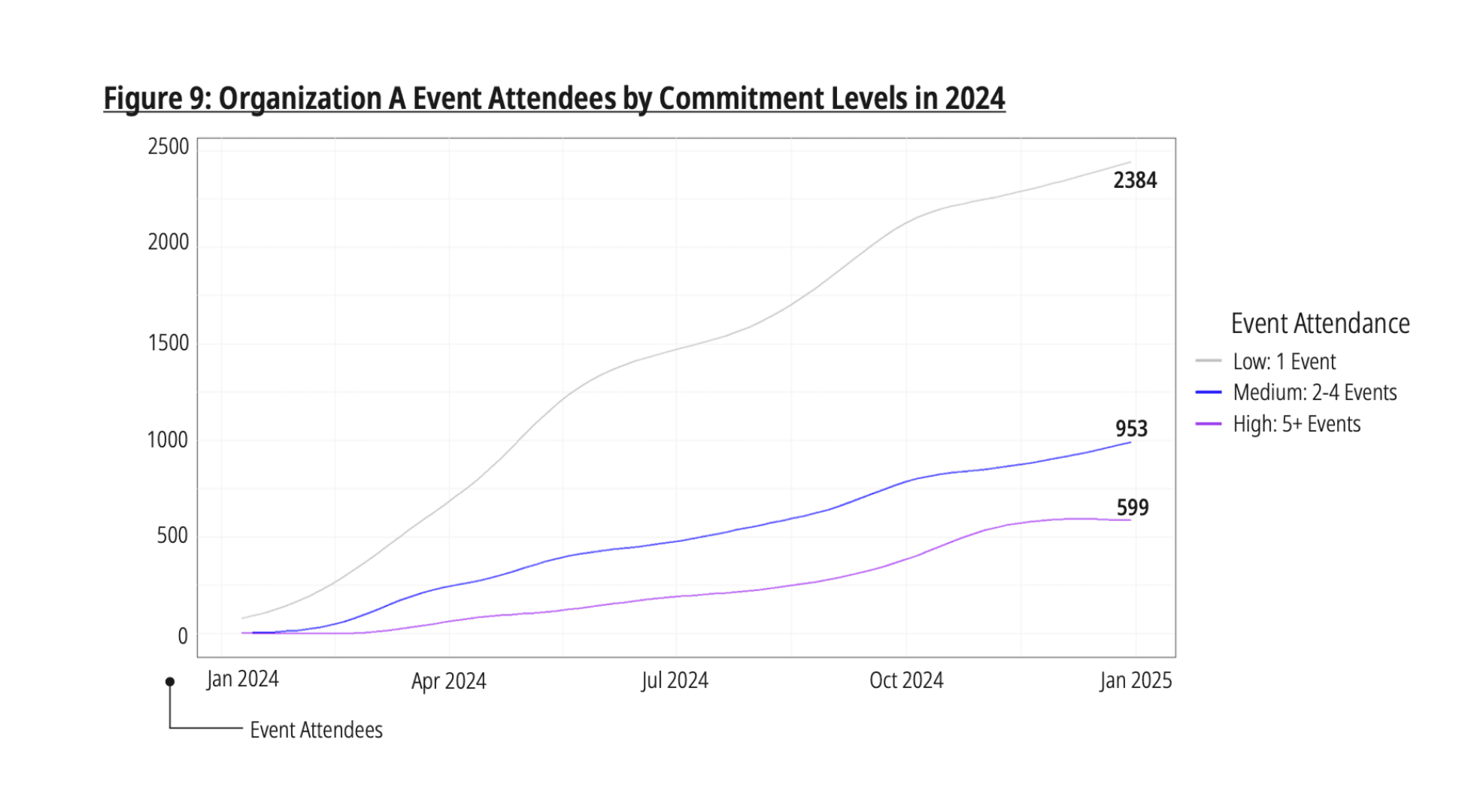
Graphic: Civic Power report, page 23. This graph shows that, in 2024, this IPO saw increased participation in both their mobilization efforts (gray line: get-out-the-vote volunteering; large, one-off events, such as rallies, etc.) and their organizing efforts (purple line: participation in ongoing advocacy campaigns, leadership meetings, etc.). Using the report’s definition of “highly committed leaders” as someone who participated in at least five events, the purple line indicates an increase in highly committed leaders' involvement in the organization. Therefore, as the Civic Power report notes, “in 2025 we observed this organization pivot quickly to influence local, state and federal legislative decisions.”
Organizing and mobilizing: We need both
IPOs need a balance of organizing and mobilizing to successfully build power.
- Mobilizing activities — voter turnout, large-scale event attendance, etc. — enable IPOs to capture a wide net of participants interested in taking action in elections and/or on issues that they can then draw from to engage participants in organizing.
- Organizing activities invest in and grow the base of an IPO’s committed leaders who feel a sense of agency, community, power, and commitment to participate in collective change-making over time.
While the progressive movement as a whole over-emphasizes mobilization, often at the expense of organizing, there is good news: Making the shift toward balancing mobilizing and organizing efforts is possible. It requires a shift toward prioritizing and investing in organizing as much as voter mobilization, and even modestly scaling an organization’s civic leadership can still lead to policy influence.
As the report states (page 20):
“If IPOs across the country, with the support of their stakeholders, apply the same level of focus and incentives to their organizing programs as they do to their electoral programs, there is potential for them to significantly increase their influence in a relatively short timeframe.”
Many of MVP’s partners are already prioritizing organizing alongside their voter mobilizatoin programs, but, as a movement, we collectively need to invest more to support the scaling and expanding this critical alignment.
Key takeaways
- Voter mobilization and other one-off, short-term activations are not enough to build the power needed to influence governing structures. The progressive movement needs to connect mobilization activities to organizing efforts.
- Effective organizing that will build long-term power includes developing highly committed leaders, deploying these leaders to expand a base of support and participation, and providing opportunities for engagement that give participants a sense of belonging, agency, and personal power.
- Of the IPOs studied, the threshold to achieve local influence in 2025 was 80 to 100 committed leaders by the end of 2024, while state-level policy wins in 2025 required between 200 and 700 committed leaders by the end of 2024.
- IPOs intentionally and strategically target racially diverse, younger, and less frequent voters because these voters help win tight elections and are the people we need to shape, build, and lead organizing efforts for lasting policy change.
- Primarily, as the Civic Power report points out (page 25): “Strengthening civic infrastructure for responsive governance at the local and state levels is not only possible but eminently within reach if IPOs focus on growing a deep base of committed and active members — and have the support of key stakeholders to do it.”
Recommendations
Ultimately, what is the actionable message from these findings? We believe it is that the progressive movement and Democratic-aligned efforts — including strategists, candidates, and donors — need to value, measure, and fund both quantity and quality. In other words, we need to prioritize deep, longer-term organizing alongside and linked to large-scale, shorter-term mobilization.
This is how we create the conditions for multiracial, working-class constituencies to wield power to win elections, influence government, and enact durable policy change that benefits all of us.
The Civic Power report (page 30) closes with three critical recommendations for the progressive movement and the big-tent Democratic coalition — including MVP and our donors and partners — to follow.
- Design and support IPO voter programs that expand the electorate, contest for new voters, and translate electoral participation into actual material wins.
Like the IPOs in the study, the progressive movement and Democratic-aligned efforts as a whole must intentionally value and invest in targeting and mobilizing racially diverse, young, and less frequent voters — both to win elections and to activate those voters into organized constituencies that can wield power to influence government and bring concrete change.
- Commit to the building of 21st-century civic associations that can hold government accountable to the interests of regular people.
We cannot just throw money at scaling IPOs — we must invest in and help build their capacity to develop and execute effective organizing programs, which is a core principle of MVP’s approach. Without strengthening their own organizing capacity, IPOs will not be able to strengthen the capacity and participation of their leaders, which is key to holding government accountable to the interests of regular people.
- Stop over-indexing on quantitative vanity metrics and start building the infrastructure to measure qualitative, power-building metrics.
There is a robust data machine that quantifies, measures, and assesses voter mobilization programs, and we urgently need to create something similar to measure and advance organizing and power building. The Democratic coalition — including donors and funders — has overly incentivized measuring and reaching quantitative voter mobilization metrics without considering how those metrics do or, more importantly, do not help us actually win elections or advance power building.
We must widen our perception to match the reality of what is required to secure governing power and create material change. One of the first steps toward doing that is to build the metrics and data to measure and advance the kind of year-round power building that is needed before and after Election Day.