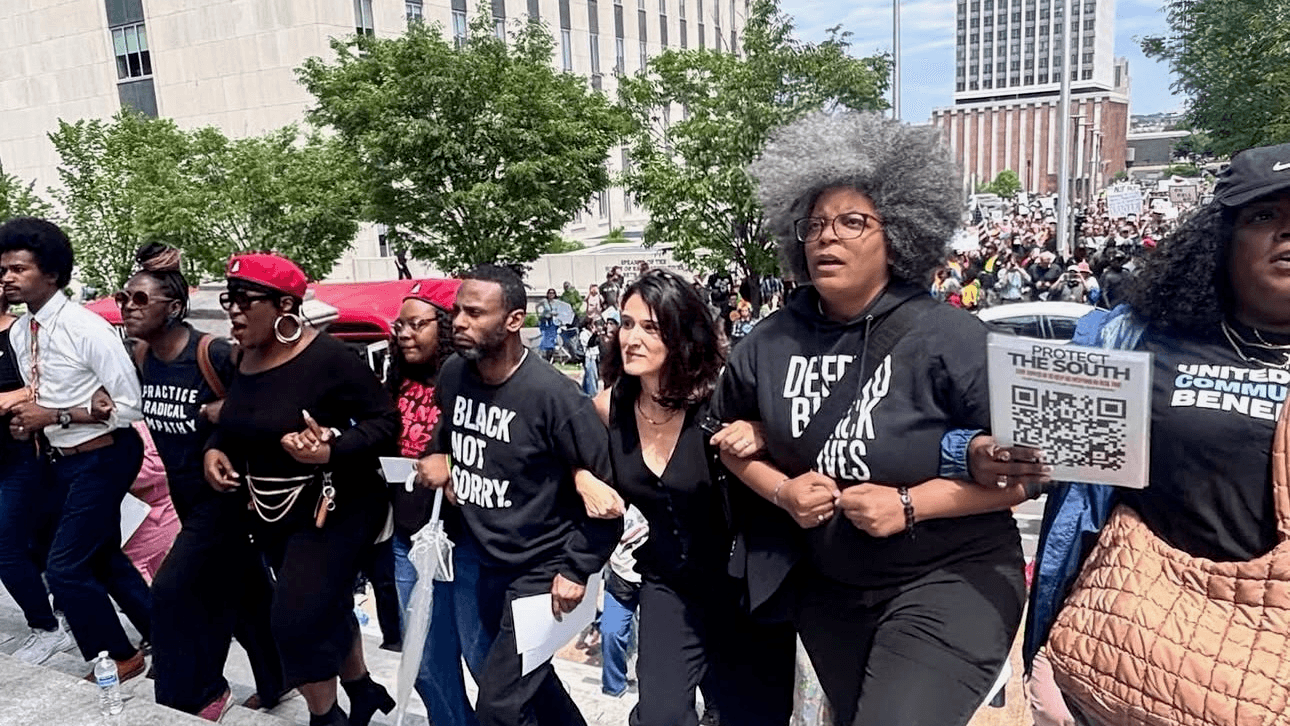
On May 8, in a significant setback to Democrats’ multistate efforts to counteract GOP-led congressional gerrymandering, the Virginia Supreme Court struck down Virginia’s redrawn congressional map.
While efforts to restore the map are underway, this decision is a loss for Democrats in the mid-decade redistricting battle. But there is still a viable path to flipping the U.S House in November.
Keep reading for a lay of the land and the path forward.
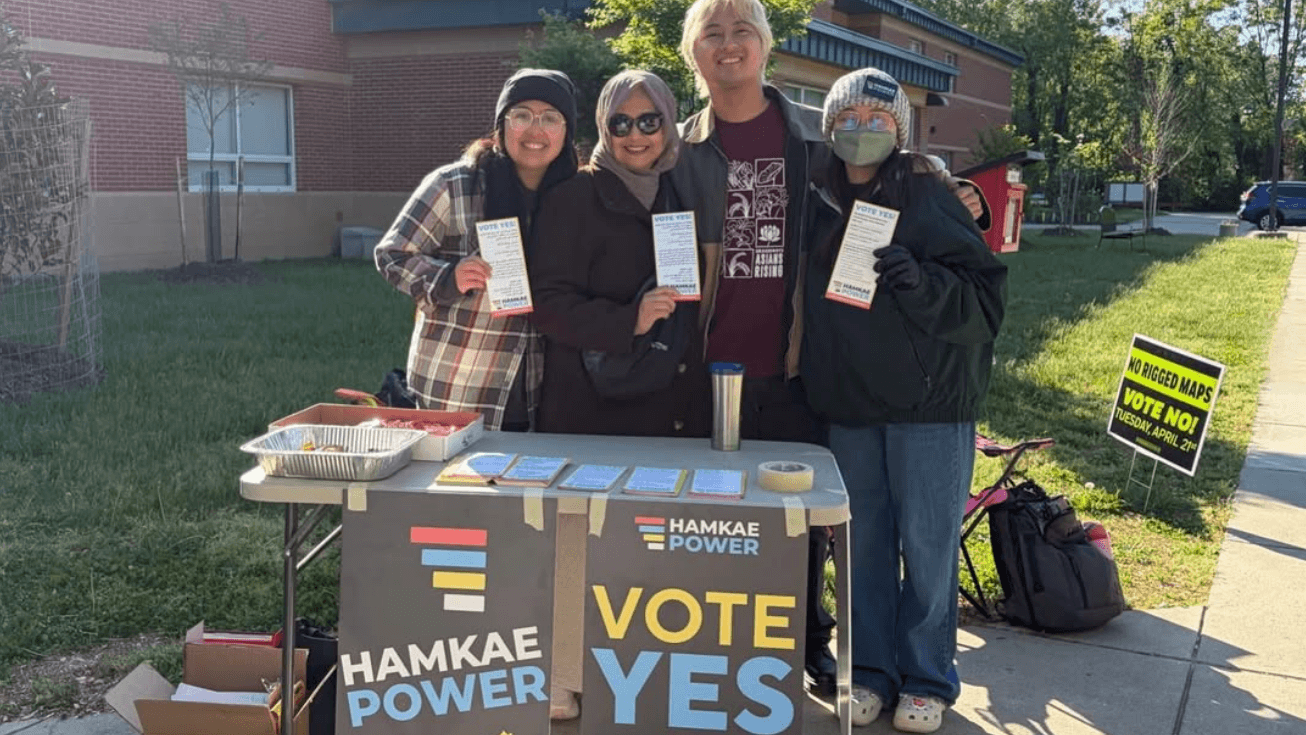
Photo: Hamkae Power, the Virginia chapter of NAKASEC Action Fund, engaging voters and persuading them to vote “yes” on Virginia’s redistricting ballot measure.
What happened in Virginia?
On April 21, Virginia voters approved a ballot measure that would allow a new congressional map to move forward ahead of the November elections.
On May 8, the Virginia Supreme Court struck down the voter-approved map. In doing so, the court ignored the will of the people, siding with Virginia Republicans and, by extension, Trump and the GOP’s national effort to cling to power at all costs.
Then, on May 11, just as we were about to publish this piece, we learned that the Virginia attorney general asked the U.S. Supreme Court to restore the voter-approved map.
We want to be real about what this means right now. This Virginia Supreme Court Decision blocks a map that could have gained Democrats up to four more seats in the U.S. House — what would have been a critical win in Trump’s mid-decade redistricting fight.
Even with this setback — which could be reversed by the U.S. Supreme Court — Democrats can still pull off a win — but it’s going to take more work and investment on all of our parts.
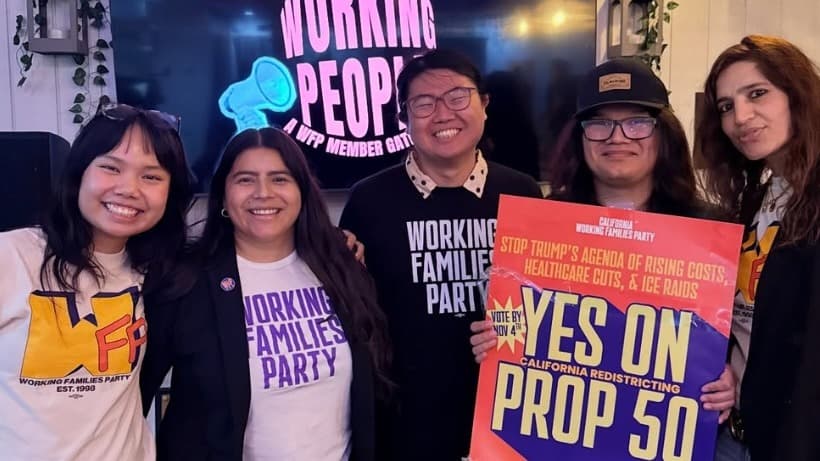
Photo: California Working Families Party helped pass Prop 50, which could gain Democrats up to five seats in the U.S. House.
Can we still flip the US House?
The short answer: YES. But we don’t want to sugarcoat it. Our path to flipping the U.S. House this year just got harder.
The new voter-approved, court-blocked maps in Virginia would have countered Republican redistricting gains in North Carolina, Ohio, and Missouri. The Supreme Court’s recent ruling in Lousiaina v. Callais further gutting the Voting Rights opened the door for racial gerrymandering.
We have already seen a rush to redistrict in Florida, Tennessee, Louisiana, South Carolina, and Alabama, which has been met with fierce resistance by Democrats and community organizers alike. New maps in the South will undoubtedly be skewed to favor Republicans, with GOP elected leaders going to unprecedented extremes — including suspending elections, to ram gerrymandered maps through.
All told, we now estimate that Republicans could gain up to 10 seats in the 2025-2026 redistricting battle (see our detailed table below).
Previously, we calculated that, at a minimum to flip the House, we’d need to protect all Democratic seats and flip two GOP seats. Now, it looks like we may need to flip a dozen seats to retake the House — a definite challenge, but nowhere near impossible.
Despite the Virginia Supreme Court’s decision, Democrats may still be able to flip two —- possibly more — congressional seats in the Commonwealth. Under the existing map, Trump won two of these districts by under five points. In a political environment in which Democrats are overperforming in special elections by more than 10.5 points and Trump’s approval rating is consistently under 40 percent (more on that below), these seats are still in play — even if Republicans’ gleeful gloating post-court ruling would suggest otherwise.
There is still a path to victory.
Even though we are facing a tougher climb, there is still a very possible path to victory.
- Redistricting wins: Democrats have won redistricting battles in California and Utah, opening the door to gain up to six additional seats in the House.
And in Virginia, there is also still technically a way for Democrats to overturn the state Supreme Court’s ruling: force all Court justices to retire, appoint new members, and re-hear the case, all before November. According to The Downballot, Virginia’s Constitution does allow for this strategy, and would be a way to fight GOP fire with fire. Although this scenario may be implausible, state Democratic leaders have not ruled it out as of this writing. - Competitive seats: MVP is targeting ~30 competitive House seats and reevaluating where else we need to shift or expand focus with these recent developments.
- Republicans’ redistricting overconfidence (aka “dummymandering”): In a handful of redrawn districts, at least in Texas and Florida, Republicans are counting on GOP turnout — especially among Latine voters — that might not actually be there. According to a recent AP-NORC poll, Trump has a 74 percent disapproval rating among Hispanic adults. This proves that these voters aren’t stuck to Trump just because they showed up for him in 2024. Republicans’ attempts at partisan gerrymandering just might turn out to be more of a dummymander than they had hoped.
- Trump is (still) tanking in the polls: According to the highly respected polling aggregator, Silver Bulletin, Trump’s average overall job approval remains under 40 percent — 38.9 percent to be exact — in what the Cook Political Reports calls an “important psychological threshold.” In fact, his net approval rating just hit a new second-term low, at -18.9 percent, with about 48 percent of Americans strongly disapproving of his job performance.
Like it or not, the GOP is still tied to Trump. Even though the occasional Grand Old Partier is having buyer’s remorse, with Trump’s sustained poll sinkage, the party as a whole is on track to pay for their poor MAGA-alignment decisions come November.
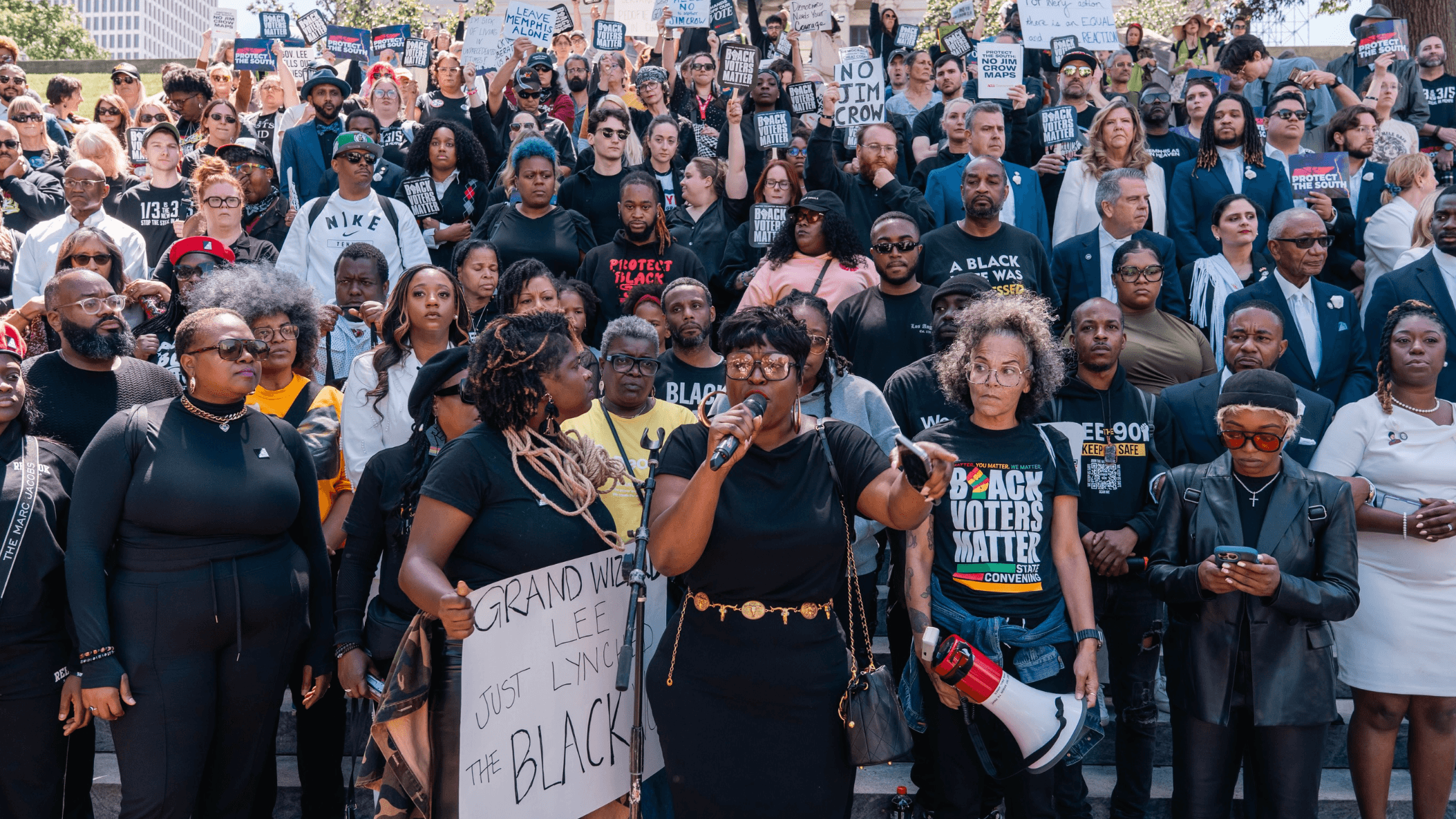
Photo: Tennessee organizations mobilized thousands of demonstrators to resist racial gerrymandering in the state.
MVP partners are ready to turn voter anger into action.
Across the country, MVP’s partners are already engaging voters on the issues they care about, activating community members to organize in their neighborhoods, and fighting back against recent redistricting measures, especially in the South. Here’s a sampling of what our partners are doing to win in November and build power for the long term.
The South
Immediately after the Supreme Court gutted the Voting Rights Act in Louisiana v. Callais, MVP moved swiftly to send funds to Fair Representation and Redistricting Action Fund (FRRA), our national partner coordinating the fundraising and strategy in response to the ruling.
FRRA is re-granting funds to support groups across the South that are leading mass mobilization, legislative, and legal efforts in their respective states.
- Louisiana: Power Coalition for Electoral Justice is leading efforts to oppose the state legislature’s attempts to redraw racially gerrymandered maps through community mobilization, direct action, and media engagement.
- Mississippi: The Mississippi State Conference of the NAACP is leading efforts focused on mass mobilization, legislative pressure, and voter education.
- South Carolina: The Grove Action Fund is coordinating efforts in South Carolina, as state GOP legislators have launched an eleventh-hour effort to redraw the state’s congressional map.
- Tennessee: Several groups, including TN Immigrant and Refugee Rights Coalition (TIRRC) Votes, Equity Alliance Fund, Memphis for All, and others have been mounting a powerful resistance to the state legislature’s redrawn maps that eliminate the only Black-majority congressional district and create new congressional lines for nearly 40 percent of the state’s residents.
- Alabama and National: On May 11, the U.S. Supreme Court ruled that Alabama could use a previously struck down map in the GOP-controlled state’s rush to redraw its maps and even postpone it’s May 19 congressional primary elections.
MVP partner Black Voters Matter Fund and others are calling for a National Day of Action for Voting Rights: All Roads Lead to the South on May 16 — starting in Selma and Montgomery, Alabama, the bookends to the monumental civil rights marches in March 1965 that catalyzed the passage of the Voting Rights Act just five months later.
The West
- Texas: MVP partners Texas for All, Texas Youth Power Alliance, and others are working hard to reach voters throughout the state, including in gerrymandered districts. As of right now, MVP needs additional partisan funding to be able to fully support their efforts to win in these districts, specifically in TX-15, TX-28, TX-34, and TX-35.
- Colorado: MVP partners New Era Colorado Action Fund, Colorado Immigrant Rights Coalition Action Fund (CIRC Action), and others are focused on flipping Colorado’s 8th Congressional District, which the Republican incumbent won by only 2,449 votes in 2024.
- California: After winning Proposition 50 in the fall (with the help of MVP partners), Democrats have a chance to flip up to five U.S. House seats in California. MVP partner Battleground California is focused on flipping California’s 22nd and 48th Congressional Districts and protecting California’s 13th and 45th Congressional Districts.
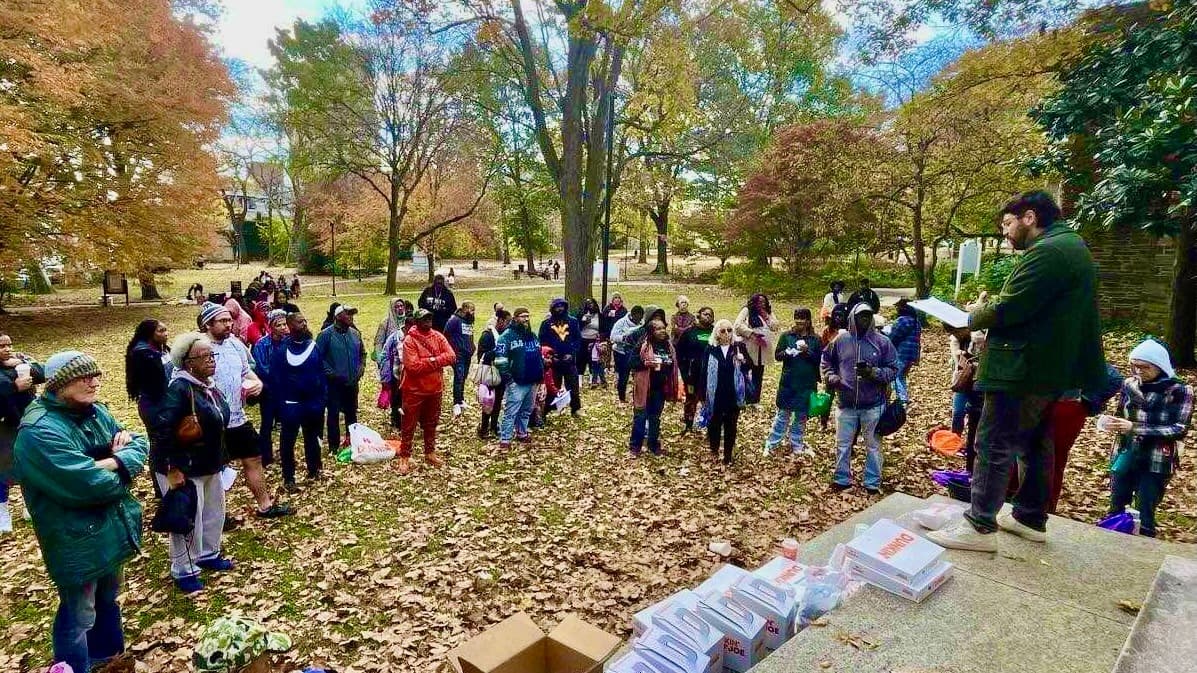
Photo: Pennsylvania Working Families Party training Neighborhood Captains.
The Northeast
- Pennsylvania: MVP Pennsylvania partners are aiming to flip three Pennsylvania House Districts — PA-01, PA-08, and PA-10 — all seats where the GOP incumbent won by less than 2 points. Anchored by Pennsylvania Working Families Party, MVP’s partners, including One PA, Make the Road Action Pennsylvania, and Asian Pacific Islander Political Alliance (APIPA), are replicating and expanding their successful 2025 Neighborhood Captains program in these districts, which helped win critical state Supreme Court retention races.
- New Jersey: Make the Road Action New Jersey is organizing in NJ-07 to unseat GOP Rep. Tom Kean. Kean won the seat in 2022 after redistricting and held it by only 5 points in 2024. Make the Road Action NJ knocked 63,742 doors in the district in 2022, laying the foundation to hold Kean accountable during his term and run a larger electoral program to flip the seat in 2026.
- New York: Battleground New York (BGNY) is a collaboration between local organizers, labor, and community organizations, launched in 2023 to take back House seats lost in 2022. In 2024, they reached 800,000 voters at their doors to help flip four seats and defend two. In 2026, BGNY will target NY-03, NY-04, NY-17, NY-18, NY-19, and NY-22, aiming to hold five Democratic seats and flip one (NY-17) seat — which the GOP incumbent won by a little over 6 points in 2024.
Make the Road Action New York is organizing and mobilizing Latine voters in the state to also focus on defending NY-03 and NY-04 and flipping NY-17, as well as building power to possibly flip NY-01 and bolster support in NY-07 and NY-10, two strong Democratic districts. - Maine: All of MVP’s Maine partners will play a role in defending Maine’s 2nd Congressional District with the departure of Democratic Rep. Jared Golden.
- Maine Youth Power is organizing rural youth in this heavily rural district.
- Community Action Alliance is organizing African Muslim immigrants in Lewiston/Auburn — the district’s biggest urban area.
- Food AND Medicine is organizing residents around workers’ rights and food justice in the greater Bangor area, the district’s second biggest urban area.
- Maine Labor and Climate Council is organizing white, working-class mobile home residents.
- Maine People’s Alliance has a long-standing, effective chapter in the district that will lead voter engagement and mobilization efforts.
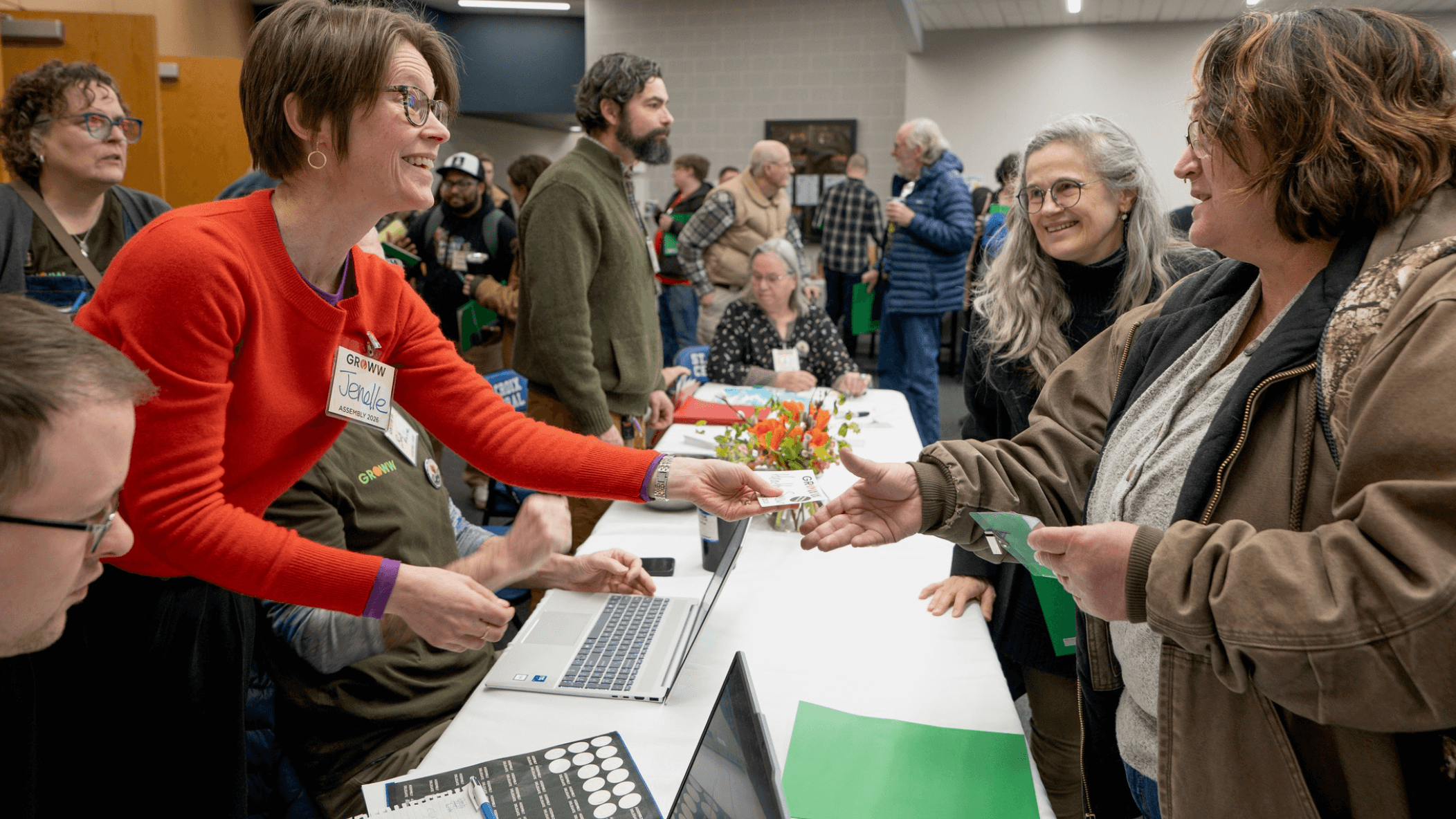
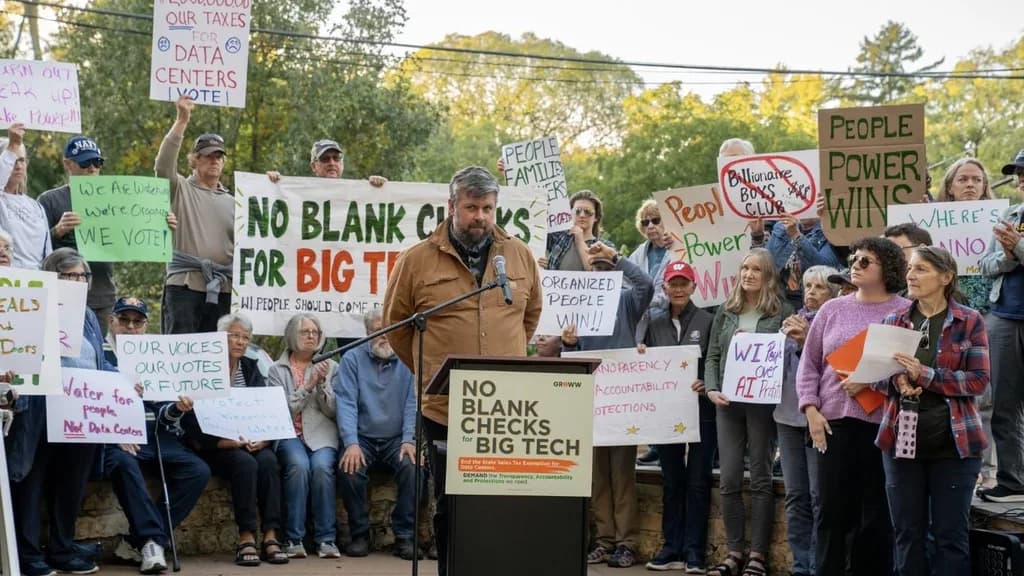
Photo: Grassroots Organizing Western Wisconsin (GROWW) hosting a town hall with their members and Wisconsin candidates for office.
The Midwest
- Wisconsin: MVP partners are organizing and mobilizing voters to flip WI-01 and WI-03. In WI-01, Citizen Action of Wisconsin, Wisconsin Muslim Civic Alliance, and Voces de la Frontera Action are working to oust Republican Brian Steil, who won by 10.2 points in 2024. In WI-03, Citizen Action Wisconsin, Grassroots Organizing Western Wisconsin (GROWW), and Main Street Alliance are mobilizing voters to defeat Republican Derrick Van Orden, who won by just 2.7 points in 2024.
- Michigan: MVP plans to support partners to help flip MI-07 and MI-10 and defend MI-08, but as of now, needs additional funds to do so. Each of these seats was won by less than 7 points in 2024 and continue to be competitive this year. If we have the resources, we will support our existing partners — such as Michigan United Action, Detroit Action, and MI Poder — to launch canvass and get-out-the-vote programs in these districts.

Photo: Tennessee Immigrant & Refugee Rights Coalition marching for voting rights and mobilizing people to the polls. (Photo credit: Jon Dragonette)
Seatbelts on, hands inside the vehicle — we are going the distance.
These recent setbacks in Virginia and the South are difficult to take in, but we cannot become defeated. That is exactly what Trump, his MAGA acolytes, and the entire Republican Party want — to convince us that we are powerless, so we give up. But we can’t and we won’t.
We have laid out the path to victory, not only to give a glimmer of hope, but to show what we truly know is possible. We can and must win in 2026 to secure a Democratic trifecta in 2028 — especially when more Southern states will try to redistrict in 2027 — so that we can finally undo the travesty of all partisan gerrymandering once and for all.
Remember, when Republicans are scared of losing, they rig the system. That’s exactly what they did in 2021 after historic Democratic voter turnout in 2020, and that’s exactly what they are doing now. They know Trump is unpopular. They know key voters Trump won in 2024 aren’t sticking with them. They know Trump’s brand of authoritarianism has become a quagmire, not the winning populist agenda Trump thought it would be. They are changing the rules of the game — a sure sign of the shaky ground they stand on.
For MVP, it’s not “if we win”; it’s “when we win.” And we will win.
Our path to a durable progressive governance in this country was a multi-cycle plan prior to this Virginia Supreme Court ruling, and it remains a multi-cycle plan now.
But we need everyone on our side to summon their resources — strategically, effectively, and boldly — to get there. That means digging deep to remember why we do this work, believing in our movement, and, above all, investing now to ensure our path to victory becomes a reality in November.
Appendix: Redistricting rundown
With the wins, losses, court cases, special elections, and protracted timeline of the 2025-2026 redistricting battles, keeping up could easily be a full-time job — and, in fact, it’s our full-time job.
Last updated June 18, 2026.
State | House Seats Gained | Context |
|---|---|---|
Texas | Republicans: up to 5 | In August 2025, heeding Trump’s demands, the GOP-controlled state legislature and GOP Gov. Greg Abbot approved a new map that would heavily favor Republicans, which the Supreme Court upheld in Dec 2025. |
California | Democrats: up to 5 | In Nov 2025, Democrats and MVP partners helped win Prop 50, serving as a direct response to Trump’s redistricting push in Texas. |
North Carolina | Republicans: 1 | In Oct 2025, the GOP-controlled state legislature approved new maps favoring Republicans. |
Missouri | Republicans: 1 | In March 2026, a county judge ruled that the new GOP-drawn map could stand, despite MVP partners’ campaign to get a ballot measure before voters. As of this writing, the Missouri Supreme Court is poised to hear three cases that will decide if these maps will be used in the 2026 midterms. |
Ohio | Republicans: up to 2 | In Oct 2025, Ohio’s redistricting commission approved new maps favoring the GOP. |
Utah | Democrats: 1 | In Nov 2025, a state judge tossed out a GOP-favored map, adopting a map that could gain Dems up to one seat. |
Florida | Republicans: up to 4 | In April 2026, the GOP-controlled state legislature and GOP Gov. Ron DeSantis approved new maps favoring Republicans. |
Tennessee | Republicans: 1 | After the April 2026 SCOTUS ruling, the GOP supermajority in the state legislature and GOP Gov. Bill Lee approved a new map splitting the state’s only Dem and Black-opportunity district. |
Louisiana | Republicans: 1 | After the April 2026 SCOTUS ruling, GOP Gov. Jeff Landry suspended Congressional primary elections, even though early voting was already underway. On May 29, Gov. Landry signed a new congressional map that eliminates a Black-majority district and will likely gain Republicans on seat. |
South Carolina | — | After the April 2026 SCOTUS ruling, the GOP-controlled state legislature rejected a Trump-backed plan to redraw the state's maps to erase South Carolina's only Democratic House seat held by 17-term Congressman James Clyburn, who is also the state's only Black Member of Congress. |
Alabama | Republicans: 1 | After the April 2026 SCOTUS ruling, GOP Gov. Kay Ivey called the GOP-controlled state legislature into a special session to consider postponing the May 19 congressional primary elections. On May 11, SCOTUS ruled that Alabama could use a previously drawn 2023 map that would eliminate at least one majority-Black district and favor Republicans, but on May 26, a federal court blocked the state from re-implementing the 2023 map. On June 3, SCOTUS ruled again in favor of an appeal brought by GOP Attorney General Steve Marshall, which, reinstates the 2023 map that favors Republicans and dilutes Black voting power. |
Virginia | — | In April 2026, voters — with the help of MVP partners — approved a new map that would give Dems up to five seats. On May 8, the Virginia Supreme Court struck down the new map, rendering it invalid. On May 18, the U.S. Supreme Court ruled against Democrats' appeal, refusing to reinstate the voter-approved map, ending the redistricting fight in Virginia. |
Georgia | — | Georgia's GOP Governor, Brian Kemp, called a special legislative session to start on June 17 to take up redistricting but thanks to MVP partners' organizing, Republicans backtracked and will not take up redistricting in 2026. |
Maryland | TBD in 2028 | Maryland's Democratic Senate President, Bill Ferguson, may be reversing course and opening the door to a special legislative session to consider redistricting. Redrawn maps under Maryland's Democratic trifecta could gain Dems up to one seat in 2028. |