SEPTEMBER 2026
Beyond the
Autopsy

SEPTEMBER 2026
Dear reader,
There are countless reports and think pieces out there about why and how we must reform the Democratic Party. Today, Movement Voter PAC (MVP) is putting our money where our mouth is.
We are announcing an initial $1 million investment in an eight-part agenda to reform the Democratic Party, as part of a $50 million commitment in political funds over the next three years to community organizations to build a winning Democratic majority.
Here is the 8-part action plan:
Since 2016, MVP has helped tens of thousands of donors move tens of millions of dollars to support over 600 year-round organizations in 45 states. After the 2024 elections, it was clear that a successful outside game depends on a strong inside game. We can fund the best local organizers in Arizona or Ohio, and it will not be enough if the official party structures they interact with run on outdated rules, get fleeced by consultants, or do not reflect the people they represent.
A successful outside game depends on a strong inside game.
We didn’t set out to do an “autopsy.” But we did quietly spend nearly a year having over 100 in-depth conversations across the Democratic ecosystem, surveying 250 donors in our community, holding a lively panel at Netroots Nation, kicking the tires with subject matter experts, and eventually discussing our findings with Democratic National Committee (DNC) leadership.
In so many ways, insiders and outsiders alike agree that the corrupting influence of money and selfish interests has hollowed out the Democratic Party, undermined trust in the party brand, and depleted the goodwill of Democratic voters and donors — leaving the door open for demagogic charlatans to seize power. Too often, the Democratic Party feels like a technocratic, top-down, money-driven racket instead of a people-powered, mission-driven vehicle to improve our country.
So we wanted to understand what we could realistically do to fix it.
The good news: Leaders across the party, from county chairs to campaign managers to donors to digital organizers, are far more aligned than not — even across lines of ideology. Almost everyone we talked to emphasized the need for fundamental changes in how the Democratic Party operates.
Leaders across the party are far more aligned than not.
To complement our qualitative research, we also partnered with Data for Progress to poll Democratic and independent voters (whose views largely reflected what we heard in our interviews) and gained empirical validation that there is strong support to make these changes.
What surprised us most throughout our research was how many people shared appreciation that MVP, as an outside entity, was leading this effort. Many insiders strongly urged us to keep going.
After much listening and synthesizing, we now have a modest three-part plan:
Responsibility for the success of the Democratic Party is all of ours, whether we like it or not.
We will continue to invest the vast majority of our funding in grassroots organizing, media, and outside strategies for change. But we are officially starting a special three-year initiative to invest in the unglamorous but necessary work of reforming and improving the Democratic Party. This report is a first step — to be followed by a series of actionable conversations and strategic grants.
We learned the hard way in 2024 that responsibility for the success of the Democratic Party is all of ours, whether we like it or not.
We invite you to join us in supporting and pushing the Democratic Party to improve as a vehicle for defeating authoritarianism — and for advancing a hopeful new era in which everyone can flourish.
Billy Wimsatt
Executive Director, Movement Voter PAC
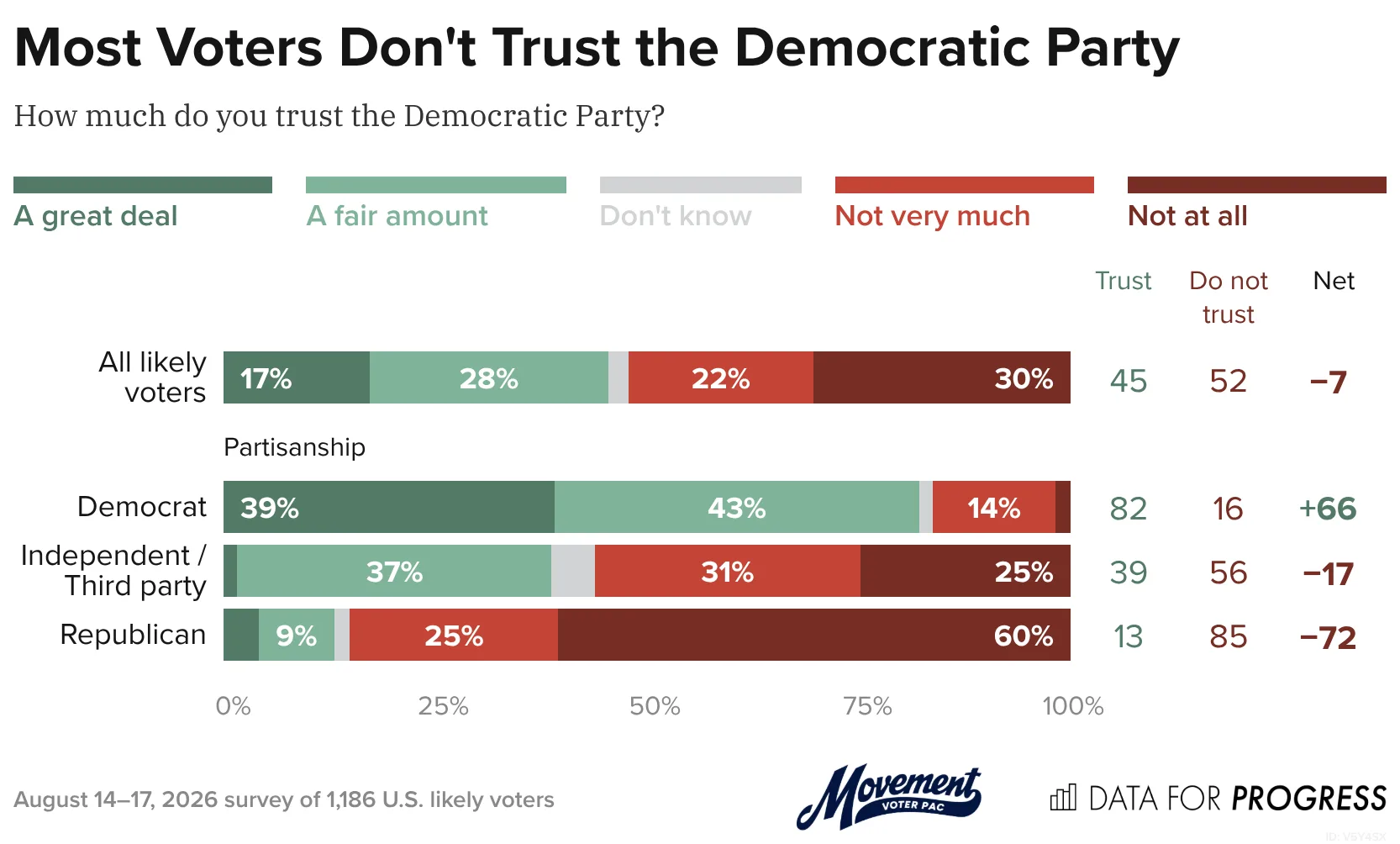
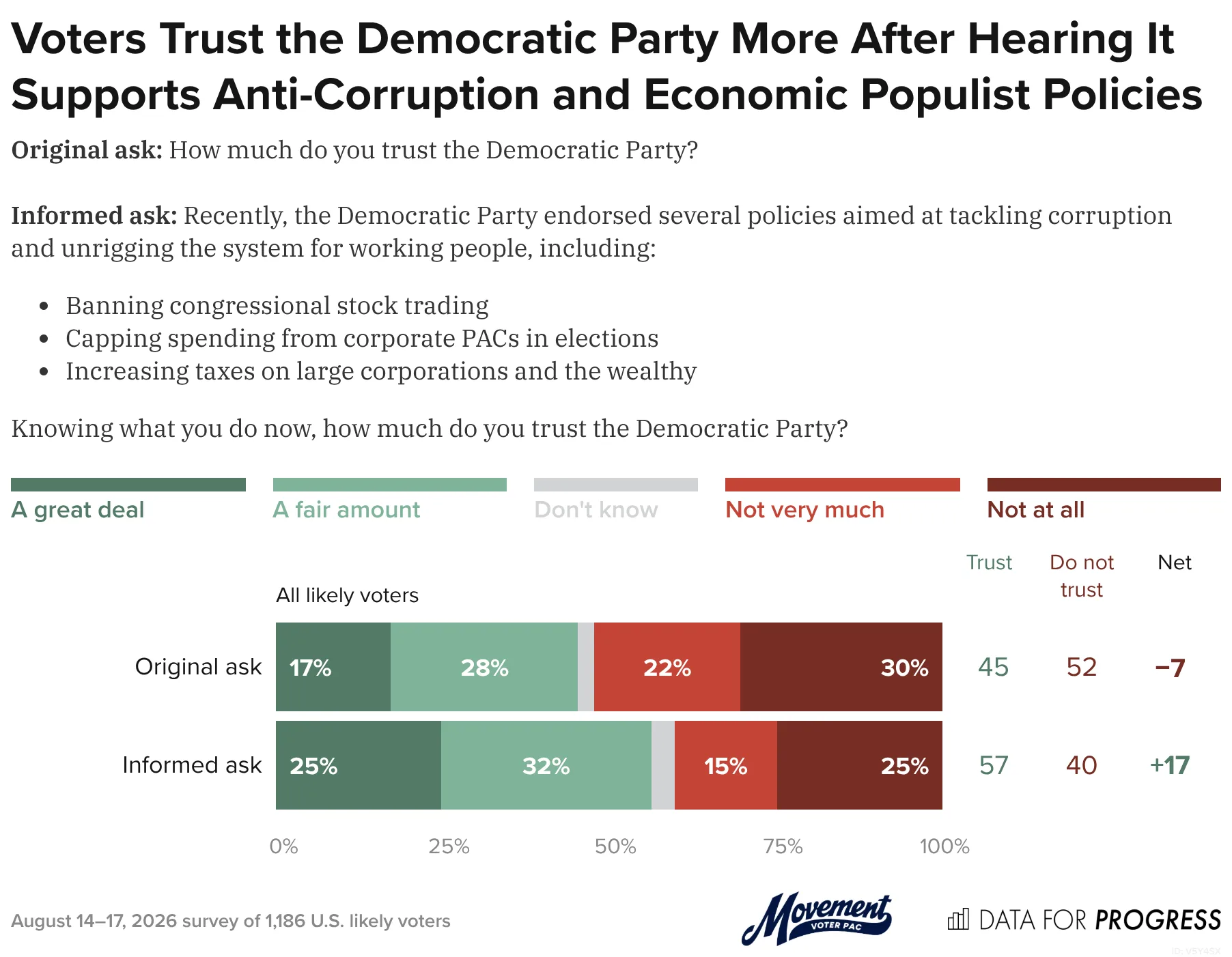
While voters are turning away from Trump, they are not necessarily turning toward the Democratic Party. Our own research confirmed what many others have found: A majority of voters do not trust the Democratic Party. This is more than a marketing problem.
So many Democratic-aligned voters, leaders, activists, organizers, donors, and supporters lost trust after 2024, and many told us that they were questioning if future engagement was worth it. We take that seriously: Resignation is a win for authoritarians. We cannot let that be the end of the story. That is why we took on this project: to launch a forward-looking, solutions-oriented effort to re-envision the Democratic Party and take collective responsibility for making it real.
A majority of voters do not trust the Democratic Party. This is more than a marketing problem.
This report's premise is that fixing this is shared work: Party institutions, elected officials, donors, vendors and consultants, independent organizations, and voters and communities each hold a distinct piece of the way forward, and none of us can do it alone. Our hope with this project is to help everyone with a stake in our democracy see their own piece of that shared responsibility, and to build a new politics that can bring us back from the brink of authoritarianism by 2028.
For one example of what party institutions and community-based organizations can accomplish together, we point to Minnesota, where a long-term inside-outside strategy coincided with a Democratic trifecta and substantial progressive legislation. Many interviewees believe leaders want to build toward a Minnesota-style vision, and were direct about what they see standing in the way: entrenched interests, misaligned incentives, and outside money that can distort party primaries — and enrich a select few.
Interviewees consistently urged boldness over incrementalism. We can pursue many of the reforms in this report without major rule changes or major expense.
What is needed, in their view and ours, is a clear vision and leadership willing to move toward it.
We are putting forth and actively investing in an eight-part action plan — grounded in interviews, surveys, and newly released polling data — to reform the Democratic Party and set Democrats up for success in 2028 and beyond.
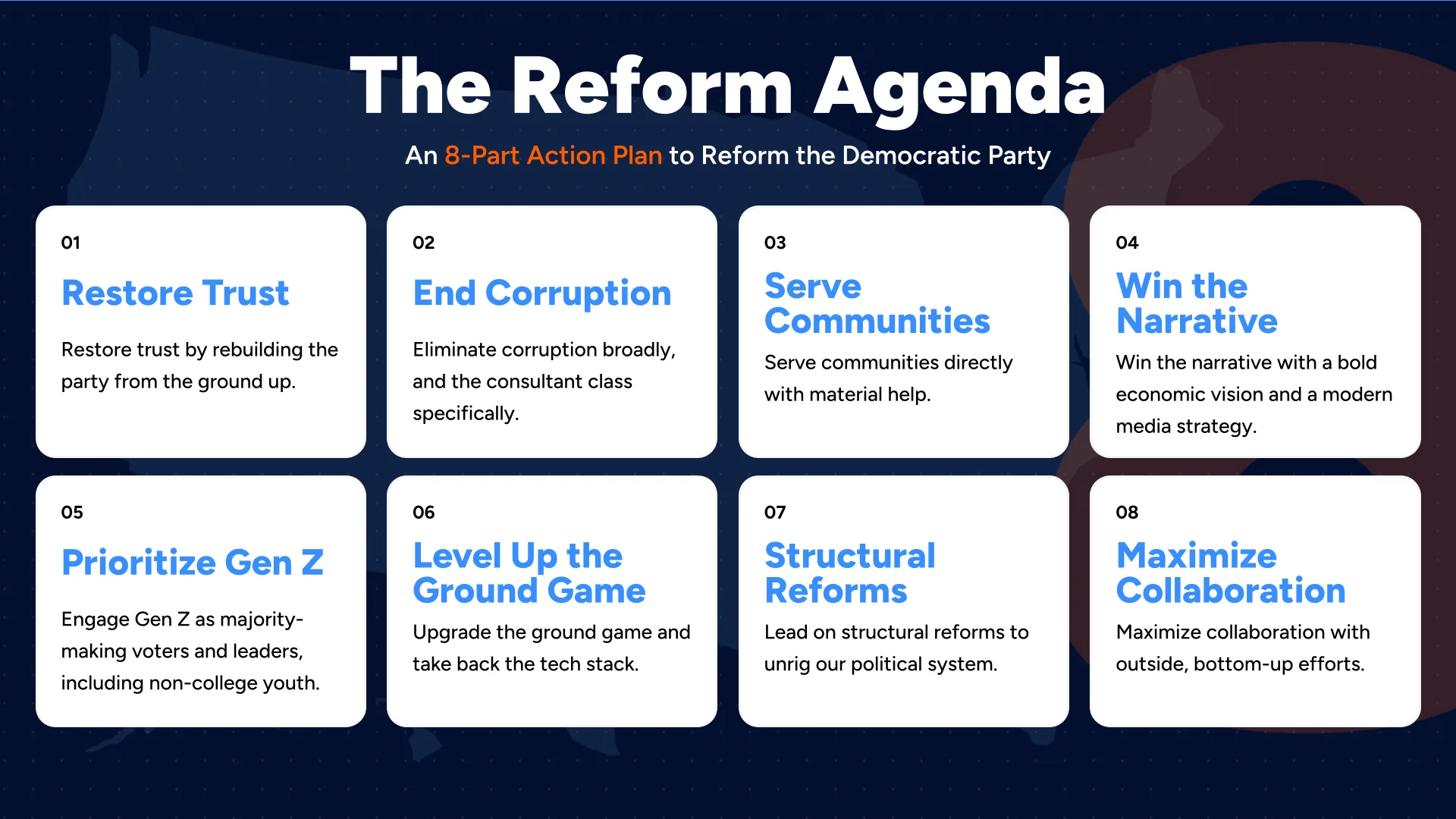
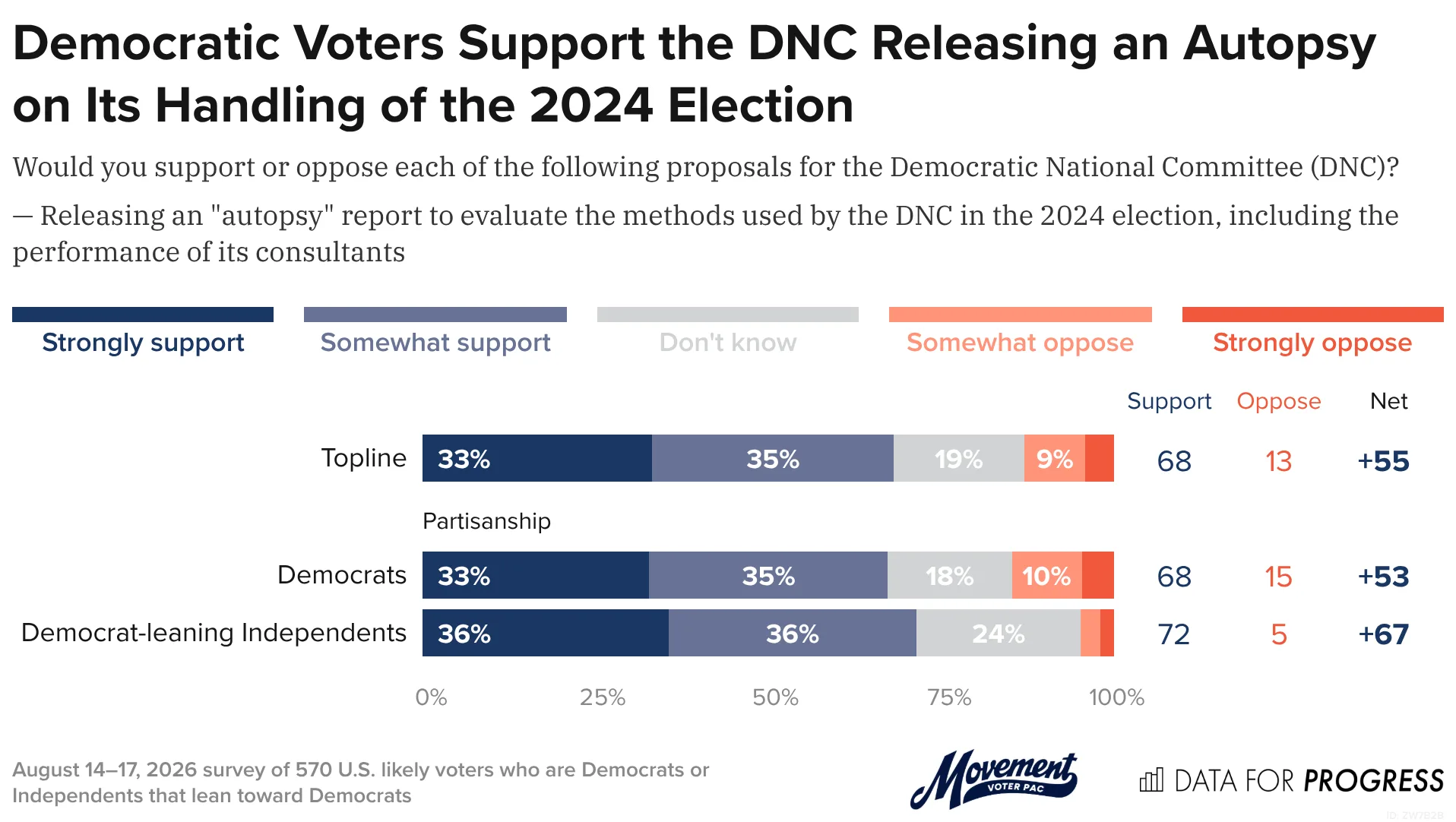
1. Restore trust by rebuilding the party from the ground up. Local committees are the party's front door, and today that door is often not wide open or well-tended. We recommend making party leadership a real, paid job with the respect — and performance expectations — that go with it. This investment in local leadership must come alongside more modern rules and ways of working. We also note that 68% of Democrats and Democratic-leaning independents supported producing a 2024 “autopsy,” a project that was never completed by the DNC, and this should be a mainstay going forward to restore broken trust.
2. End corruption in the party broadly, and the consultant class specifically. Across the electorate, 90% of voters are concerned about corruption in government and politics, and Democrats and Democratic-leaning independents back specific reforms by wide margins, with a 78% majority favoring a crackdown on misleading fundraising appeals. We call for high-road contracting standards by party committees and campaigns, a blacklist on private-equity-owned vendors, and a crackdown on scam PACs that prey on small donors, especially seniors.
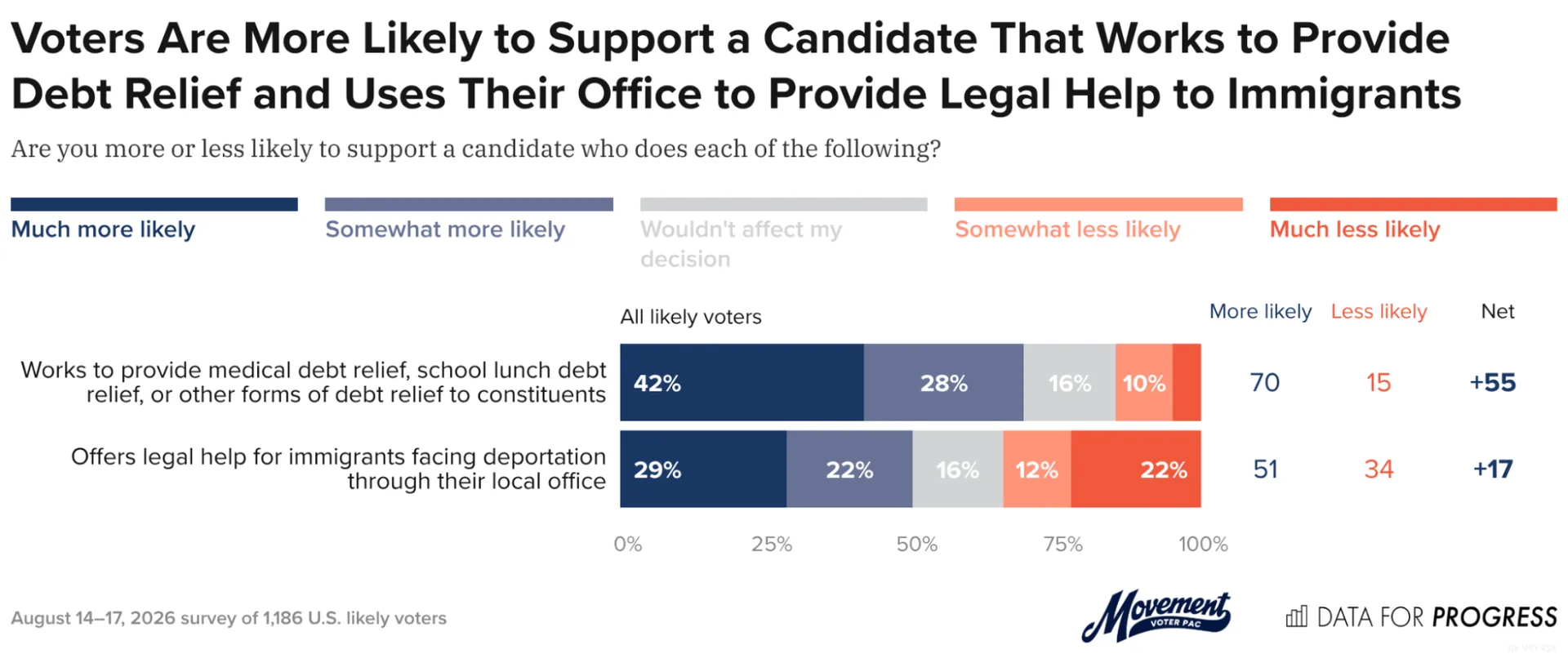
3. Serve communities directly with material help, as well as direct and ongoing feedback loops. Trust isn't rebuilt by buying it with advertising; it's rebuilt by showing up. We recommend prioritizing visible, material help — medical debt relief, disaster aid, and legal defense against outrageous ICE enforcement actions — alongside structured ways for elected officials to hear directly from constituents, not only from consultants, lobbyists, and donors. Voters back this approach decisively: candidates who personally help with disaster preparedness and recovery earn a +72 net in likely support, the single strongest predictor tested in our entire poll.
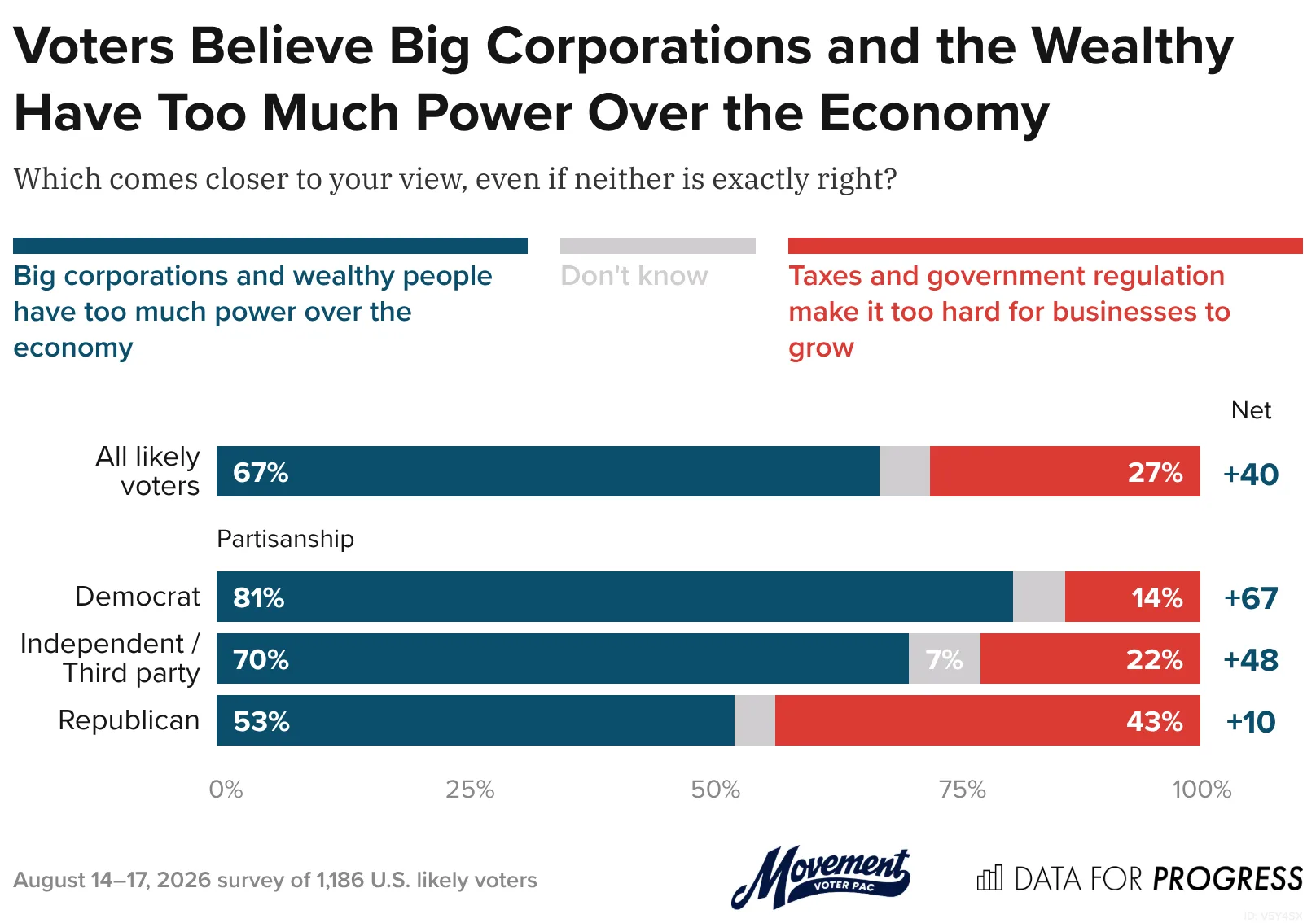
4. Win the narrative with a bold economic vision, and a modern media strategy. 67% of voters blame big corporations and wealthy people for having too much power over the economy. They also tell us that Democrats lack a credible, memorable answer to this problem of concentrated wealth and corporate power. We recommend a plain-language economic platform, discussed openly through a transparent primary process, and echoed repeatedly through the new media environment where voters increasingly consume news, politics, and culture.
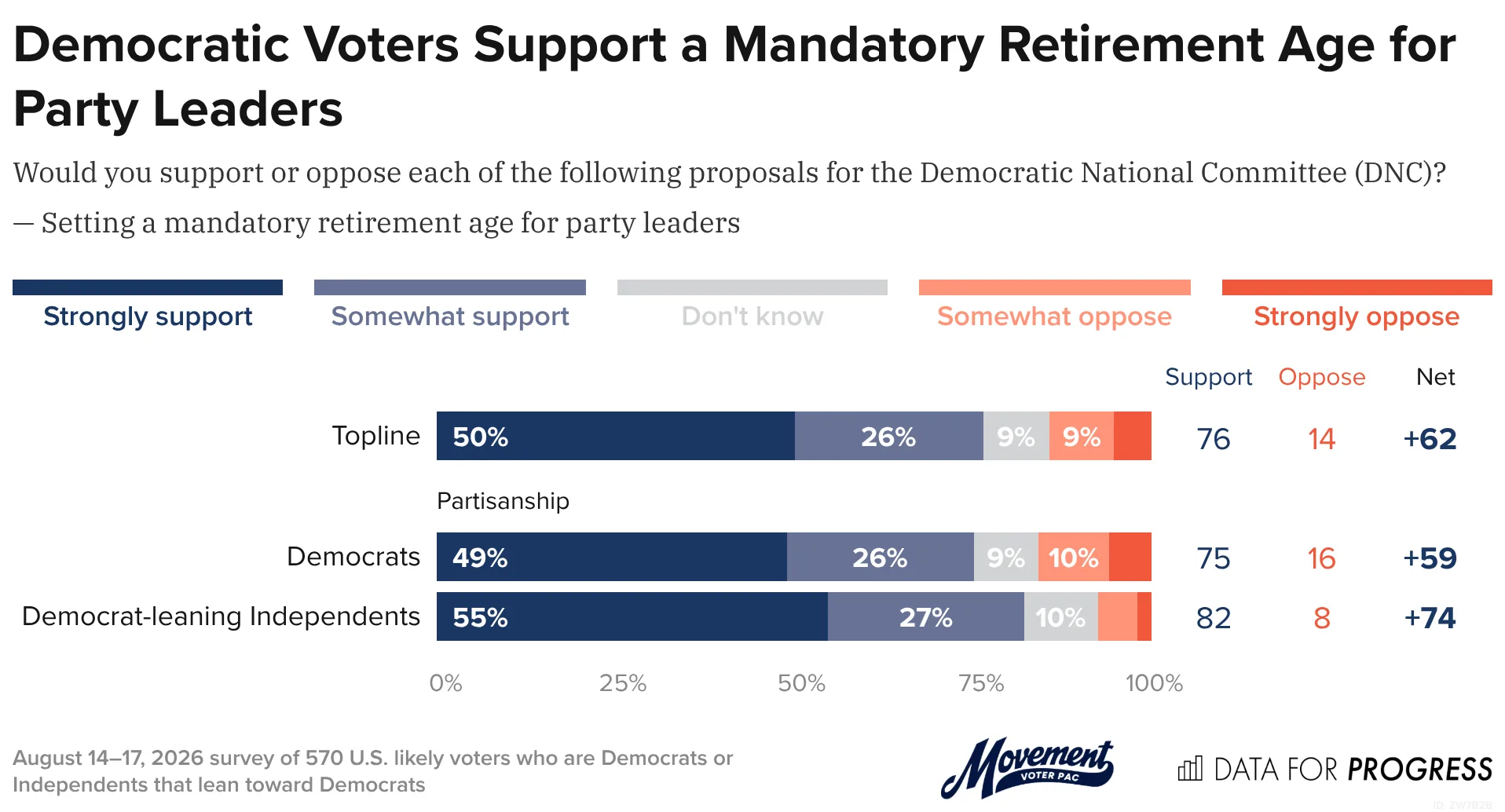
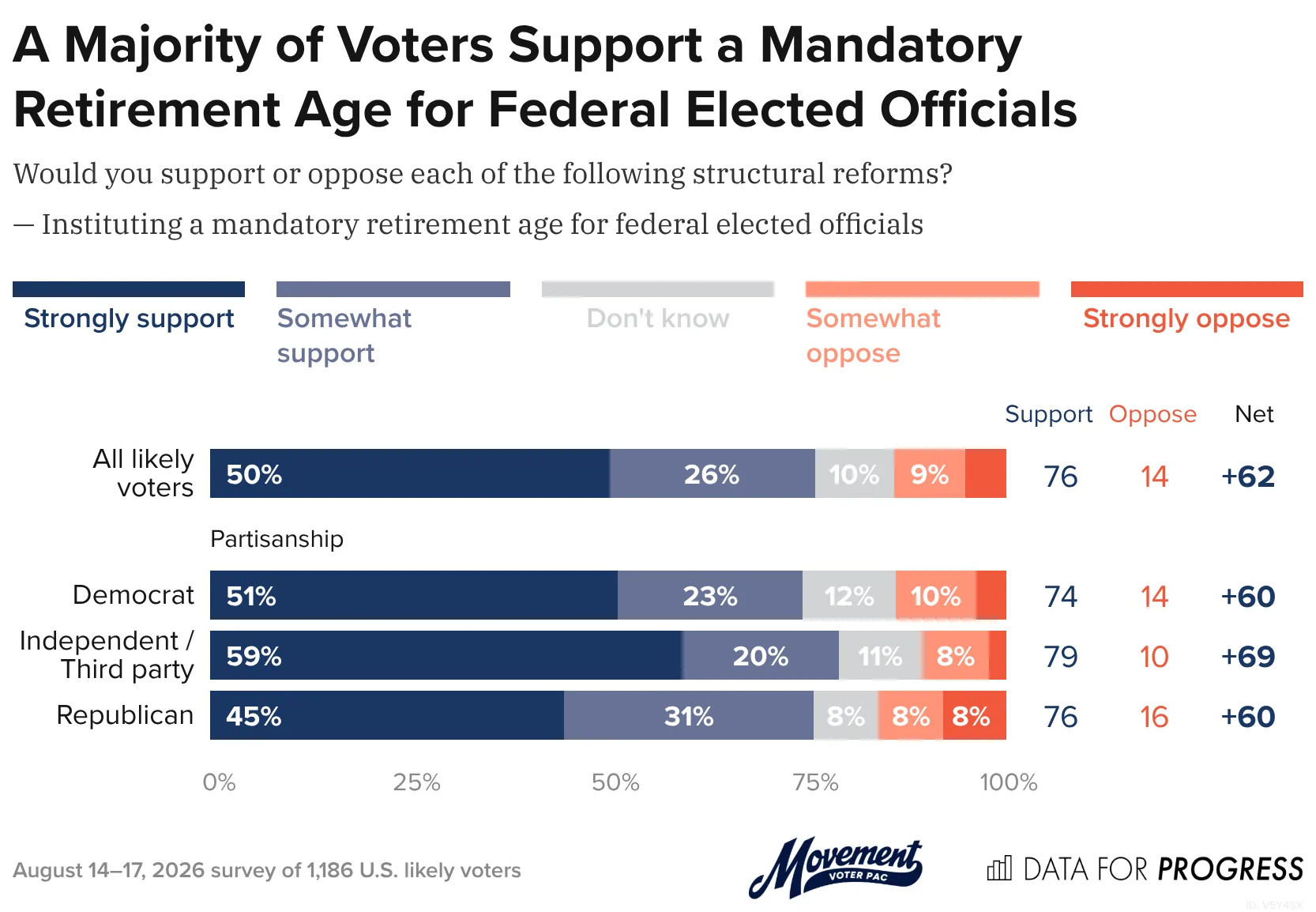
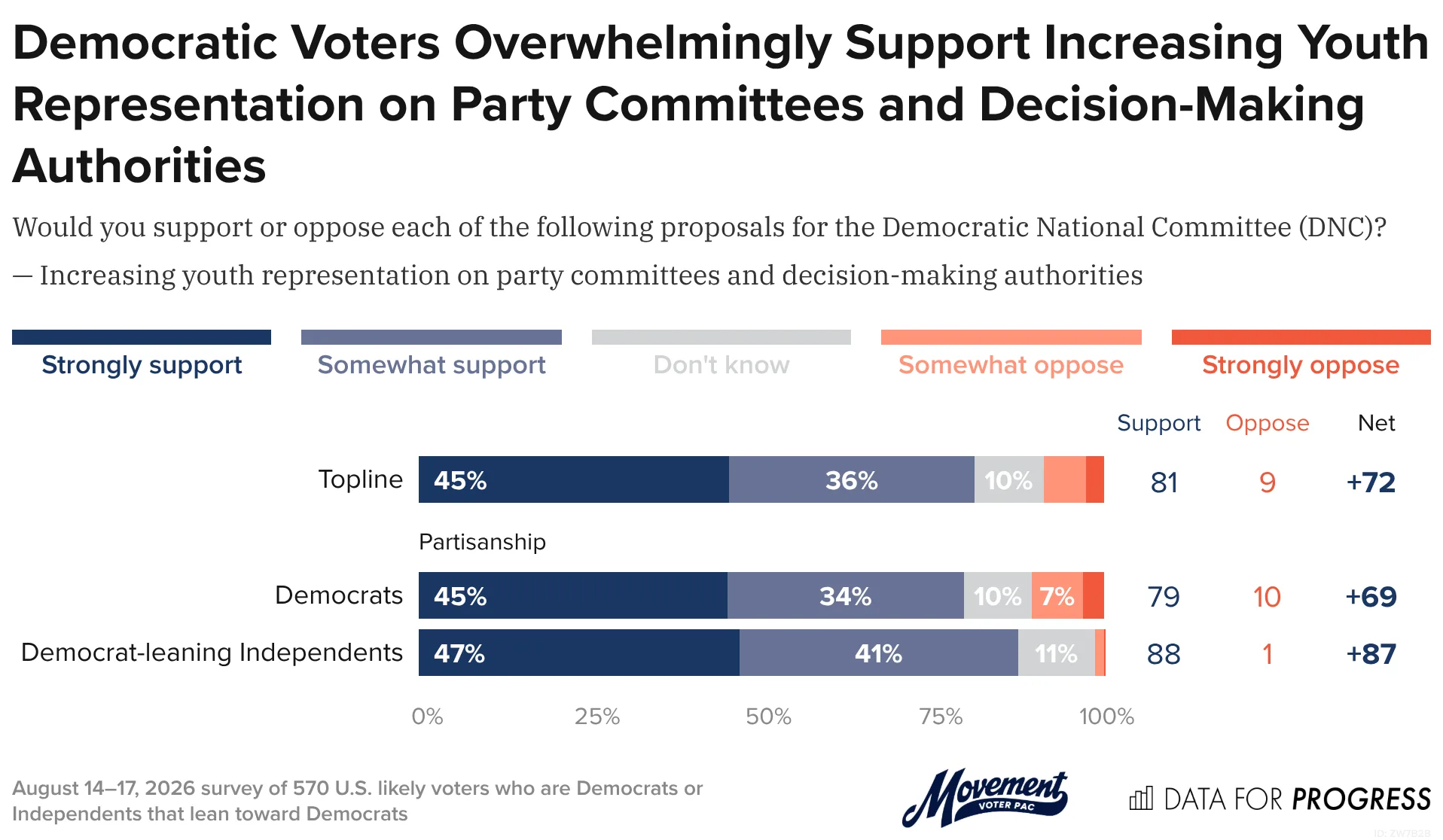
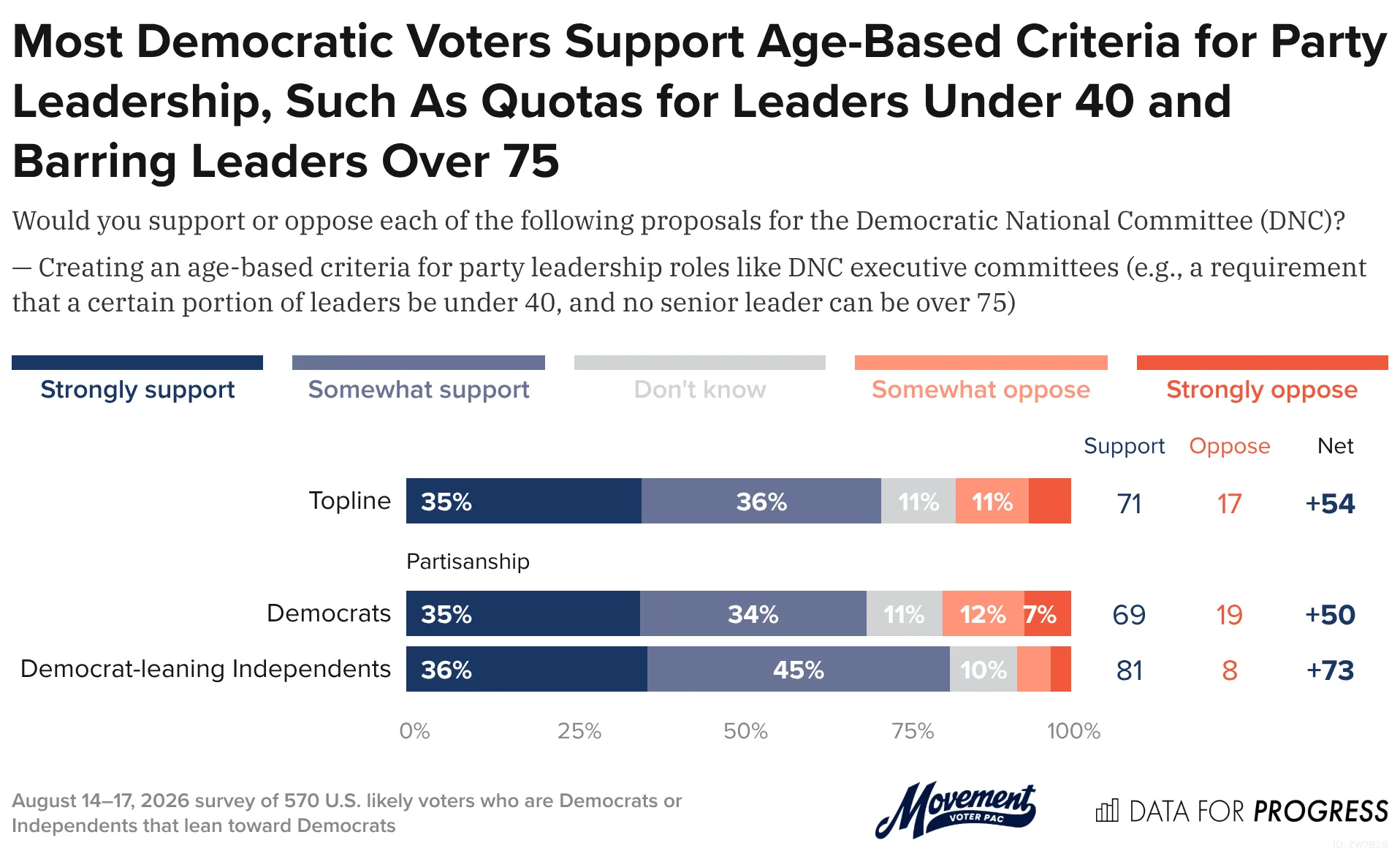
5. Prioritize Gen Z as majority-making voters and leaders, including non-college youth. Among Democrats and Democratic-leaning independents, 81% support ensuring representation of young people on party committees — one of our strongest-polling solutions. Besides major investments in reaching, persuading, and organizing young voters, we recommend age-balance requirements for party officer roles, and mandatory retirement ages — reforms with wide margins of support.
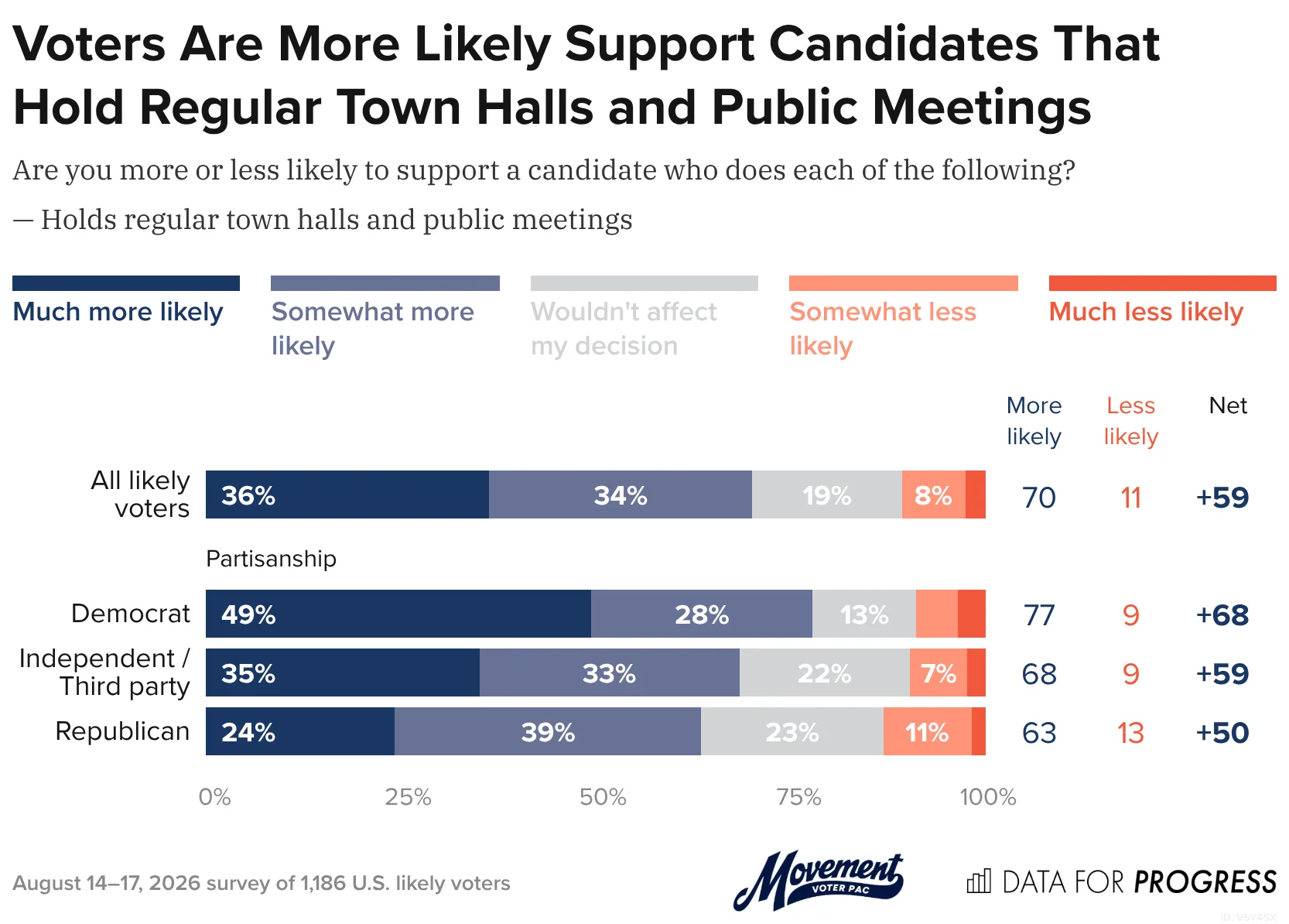
6. Level up the ground game and take back the tech stack. Sustained, in-person engagement moves voters: candidates who hold regular town halls and public meetings earn a +59 net in likely support. This strategy covers two distinct jobs: rebuilding the relational, face-to-face organizing capacity that has atrophied especially since the pandemic, and modernizing the party's shared data and technology that supercharges voter contact.
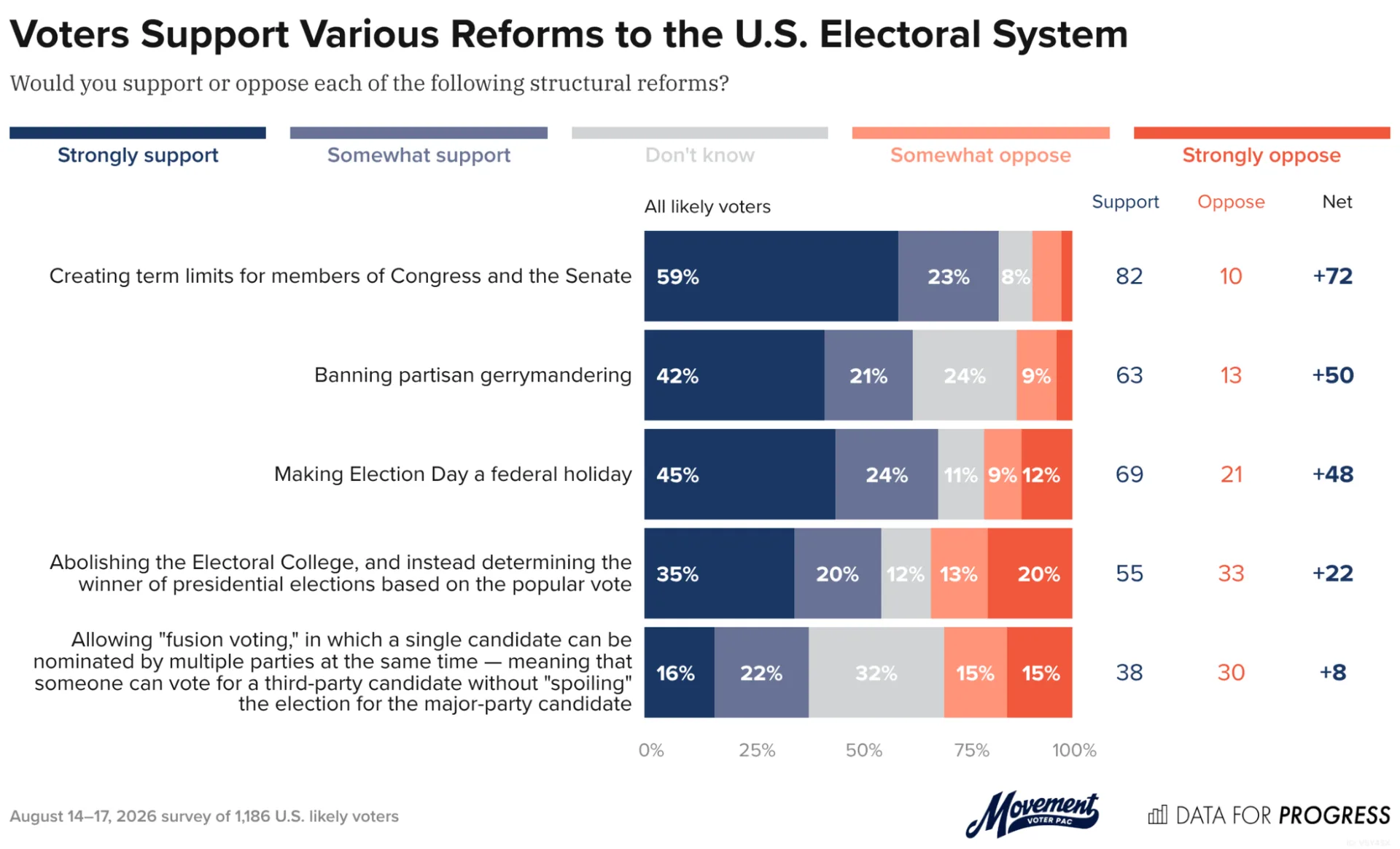
7. Lead on structural reforms. We cannot be the party that wants only to defend a system most Americans already see as rigged against them; we must offer a plan for forward-looking change that unrigs the system. In the wake of the Supreme Court's Callais decision and the redrawing of maps to dilute Black political power, we recommend that Democrats champion anti-corruption reform and expanded democratic participation as an affirmative governing project, offering a menu of options, from fusion voting to ending partisan gerrymandering. Term limits for Congress and the Senate are the single most popular structural reform we tested, with 82% support.
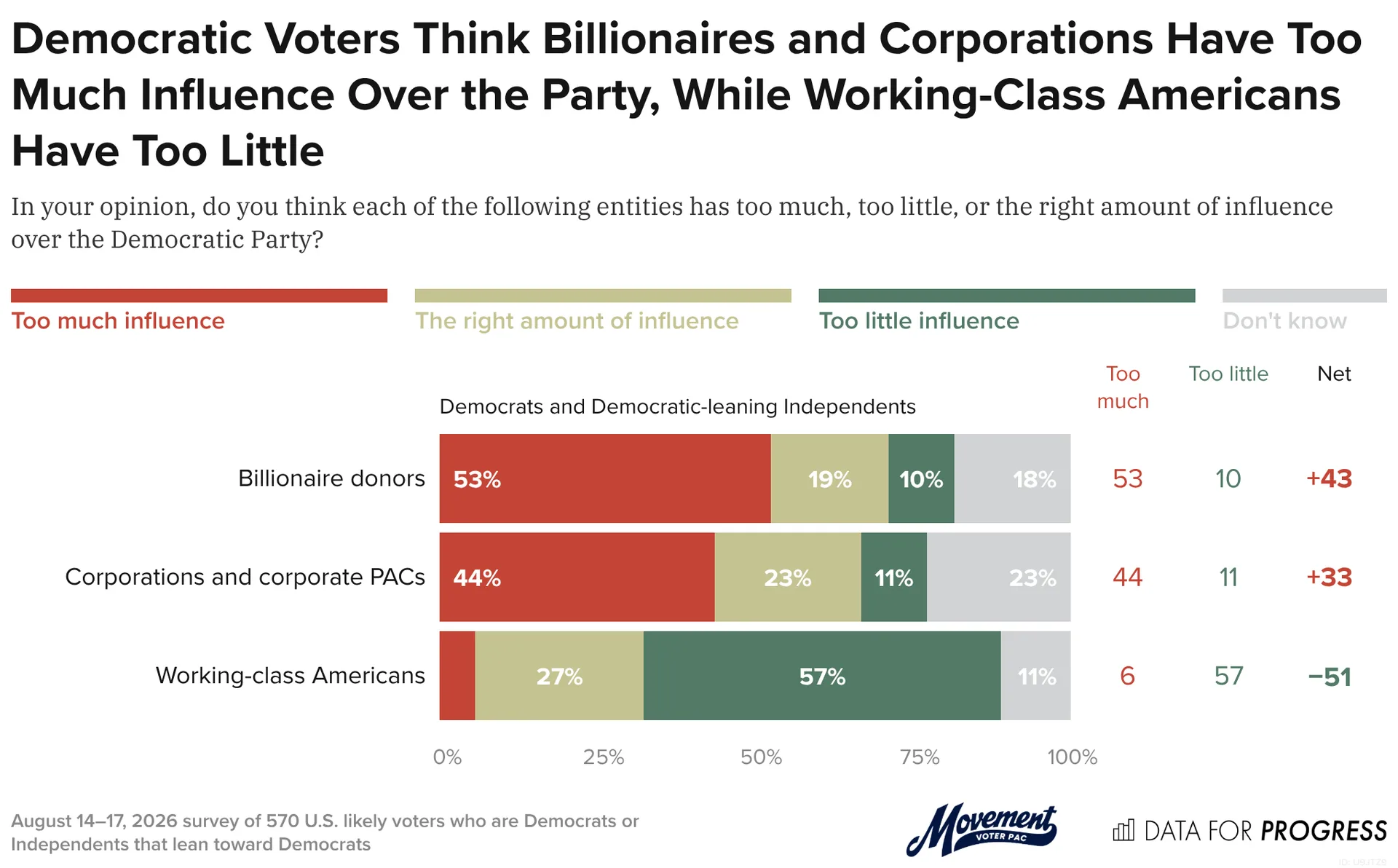
8. Maximize collaboration with outside, bottom-up efforts. Democrats and Democratic-leaning independents say working-class Americans (net -51) and young people (net -44) have far too little influence over the party, while billionaires (net +43) and corporations (net +33) have far too much. That power imbalance must shift, and we can do it by working better together. Minnesota's path shows what's possible when party leaders treat independent organizations as partners, not threats - and when outside groups get serious about winning. Recent legal openings give Democrats new room to coordinate with outside groups on organizing, and Republicans are already using them; we recommend Democrats do the same.
Defeating authoritarianism and making lasting change requires both accountable party institutions and durable, independent organizing power. Elected officials, donors, community organizers, candidates, operatives, party officials, and vendors each hold a piece of what happens next.
Some of this work is already underway and deserves to be funded at scale and accelerated. Some of it requires political will that only party leadership can supply. Much of it requires resources to be raised or reallocated.
Our collective future gets built by people who act on the urgency of this moment.
This report began as a search for meaning in a moment of crisis.
In the aftermath of 2024, we were shaken. MVP has spent years investing in the outside game. Our partner organizations worked their hearts out. We still came up short. So we set out to listen, deeply and broadly, to those actually working inside the Democratic machine, about where we are and what must change.
In 2025, our team interviewed roughly 25 trusted operatives and put together an initial internal discussion paper. The response was promising. So in 2026, we conducted more than 100 in-depth interviews and exchanges with people across the Democratic ecosystem. We deliberately sought out a wide range of roles and viewpoints: state and county party chairs, campaign managers, labor and community organizers, pollsters, donors, political consultants, digital creators, advocacy leaders, and operatives spanning the ideological range from the Democratic Socialists of America (DSA) left to the moderate center of the party. We asked people to go beyond the usual generalities. Our interview approach was explicit about this: we told people we wanted "the ultra granular details of specific solutions" and that no idea was too small…or too audacious.
We deliberately sought out a wide range of roles and viewpoints: from the DSA to the moderate center of the party.
From there we published a public invitation for ideas, survey responses, and implementation partners and sent this to the MVP network. We received more than 250 responses from across MVP's own donor and community organizing networks, asking a parallel set of questions: what are the greatest roadblocks you have personally experienced, what would you do right now to improve the party, and who else should we be talking to? Combined with the interviews, this process surfaced more than 150 distinct ideas, which our team grouped into recurring strategic themes.
We then tested our early synthesis in public. In June 2026, we shared our findings in a workshop at Netroots Nation, with feedback from about 100 activists, organizers, donors, and creators.
That framework evolved over several rounds of feedback. Practitioners and subject matter experts, including political strategists, organizers, and seasoned consultants, reviewed our synthesis and pushed us to sharpen it, round it out, and sequence it by degree of urgency and importance.
A refined, eight-strategy framework formed the basis for a memo to Ken Martin, Chair of the Democratic National Committee, in June 2026, and a follow-up meeting in August. We brought this to the DNC Chair directly because parts of our agenda are things a Chair has the power to move: contracting standards, rules and bylaws, primary practices, and party infrastructure.
Our report then went through a second, more structured round of review from dozens more practitioners, organizers, pollsters, and party officials. We also commissioned a poll with Data for Progress to survey Democratic voters on the ideas presented, and have incorporated those results.
This report, in other words, is not a single survey or a single interview series. It is a synthesis: built from qualitative interviews, a broader community survey, a public workshop and open call for ideas, two rounds of practitioner review, and a survey of actual voters.
This report is not a single survey or a single interview series. It is a synthesis.
We bring forward the best ideas we heard, but we also have a built-in bias: supporting power-building strategies for historically marginalized communities remains our central mission.
We want to be direct about what this process can and cannot establish, because several reviewers correctly flagged that this process is hardly political science per se.
Note: Many “featured projects” in this report are current or former MVP grantee partners. We share this as a point of pride: So many of the answers are right in front of us, waiting to be funded at scale.
In 2025, we spoke with operatives across the space about lessons learned looking back (A discussion of that research is included as an addendum). In 2026, we focused our practitioner interviews not on looking back, but on forward-looking strategies, what people are doing differently, what new ideas are promising, as well as where we’re still stuck.
Building a durable path from here to governing power requires more than a shared enemy in Trump.
Across the space, interviewees said that building a durable path from here to governing power requires more than a shared enemy in Trump. It requires the party and its allies to build, or rebuild, the fundamentals: trust, a compelling economic story with a credible plan to deliver material benefit for voters, a real relationship with young voters, a modern technology and organizing infrastructure, a bold and disciplined reform agenda, and a genuine, non-defensive partnership with the organizations and movements operating alongside campaigns.
Below, we offer eight actionable strategies to reform the Democratic Party. For each, we are lifting up key voices, reflecting on our grasstops interviews, offering our grassroots polling results, and showcasing groups and projects doing good work.
Across dozens of interviews, one theme surfaced with almost no ideological variation: formal party structures feel antiquated, confusing, dysfunctional, and hard to participate in meaningfully. Interviewees described outdated party structures as blocking the talent, participation, and accountability the party needs right now. Words like “calcified,” “toxic,” and “bureaucracy" were used more than once to describe state, county, and national party structures, including the DNC.
“We keep trying to fix messaging without fixing the machinery producing the messaging... We need to be honest that the inside of the party is broken before we can realistically expect the outside brand to improve.”
— Lauren Gepford, “The Democratic Party's Internal Machinery Is Breaking Its Brand”
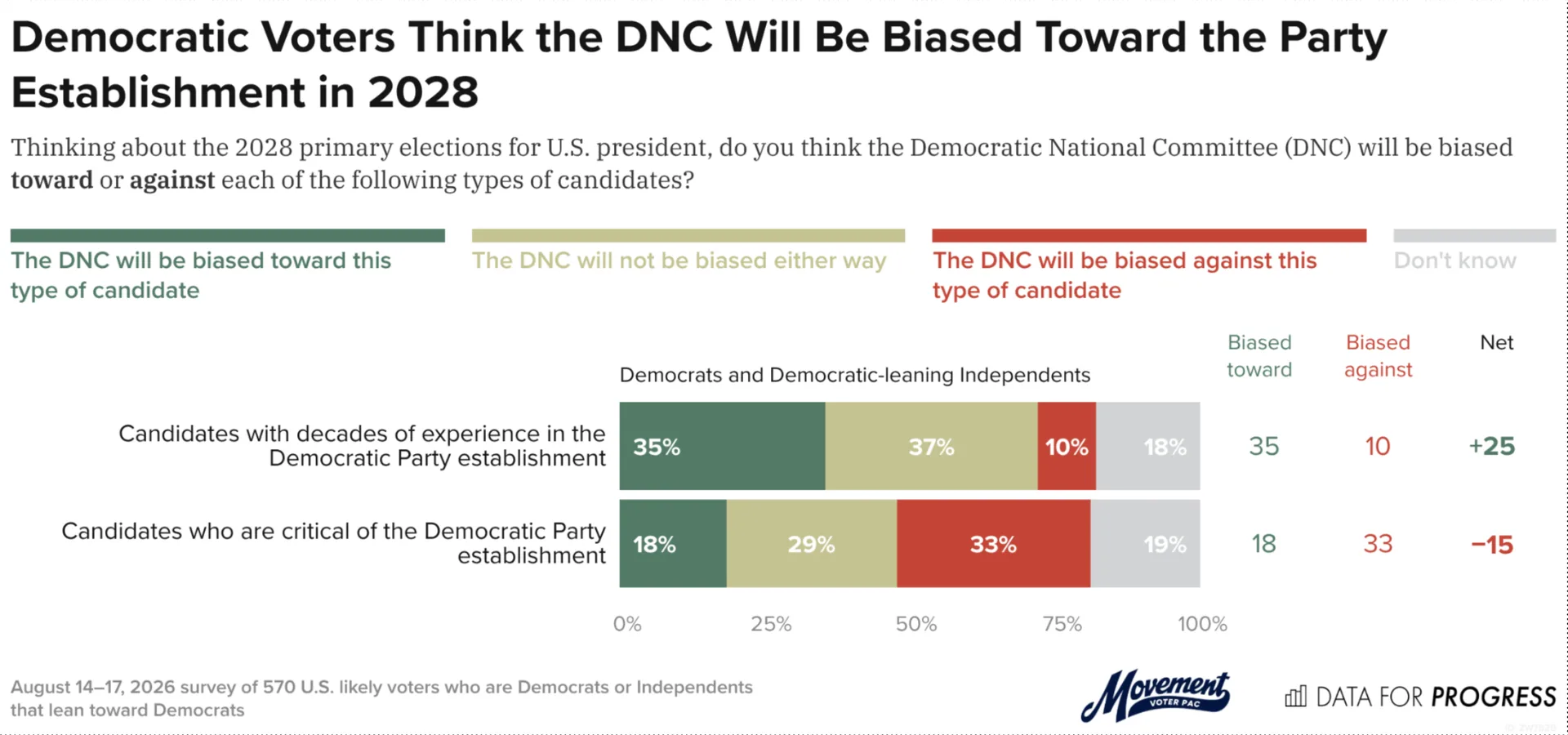
Multiple interviewees expressed anger and/or dismay that the party's own 2024 post-mortem report was never completed or released on a timely basis, which they read as an unwillingness to have a hard, honest conversation or bring any accountability or change moving forward, and a huge missed opportunity. Our own August 2026 polling reinforces this: 68% of Democrats and Democratic-leaning independents support producing exactly this kind of “autopsy,” the project the DNC never completed.
(We note that, in the final days of drafting this report, Paul Rivera released his 500+ page report, Blue by 2032, independently of the DNC.)
Graphic: Data for Progress
Nevertheless, there was significant support — even passion — across the board for investing in local politics, local and state parties, and the people who run them and can make them better. Across the ecosystem, there is a shared vision for local Democratic Parties to become more modern, welcoming, and dynamic hubs for rank-and-file Democrats and emerging leaders, to build lasting power together. But to achieve that vision, changes are needed now.
Graphic: Data for Progress
Seasoned operators described a hollowing out of the core of the institutions and said that a dysfunctional and closed culture made anyone with ambition or creativity eschew engagement with the formal party structures altogether — instead working around them and building parallel structures. This has coincided with the dominance of (unlimited) outside money in elections under Citizens United. (Notably, the emerging new case law around unlimited spending by Parties may shift this dynamic going forward).
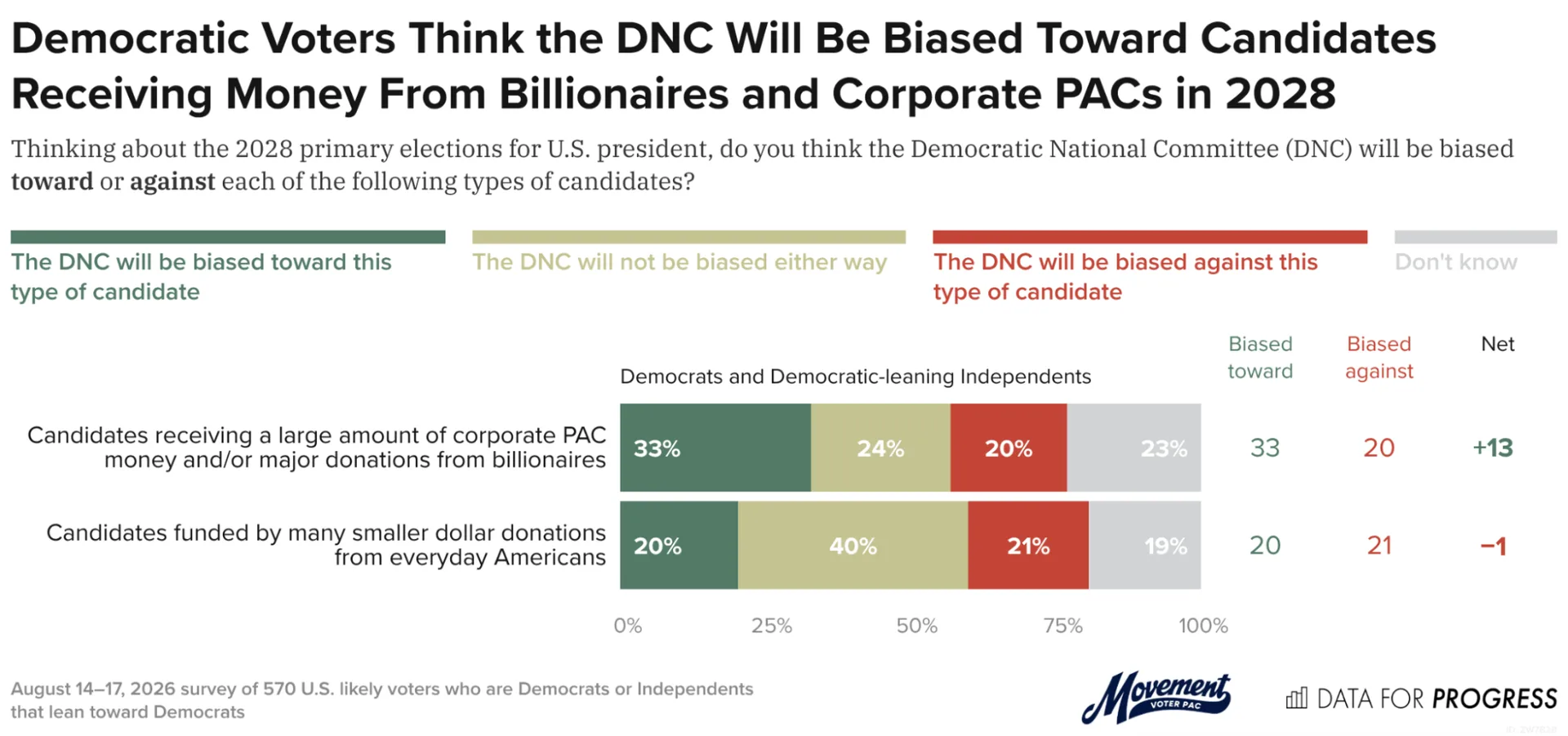
Graphic: Data for Progress
The result of this institutional hollowing is that the ecosystem has become lopsided, with Democratic politics operating as a privatized network of operators who can navigate the byzantine structures and personality-driven politics of the party apparatus — and also build an opaque network of outside PACs around it — with little incentive to build the party itself as a collective political project (see agenda item 2 below). This is an underlying dynamic of many problems.
“Local Democratic committees should be the beating heart of the Democratic Party. Instead, most of them are left to fend for themselves. Some are deeply corrupt, others are terribly under-resourced, most are not well networked with the larger ecosystem and there is no playbook for how campaigns and county parties work together.”
— Anonymous interviewee
One actionable item that interviewees flagged is that state and county party roles are too often volunteer-only positions that effectively require outside wealth or retirement income to sustain, which filters out exactly the committed, talented people — especially working-class and younger people — the party needs in those seats now more than ever.
“The [party] structure does not promote accountability to the membership at large. For the most part, they [party insiders and operatives] appear to be a “boat anchor,” obsessed with petty internal disputes, and completely unable to rise to the challenges of our times.”
— Anonymous interviewee
“Because the party brand is so toxic, people do not want to be a ‘party leader.’ We need to make it desirable to be a party leader within our own ranks before we can make identifying with the party desirable to the general voting public.”
— Anonymous interviewee
Contest Every Race runs the country’s largest year-round organizing network and is one of the largest investors in Democratic Party infrastructure: 392 county-level teams across 40 states in a pay-for-performance grants program, each supported by a dedicated organizer.
State Democratic Parties cannot win without strong professional staff, and there is no reliable pipeline producing them. The gap is structural: State parties choose between staff with local fluency but no national perspective, or national experience but no local credibility. Both are hard to retain; the role is underpaid for its complexity, and a weak political or organizing director can set a state party back years. Contest Every Race has a plan to change this by converting their organizing roles into a deliberate talent pipeline for state parties: the State Party Professionals Training Academy.
The State Party Advancement Network (SPAN) connects progressive donors with Democratic state parties building infrastructure to help elect more Democrats.
Democratic donors formed SPAN in 2019 to build a community of funders committed to strong, effective Democratic state parties, on the premise that state parties are a constant, on-the-ground network connecting party infrastructure with grassroots movements.
Interviewees across the spectrum consistently identified corruption and accountability as a top concern, and many said voters do not currently see Democrats as meaningfully different from Republicans on this front.
This was, by our team's account, the single most prominent theme across our 100-plus interviews. Our own polling confirms this: 90% of voters say they are concerned about corruption in government and politics.
“If the organizations hiring consultants don’t take a leading role in reform, change will never happen. Nearly two-thirds of all Democratic candidate spending moved through just 30 firms. More than 75% of independent-expenditure spending moved through 10 … That’s the shape of the entire market. [Rivera’s] own recommendation to party leadership is to broaden and diversify the strategist ecosystem — too much money and judgment sitting with too few people, for too long.”
— Amy Pritchard, “We Need Real Accountability for the People Running Our Campaigns… Starting With Ourselves”
Voters have reason to believe Democrats tolerate corruption in their own ranks. In 2024, a federal jury convicted U.S. Senator Bob Menendez of New Jersey on 16 counts of bribery, extortion, and acting as a foreign agent, after agents found gold bars and roughly $480,000 in cash hidden in his home. Rather than force an expulsion vote, Senate Democrats let Menendez remain in office for more than a year after his initial indictment and resign on his own terms in August 2024.
Party leaders showed similar restraint with U.S. Representative Henry Cuellar of Texas: After his May 2024 indictment on charges of accepting nearly $600,000 in bribes from Azerbaijan and a Mexican bank, Democratic leadership continued to back his reelection bid.
These are only the highest-profile cases. Countless corruption problems at the state and local level go unreported and under-investigated, and voters see the pattern. When Democrats tolerate this kind of behavior, we lose the clearest, most credible contrast with Donald Trump, who leads the most corrupt White House in modern American history. Many of our interviewees emphasized that it is an abject failure that Democrats can not get more traction with contrast on the issue.
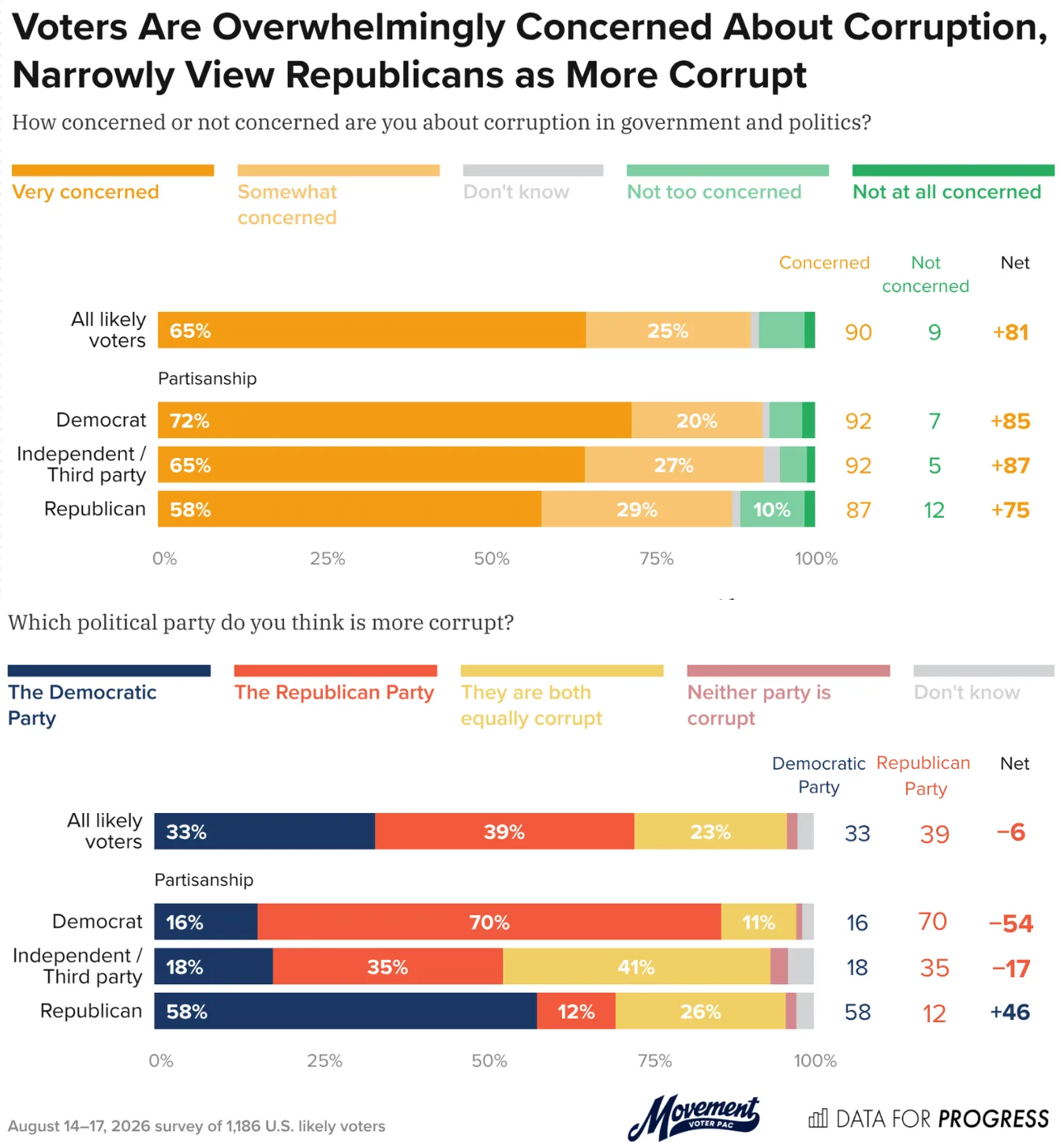
Graphic: Data for Progress
Interviewees also flagged smaller-dollar "scam PACs" that solicit donors with spam, which several described as a distinct problem that blends into a denigration of trust across the Democratic space. Our polling confirms that our target voters agree: Democrats and Democratic-leaning independents show a 78% majority favoring a crackdown on misleading fundraising appeals.
In particularly egregious cases, these “spam and scam PACs” target elderly donors and pocket the money. We observed a widespread recognition that some firms are quite plainly in the business of ripping the American people off — which is fundamentally misaligned with our goals and values as the Democratic Party — but no one seems to know quite what to do about it.
“I’m a political scientist who studies money in politics, but I’m also a lifelong Democrat. I believe my party is doing itself a disservice by following Republicans down this dark path. Winning back the House this year on the back of Donald Trump’s unpopularity would not be enough. We need a party capable of sustaining a durable majority to force authoritarianism into permanent retreat, a party that commands genuine enthusiasm and broad public trust. This fundraising model is not the way to build it.” — Adam Bonica, “Hook and Squeeze”
Notably, ActBlue has taken steps to crack down on this practice, but there is more work to do. This is an urgent priority to restore trust in the Democratic brand.
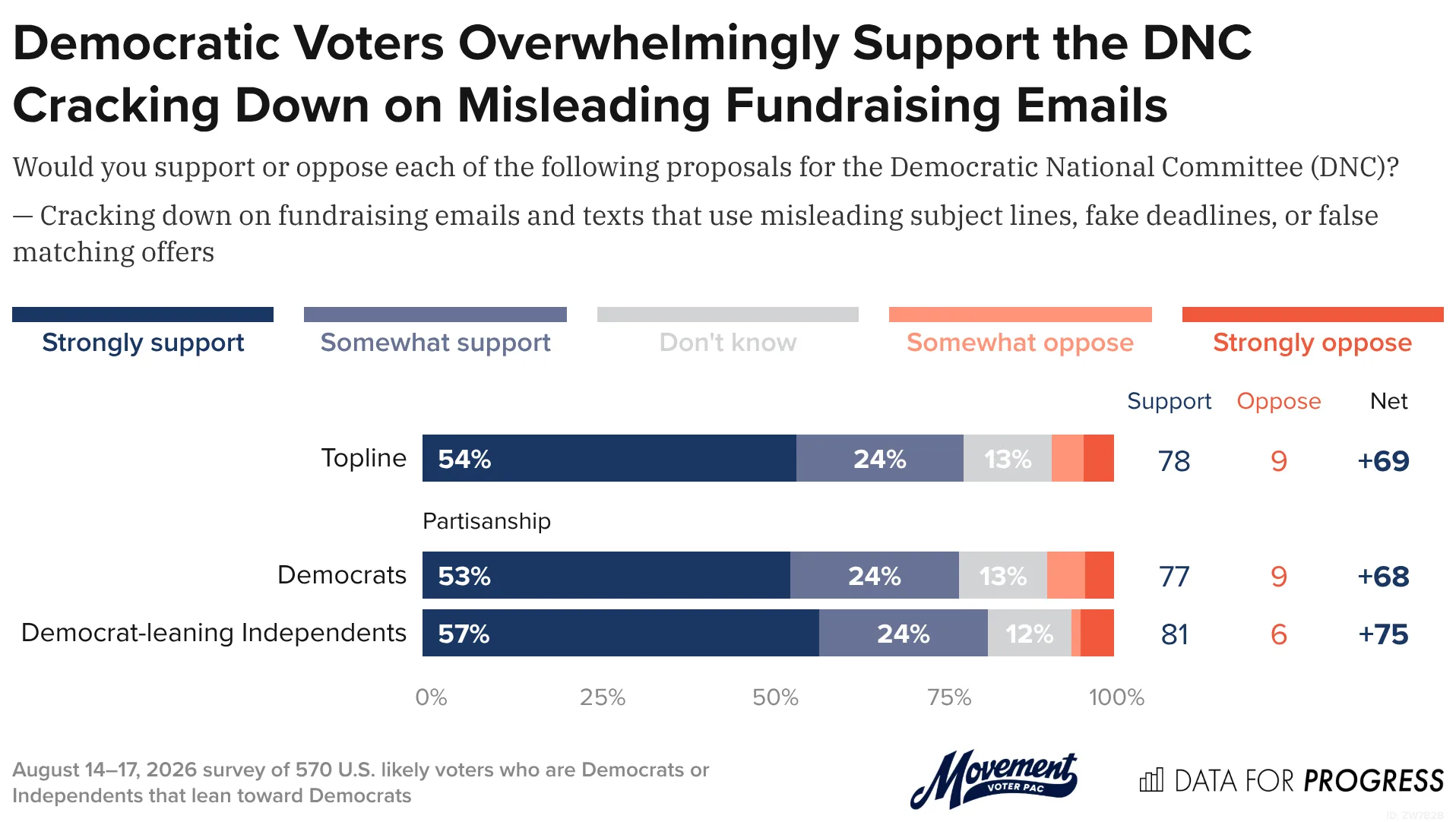
Graphic: Data for Progress
A third area of focus is the consultant network that serves the party and most prominent committees and PACs. Some of the largest and most “trusted” Democratic firms are now owned by Private Equity; their motive is the rate of return of those private investors, not winning for Democrats or delivering on our agenda. This misaligned incentive structure is at the heart of the concerns echoed by nearly everyone we interviewed.
It is not uncommon for less than 50 cents of every donor dollar to go to voter contact or communications.
Interviewees described vendors obscuring fees through layered transactions, a “shiny object” donor culture that keeps rewarding the same firms regardless of results, and a pattern of limited accountability for underperformance. One veteran organizer described watching “five firms get paid on a single program,” calling it “over consulting” and “rent seeking.” The result is that it is not uncommon for less than 50 cents of every donor dollar to go to voter contact or communications.
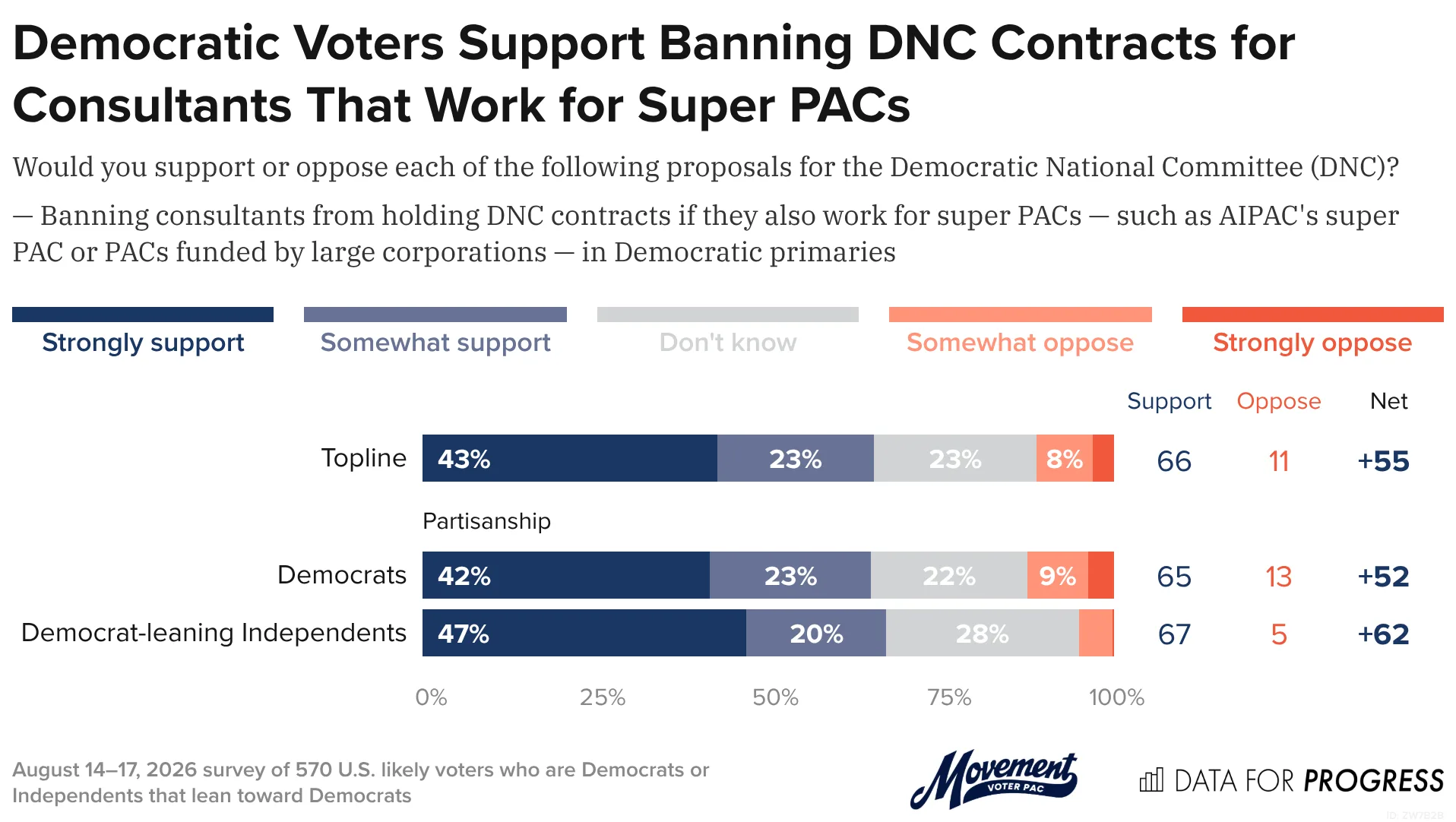
Graphic: Data for Progress
In the worst cases, most of the money goes to consultants. Interviewees described a network of political infrastructure that is, in their account, opaque by design, and several said that opacity is itself part of the problem. This came up unprompted in a large share of our conversations.
Graphic: Data for Progress
Interviewees described outside PAC spending in Democratic primaries — sometimes financed by AI, crypto, AIPAC, and other big-money and often right-wing interests — as a corrosive force that wastes money and even allows GOP-aligned money to influence the party's own nominating contests. The super PAC system has completely distorted the primary process, with record spending topping $180 million in Democratic primaries specifically as of late July 2026, split roughly across three networks — the crypto industry's Fairshake, two AI-focused PACs (Leading the Future and Public First Action), and AIPAC's United Democracy Project.
“It is absurd that they [billionaire-funded super PACs] spend tens of millions of dollars to try to determine who the Democratic nominee is and, if they fail, then proceed to support the Republican candidate in the general election.”
— Senator Bernie Sanders, The Hill (August 9, 2026)
Dismay at the role of super PACs in Democratic politics was widespread, including the sense that in 2026, “You can’t run for Congress anymore without your own Super PAC in the primary.”
Party committees do not control the behavior of independent super PACs, donors, or elected officials. To be clear: No one claims that all outside spending is inherently corrupt. At the same time, most agree that Democrats as a whole can set and enforce higher standards for the conduct the party does control — its own committees' contracts — and can press for accountability from elected officials, consultants, and vendors alike. And we must. All of us can make decisions about standards for contracting and send a message about conduct that is expected, or disfavored.
GAIN Power is a professional network and platform for the pro-democracy workforce: operatives, organizers, fundraisers, communicators, and technologists who power progressive campaigns and causes. GAIN is building the first review-driven marketplace for political consulting and technology, which will connect campaigns and organizations with vetted consultants and vendors so the movement can find the right partners faster and build power that lasts.
Campaigns and supporters need better ways to access information to evaluate who to send money to and work with. We hope these and other projects will strengthen shared ethical standards.
Stanford political scientist Adam Bonica has published two data-driven investigations on his Substack “On Data and Democracy,” documenting the scale of Democratic “scam PAC” fundraising. His August 2025 report, “The Mothership Vortex,” found that PACs tied to the consulting firm Mothership Strategies raised $678 million from individual donors since 2018 but delivered just $11 million — 1.6 percent — to actual candidates and party committees.
Spam PACs have raised $1.4 billion since 2017.
His August 2026 follow-up, “Hook and Squeeze,” analyzed more than 300 million FEC donation records and found that spam PACs have raised $1.4 billion since 2017, disproportionately from a small pool of roughly 138,000 donors averaging age 75, while Democratic fundraising costs overall ballooned from 8 cents per dollar raised in 2008 to more than 50 cents by 2024.
Bonica’s research, which reportedly informed the DNC’s own 2024 post-election review that was never published, puts hard numbers behind the argument that ending predatory small-dollar fundraising practices is a corruption problem the party must confront from within.
Trust cannot be repaired by renting attention with advertising. People need to experience Democrats actually helping their communities, in ways they can see and feel and understand. Right now, Democrats are a party that messages at people, rather than doing things for people.
Trust cannot be repaired by renting attention with advertising.
Actions speak louder than words. That is what rebuilds trust over time. Campaigns, committees, party structures, and outside groups can all champion this shift directly, and it is one of the least expensive, most immediately achievable strategies in this report.
Graphic: Data for Progress
Democratic leaders being in more frequent and organic conversation with constituents — not just consultants and lobbyists — will also self-correct many of our challenges that distort our agenda and message. Too much of the Democratic ecosystem is optimized for short-term transactions rather than long-term trust and power: raise money, rent attention, run the election, then disperse and disappear, rather than listen, serve, organize, lead, and build power year-round.
While this shift is part of a larger drift of our society away from civic life, third places, and political engagement as part of social institutions, we have to take it on.
“You can't repair trust by buying it with advertising. People need to experience Democrats actually helping their communities.”
— Anonymous interviewee
Interviewees described a party that talks to voters mostly through paid media and almost never through direct, structured listening–outside of consultant-run focus groups.
Others emphasized that constituent service is itself a campaign message: showing up to help a family with a medical debt problem or a disaster recovery effort tells a more convincing story about a party’s values than anything money can buy. The polling bears this out: candidates who personally help with disaster preparedness and recovery earn a +72 net in likely support, the single strongest predictor tested in our poll.
“Strong and visible constituent service is not separate from messaging. It is the message.”
— Anonymous interviewee
At the local and state levels, this kind of delivery is often most visible and most achievable in the near term. Helping navigate small-business licensing, landlord-tenant disputes, utility shutoffs, and unemployment or benefits systems as material, local and state-level services that are within elected officials' and party organizations' reach.
Not every elected official is destined to become a telegenic digital superstar, but this emerging training program will help them think creatively about local communication: which partners to consider (Reddit moderators, content creators, Facebook groups), as well as how new storytelling approaches can help them pass legislation, win reelection, and build lasting change in their communities. Partnering with Elijah Fox — the Communications Director who prototyped Mayor Mamdani's approach with Councilmember Chi Osse — the Pothole Politics team has developed a day-long training to help our electeds and their staff rethink how they engage with the public.
Down Home North Carolina is a member-led organization building power with poor and working-class people in North Carolina's small towns and rural communities. It enters each new county with a structured “listening canvass,” collecting surveys at Department of Social Services offices, Walmart, and food banks.
Make the Road Action NJ worked with families, elected leaders, demonstrators, and others to support immigrants detained at Delaney Hall, raising the profile of ICE impacts on New Jersey’s working families. Just prior to her visit to Delaney Hall, Governor Sherrill announced that New Jersey would fully fund the state’s Detention and Deportation Defense Initiative, which provides legal services for people detained by ICE — a massive victory catalyzed at least in part by MRA NJ’s advocacy.
Siembra NC is focused on defending communities from abusive employers, landlords, ICE, and bad políticos. Siembra’s strategy is to achieve el buen vivir and dignity for communities by recruiting thousands of Latinos to fight to win a true multiracial democracy. Siembra takes wage-theft cases and won over $280,000 in returned stolen wages for workers in 2025.
The Progressive Caucus Action Fund has held town halls in districts represented by Republicans, working with partners to highlight the harms of the 2025 federal budget law and offer progressive alternatives.
Through thousands of surveys, 1:1 conversations, and focus groups, RLP-250 is exploring how rural Republican and independent community members and leaders are thinking about authoritarianism and democracy as the country turns 250. The findings point to potential trends that we believe are important, especially around attitudes on authoritarianism and what it might take to move people who are Republican and/or independent-identified to stand against it.
The Rural Urban Bridge Initiative works to repair the rural-urban divide through direct, respectful engagement rather than top-down messaging. Its Community Works chapters partner with local civic groups, churches, and schools to build trust and address concrete needs in rural and small-town communities, while its trainings teach organizers to run issue-based campaigns. The group also co-authored the Rural New Deal, a policy blueprint for rural economic prosperity, with Progressive Democrats of America.
Interviewees across the ideological spectrum, from DSA organizers to establishment operatives, raised this theme time and again without prompting. Many said voters do not trust Democrats to deliver on the economy, and that generic “affordability” messaging is not breaking through or closing that gap. We don’t have a clear message, and even if we did, we’re not set up to spread that message in a way that will be trusted. Everyone is concerned about this.
Generic “affordability” messaging is not breaking through.
Across interviews, the critique of Democratic economic messaging was strikingly consistent regardless of ideology: the party talks about affordability in the abstract, without naming who is responsible or offering anything concrete enough for a voter to repeat to a neighbor, and isn’t pumping the algorithm with an economic message in the way the Republicans are.
Several interviewees pointed to Zohran Mamdani's working-class platform in the 2025 New York City mayoral primary, built on concrete commitments like faster and free buses, a rent freeze, and universal childcare, as one model for translating economic populism into language people can understand and repeat.
“Candidates are running on affordability, but it sounds like a Memorial Day sale. It's not landing.”
“Mamdani's approach was that his policies on cost of living were simple and concrete enough for people to understand and repeat: faster and free buses, freeze the rent, universal childcare, lower grocery costs. He named an everyday problem and had a solution.”
— Anonymous interviewees
The DNC is not positioned to author policy on its own, but through the primary process and its convening role, it can help lead an economic story: one that names the problem plainly and offers concrete commitments rather than vague assurances. The strikingly common thread named was not a single ideology, but specificity, a fighting posture, and clarity about the structural problem: concentrated wealth and corporate power. The polling agrees: 67% of voters say big corporations and wealthy people have too much power over the economy.
67% of voters say big corporations and wealthy people have too much power over the economy.
Graphic: Data for Progress
The New Affordability Agenda is a 10-bill legislative package modeled on the 1994 Republican Contract with America. Led by CPC Chair Greg Casar, it serves as a midterm roadmap focused on lowering everyday living costs for working families. This is the kind of legislation that speaks louder than words.
Graphic: Data for Progress
More Perfect Union (MPU) is an Emmy-winning nonprofit newsroom founded in 2021 to “build power for the working class,” pairing video-driven reporting on labor issues and corporate power with advocacy campaigns. In April 2026, MPU launched More Perfect University, a national campus initiative built explicitly as a progressive counterweight to Turning Point USA. Its reach and reception show the appetite for unapologetic economic-populist storytelling.
Iowa Creator Corps is a new initiative to empower aspiring, Iowa-based social media creators in their efforts to build a more progressive and prosperous Iowa. The project provides tools, resources, training, and a sense of community to local creators to help them build their own brands and produce fact-based, pro-democracy content that will spread across Iowa social media.
“We either want to invest in a romantic notion that all change happens ‘on the ground’ or in highly controlled short-term transactions right before elections (like the billions the Democratic Party blew through in 2024). But neither of these strategies alone builds trust and sustains influence in the places where most people make meaning today.
“I don’t think we can survive if we continue to ignore the reality of an algorithmic media environment that shapes what we see, who we hear, and, in turn, what we believe. Staying stuck in the old strategies is the only way we know for sure we will lose.”
— Andre Banks, “Can Progressive Comms Conquer the Feed?”
Across the country, local governments are advancing the most innovative solutions to our biggest problems and creating new models of governance. Founded in 2012, Local Progress has built a powerful, member-led network of local leaders — mayors, district attorneys, county commissioners, city councilmembers, and school board members — representing major cities, growing suburbs, and rural communities.
Groundwork Collaborative researches and communicates the link between concentrated corporate power and everyday economic pain, aiming to build public power and broadly shared prosperity. Groundwork’s research arms Democrats with the receipts needed to make a credible, bold economic-populist case to voters. The organization is widely credited with popularizing the “greedflation” framework connecting corporate profiteering to rising prices.
The Working Families Party's new handbook, Winning the Working Class, breaks down how to talk to the multiracial working class, which the party estimates makes up 63% of the electorate. Built on research from HIT Strategies and the Justice Research Collaborative, it maps seven voter clusters — from base supporters to persuadable swing voters — and pairs each with tested message frames.
Cost of living tops every cluster's concerns, and frames like Rigged Rules, Monopolies, and AI and the Future of Work perform best across the board.
The handbook also finds that “Working Families Democrats” outperforms “Democrats” as a call to action. Candidates, campaigners, and organizers can use the full message-frame library, cluster profiles, and voting-issue data to sharpen speeches, ads, mail, and scripts ahead of the elections.
Working Families Power is also offering training on the handbook and can connect partners to its voter data models — reach out at research@workingfamilies.org.
Young voters, and non-college young people in particular, are essential swing voters that the party is not yet treating as such, and several said the party's current posture is actively repelling this population. This needs urgent attention and investment, along with structural and cultural change within Party institutions.
Multiple interviewees also described generational leadership as a structural power problem: party committee members, elected officials, and the party's most visible figures skew considerably older than the voters the party most needs to win back, and several interviewees said the party's decisions in 2024 reinforced a perception that younger Americans have limited standing in Democratic leadership. This needs to change.
Voters agree: among Democrats and Democratic-leaning independents, 81% support giving young people real representation on party committees — one of our strongest consensus findings.
Graphic: Data for Progress
Graphic: Data for Progress
Graphic: Data for Progress
Graphic: Data for Progress
Donors can commit multi-year funding to youth organizing now; party institutions control the bylaws that determine who holds real power in the party. A durable Democratic ecosystem by 2028 needs young leaders with real authority today, not advisory roles they age out of.
Interviewees described a widening generational gap in Democratic support, with the sharpest declines among younger voters and the widest gender gap concentrated in that generation.
“Non-college young people are essential swing voters. We are not treating them that way, and in some cases we are actively repelling this population.”
— Anonymous interviewee
A durable Democratic ecosystem by 2028 needs young leaders with real authority today.
Interviewees also described a structural, not just a persuasion, problem: campus organizing infrastructure has, in their account, shrunk since 2022, while conservative-aligned youth organizing groups have expanded into the spaces Democrats vacated. One interviewee described training youth organizers in Pennsylvania to listen to young voters directly, and reported that a large majority wanted to talk about the economy and job prospects rather than the issues liberal donors wanted: climate, abortion, or gun safety. And, non-college young people came up repeatedly and specifically: interviewees said this group is often treated as an afterthought relative to college-affiliated youth organizing, despite representing a large share of the electorate.
Blue Future trains and invests directly in student leaders, building a leadership pipeline and helping progressive Democrats win elections. Blue Future raises and gives money to student leaders who create and mobilize a base of volunteers to expand voter contact efforts in key Congressional districts. Blue Future is a project of the Youth Progressive Action Catalyst (YPAC).
Sunrise Movement is building a movement of young people to end billionaire rule and stop the climate crisis. Sunrise provides young people with strong organizing support and innovative strategies to get involved in political change. Sunrise believes we cannot win democratic climate action without protecting our democracy, and that means opposing Trump’s authoritarian outreach and serving the key role young people have always served in challenging authoritarians.
Youth organizing and investment in young voters is chronically and severely underfunded. To address this, we need an Apollo Project-level commitment to invest in young people. Here are some well-established and newer efforts to reach young voters:
Our interviewees shared tech and field challenges as two sides of the same coin of effective voter contact. Democrats cannot fall behind again on the next generation of data and organizing tools the way it did on digital media in the previous decade.
Several reviewers pushed us to distinguish two key goals: rebuilding relational, field-based organizing capacity, and building or governing shared technology infrastructure. These require different actors, timelines, and investments, so we treat them as two clearly distinguished goal sets under one strategy of having the right conversations with the right voters.
Graphic: Data for Progress
Interviewees described a need to rebuild field and relational organizing capacity that has dwindled since 2008. The conventional wisdom in much of the consultant class that “field doesn’t work” has become self-fulfilling, since field has been under-invested in, and therefore, “doesn't work.”
Interviewees cautioned that the focus on new media could further erode resources dedicated to making in-person connections and having persuasive conversations with voters where they live. Most agreed that a 360 approach is needed: targeting voters in the online spaces where they spend their time, via text, and through targeted ads – while also still reaching out in-person through more traditional community engagement activities that some operatives feel can carry more weight in an increasingly disconnected online-first world. Our polling backs the in-person case: Candidates who hold regular town halls and public meetings earn a +59 net in likely support.
There was a sense across interviews that organizing is becoming a “lost art,” and progressives must return to the fundamentals of building a welcoming culture and giving an expanding group of voters a sense of belonging and connection through old-fashioned conversations, community gatherings, and “third spaces.” Several conversations brought up programs on the right to create communities online that also have an in-person event experience that connects people to each other to make like-minded friends and find a sense of belonging, such as Turning Point.
Better data tools do not make up for trained organizers doing sustained, in-person, and relational work in communities.
Several interviewees stressed that better data tools do not make up for trained organizers doing sustained, in-person, and relational work in communities, especially working-class, Latine, Black, immigrant, and non-college youth communities that reviewers emphasized are still underinvested in relative to their electoral importance. It was also noted that organizing training and career pathway programs for organizers need more attention and investment, and that early-career operatives entering the campaign world have little to no experience with the hard knocks of voter outreach, making staffing organizing operations challenging.
Battleground Alliance is a bold new coalition of national and local groups, organizing in all the top swing districts to flip the House in 2026 — and build local power to keep those seats for the long term.
Battleground Alliance’s Know Your Neighbor (KYN) program is a precinct captain-type relational organizing initiative rooted in building community power. The program supports partner organizations in recruiting, training, and mobilizing volunteers at scale using relational organizing tools. Volunteers build relationships with neighbors by sharing personal stories and how policies affect them and their families. High-performing volunteers are encouraged to become neighborhood leaders and recruit others, multiplying organizing power.
Addition Action reaches working-class people who are largely disengaged from the progressive movement, and organizes with them around the issues that affect their lives. They engage in elections that have an outsized impact on the direction of the country and bring working-class people into civic life. They also build long-term organizing infrastructure outside of elections, to engage working-class people who don’t always see themselves on the progressive left.
One of their incubated projects, With Many Hands, organizes working-class New Mexicans around affordability issues. In communities with an average income under $55,000 a year, working people who have largely been excluded from policy decisions join with neighbors to find solutions to local problems. With Many Hands then leverages those solutions towards increased civic engagement.
The Ohio Organizing Collaborative (OOC) is a statewide coalition, founded in 2007, that unites community organizing groups, faith institutions, labor unions, and policy organizations across Ohio to build power for racial, social, and economic justice.
OOC has pioneered large-scale relational organizing, reaching low-propensity and nonvoters through the networks of trusted messengers; an Analyst Institute partnership found that its relational program drove a 3.8-percentage-point turnout increase among infrequent voters, far outpacing traditional tactics.
The organization has registered more than 250,000 Ohioans to vote since 2012 and continues to run year-round field and civic-engagement programs rather than episodic election-year pushes. OOC’s model demonstrates the sustained, relationship-based organizational infrastructure.
Interviewees offered sharply different, sometimes contradictory, assessments of where the real technology gap lies. Some described the party's core voter file tool, NGP VAN/Votebuilder, as outdated after roughly two decades of near-monopoly use, contrasting it with a newer Republican-aligned competitor, i360, built in 2014. Others argued VAN remains adequate for turf and list management and that the more urgent unmet need is a digital community tool for online organizing and conversation-tracking, not a new voter file system per se.
However, there is broad agreement that the tools campaigns used in the 2008 era are no longer sufficient on their own and that 2028 will likely bring major innovations in how we use technology in campaigns.
“The party fell behind once already on digital media. We cannot let that happen again in the next generation of AI and data tools.”
— Anonymous interviewee
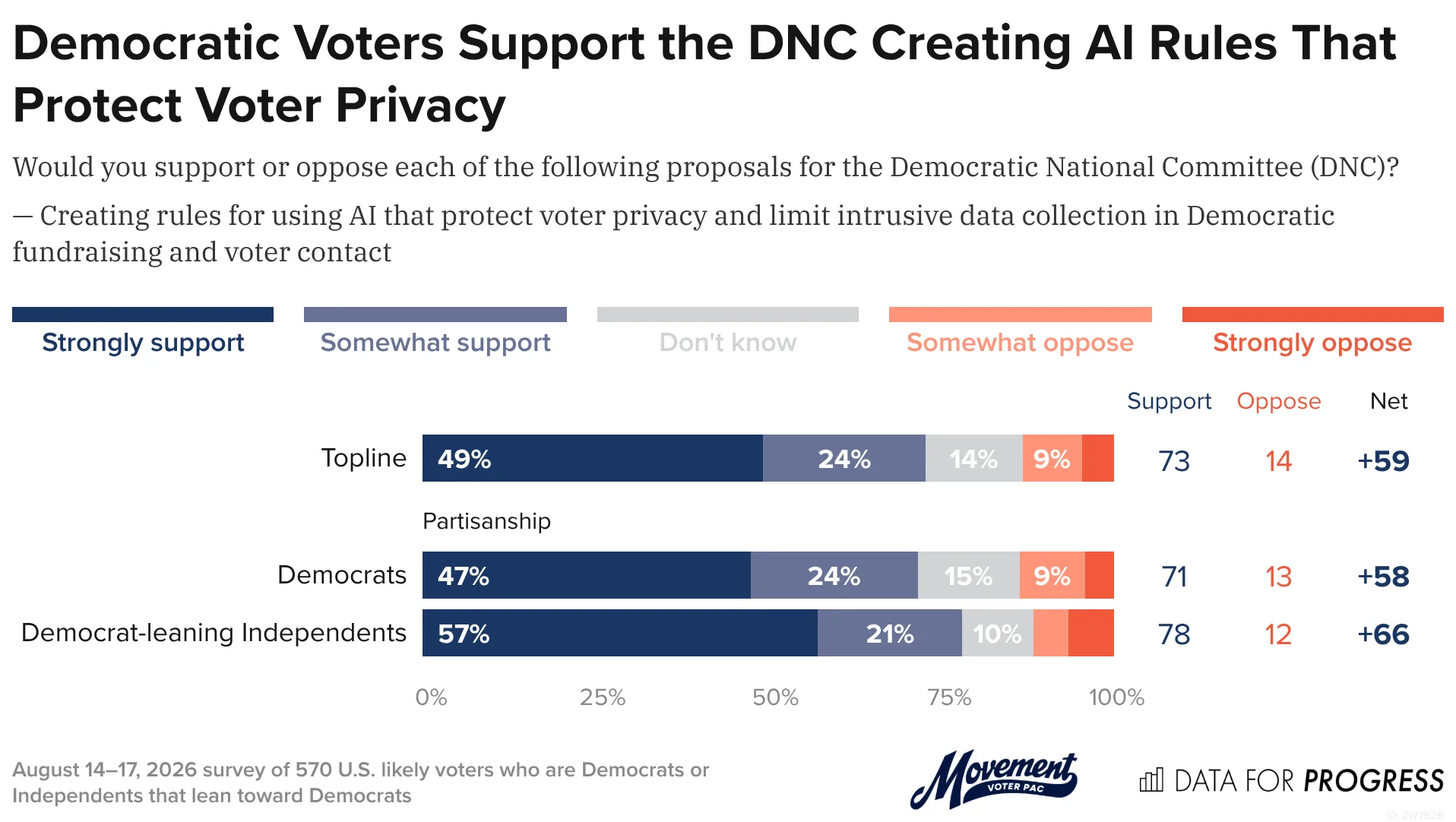
Interviewees said the DNC has not issued formal guidance on AI use with the voter file, despite requests from data and technology vendors who use the data, and that this is creating uncertainty about the rules of the road across the ecosystem heading into the cycle. There is concern that if this isn’t resolved, the primacy of the voter file may be supplanted by other actors, creating a more fragmented data set for Democrats.
Graphic: Data for Progress
The Movement Cooperative (TMC) is a member-led organization that pools progressive groups' collective buying power to provide shared data, technology, and resources. TMC supports almost 90 national and state-based members and more than 1,400 affiliates, and in 2025 commissioned work on the “Next Generation” of voter contact platforms. Since its founding in 2018, TMC has grown from a handful of founding organizations into a cooperative of more than 90 national and state-based partner organizations and over 1,400 affiliated groups, each with a voice in shaping shared data and technology infrastructure that supports ground game organizing.
In a July 2026 interview with the Tides Foundation, CEO Julia Barnes described how member ownership deepens alignment across partners and frees organizations to focus on strategy, relationships, and community impact rather than duplicating back-end systems. TMC also offers coaching and house-meeting training that helps participants put those skills into practice. Its recent Door Knocking Bootcamps and in-person trainings in swing districts show what this approach can look like on the doors: practical preparation, real conversations across political differences, volunteer recruitment, and a focus on persuasion rather than mobilization alone.
This is the kind of long-term field capacity the Democratic ecosystem needs to rebuild trust, grow local leadership, and engage people well before the final weeks of an election.
MVP's Capacity Building Program gives grantee partners free or discounted access to organizing technology, voter data, and hands-on support, including tools such as OpenField, Empower, Periscope, HubDialer, Action Network, and resources available through The Movement Cooperative. Additionally, MVP offers coaching and a tech tool help desk available to all partners.
Higher Ground Labs (HGL) is a venture fund and accelerator founded in 2017 that has invested more than $50 million across four funds into more than 70 progressive political-technology startups, including widely used tools like BallotReady and Mobilize.
In April 2026, HGL launched Fund V, which prioritizes next-generation campaign technology, civic tech that strengthens democratic capacity, and follow-on investment in proven organizing infrastructure. Recent investments include RivalMind AI, a political intelligence and research platform, and BattlegroundAI, an AI-assisted advertising tool built for Democratic campaigns.
There was a surprising amount of agreement across ideological lines that if Democrats are the party of “going back to what was,” we will continue to lose support. Democrats need to offer more than opposition to Trump, and cannot be the party seen as trying to protect or restore a system that most Americans are rejecting as rigged. In order to beat back corruption, fix the economy, and govern so that things work for regular people, not just corporations and billionaires, we need to un-rig the rules that have for decades been stacking against us.
“Democrats need to offer more than opposition to Trump, and we can not be the party trying to protect or restore a system that the American People are rejecting as rigged.”
— Anonymous interviewee
Notably, in the midst of our project, the Supreme Court issued its opinion in Callais, leading to a frenzied redrawing of congressional voting district maps to dilute the power of Black voters, with no way to challenge new maps under Section 2’s now-voided civil rights protections.
We need to un-rig the rules that have for decades been stacking against us.
This came up repeatedly in our conversations as a crisis with deep and lasting impacts that had not fully been grappled with by national Democratic leaders. The consistent viewpoint was that this was the culmination of decades of chipping away at the bedrock of civil rights legislation and Black political power in America.
Operatives shared that their pleas to take this threat seriously had not been heard on high, that the fallout will be enormous and far-reaching, and the remedies we need are more than simply reinstating Section 2.
As Rachel Rossi, President of Alliance for Justice, said: “We are left to wonder if the Fifteenth Amendment is even enforceable … We must face the reality that this Court cannot be trusted to uphold the Constitution and steel ourselves to enact reforms that will course-correct the third branch for the sake of our democracy.”
Graphic: Data for Progress
Our agenda must be synonymous with a government that is responsive to the people, supporting rule changes that allow for voters to decide their own leaders, and incentives that ensure elected leaders are accountable to the American people, not just the billionaire class. The Democratic Party can champion a bold reform agenda that is not only trying to put things back to a broken status quo, but actively combating corruption and offering voters more choice and more voice.
“Public financing for elections … Open up a multi-party system … Use the popular vote … Ethics reforms … We have to go even bolder than they did with Project 2025.”
“We need major federal legislation to ban and bar unlimited use of private wealth to buy our government — full stop.”
— Anonymous interviewees
Some of our interviewees rightly cautioned against campaigning on a long list of specific (and somewhat obtuse) bold structural changes, while others point to Project 2025 as a corollary that helped Republicans align behind a big agenda that was launched on Day 1.
Across these points of view, however, nearly all shared a strong sense that the pre-2024 status quo is over, and that Democrats must offer something boldly different and commensurate with the level of disruptive change the American people are asking for — an un-rigging of the system.
Our polling points to where to start: term limits for Congress and the Senate are the single most popular structural reform we tested, with 82% support.
Only eight states allow fusion candidacies, though it was once legal nationwide. The Center for Ballot Freedom is working to revive fusion voting state by state through legislation, litigation, and ballot initiatives. Fusion voting is an alternative to a winner-take-all system, allowing independent-minded voters to participate constructively without triggering “spoiler” dynamics. Fusion voting could allow Democrats to build more powerful coalitions, especially in areas where voters favor independents and disfavor MAGA Republicans.
Fair Representation in Redistricting Action (FRRA) convenes funders working in pursuit of an equitable, multiracial democracy — which cannot be achieved without district maps that fairly represent communities of color and other underrepresented people and enable them to exercise their full political power. Redistricting is one of the most impactful ways communities build the political power needed to participate equitably in our democracy: It determines who our government is accountable to, whose voices get amplified, and whose get erased.
FRRA operates as a national funder collaborative, bringing together philanthropy, state-based organizations, and national experts in a nonpartisan effort to transform redistricting from a closed-door partisan power grab into a community-centered democratic process. It functions as the central coordinating table for this work, where strategy is aligned, intelligence is shared, and investments are directed across states and approaches for far greater impact than any one donor or organization could achieve alone.
Proportional representation is an electoral system based on a straightforward idea: Parties should win seats based on how many votes they receive. For example, a party that wins one-third of the votes should get about one-third of the seats. It is currently the most widely used voting system among democracies worldwide. Proportional Representation Hub coordinates the national movement to achieve proportional representation in the United States.
Graphic: Leadership Now Project
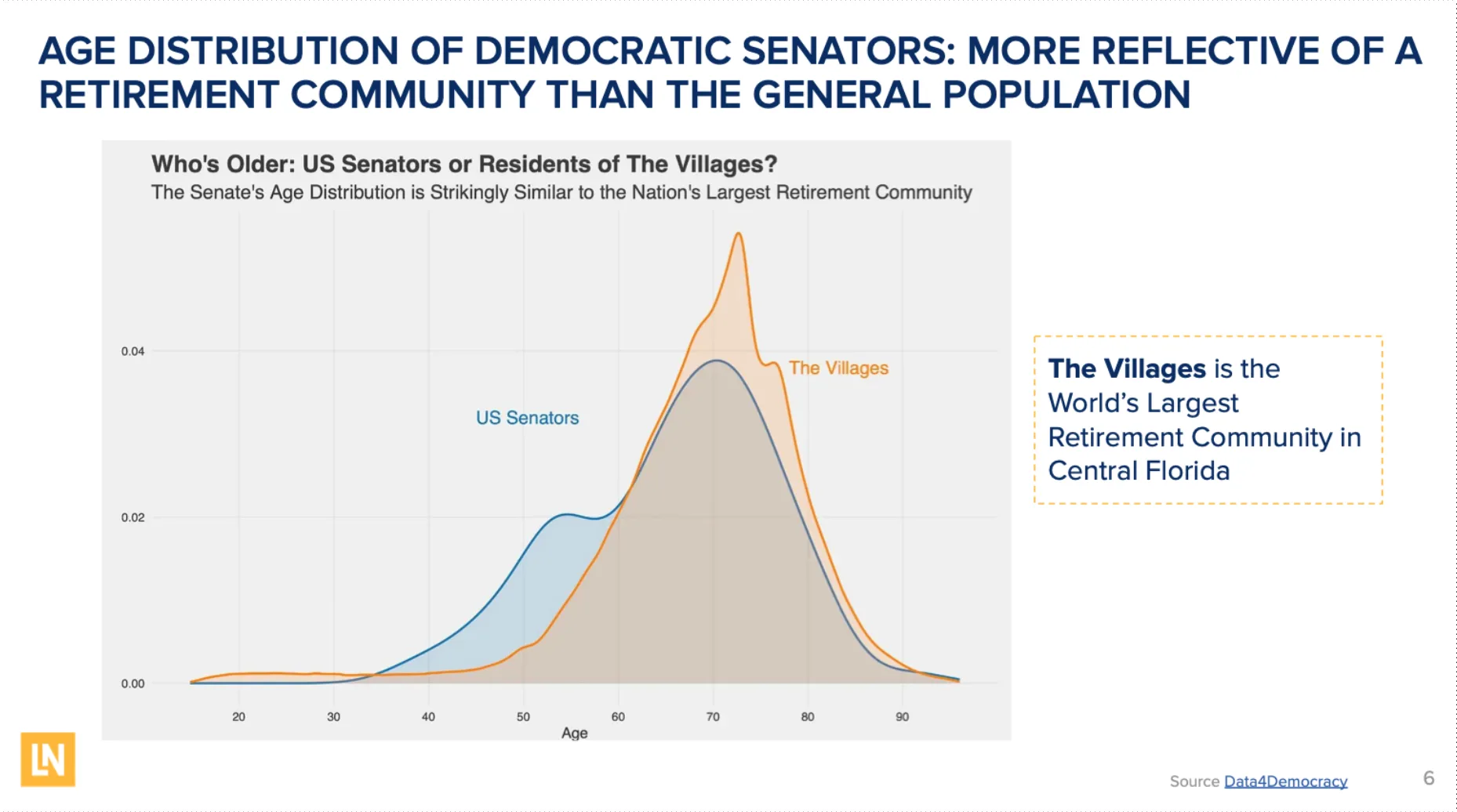
Leadership Now Project is a nonpartisan 501(c)(4) membership organization of business leaders, founded in 2017, that works to protect and renew American democracy. Its Congressional Tenure Analysis and Benchmarks report, published in July 2026, documents a generational gap in political leadership: By the 2026 midterms, the report finds, 35 House Democrats and 17 House Republicans will be over age 75, and nearly 20% of Democratic lawmakers are over 75, compared with 7% of Republican lawmakers and 10% of registered voters. Democrats also wait 44% longer than Republicans to reach committee leadership and then hold those posts more than twice as long, the report finds, and it recommends an eight-year cap on Democratic committee leadership terms and a norm against seeking reelection after age 75. Two-thirds of voters support congressional retirement at 75, per the report, and North Dakota voters approved a similar age cap for congressional candidates by 61% in 2024.
None of the other strategies can succeed at scale without a genuine alignment between the party's formal structures and the independent organizations operating alongside it.
Minnesota came up unprompted, over and over, as the clearest working proof of concept for inside-outside collaboration done well. Interviewees who worked directly on the Minnesota model described a genuine, trust-based partnership: a strong state party, independent faith and community organizations, labor, and grassroots power all pulling in the same direction, producing what has been dubbed “The Minnesota Miracle” of legislative wins. Reviewers with direct knowledge of Minnesota politics cautioned us that conditions there have shifted now and nothing is all roses...but all agreed there are things to learn about building a successful infrastructure and collaborative coalition building from the approach in Minnesota. Crucially, interviewees credited this to political leadership choosing to see outside organizations as an asset rather than a liability, or as one Pennsylvania-focused strategist put it, “a thorn in their side.”
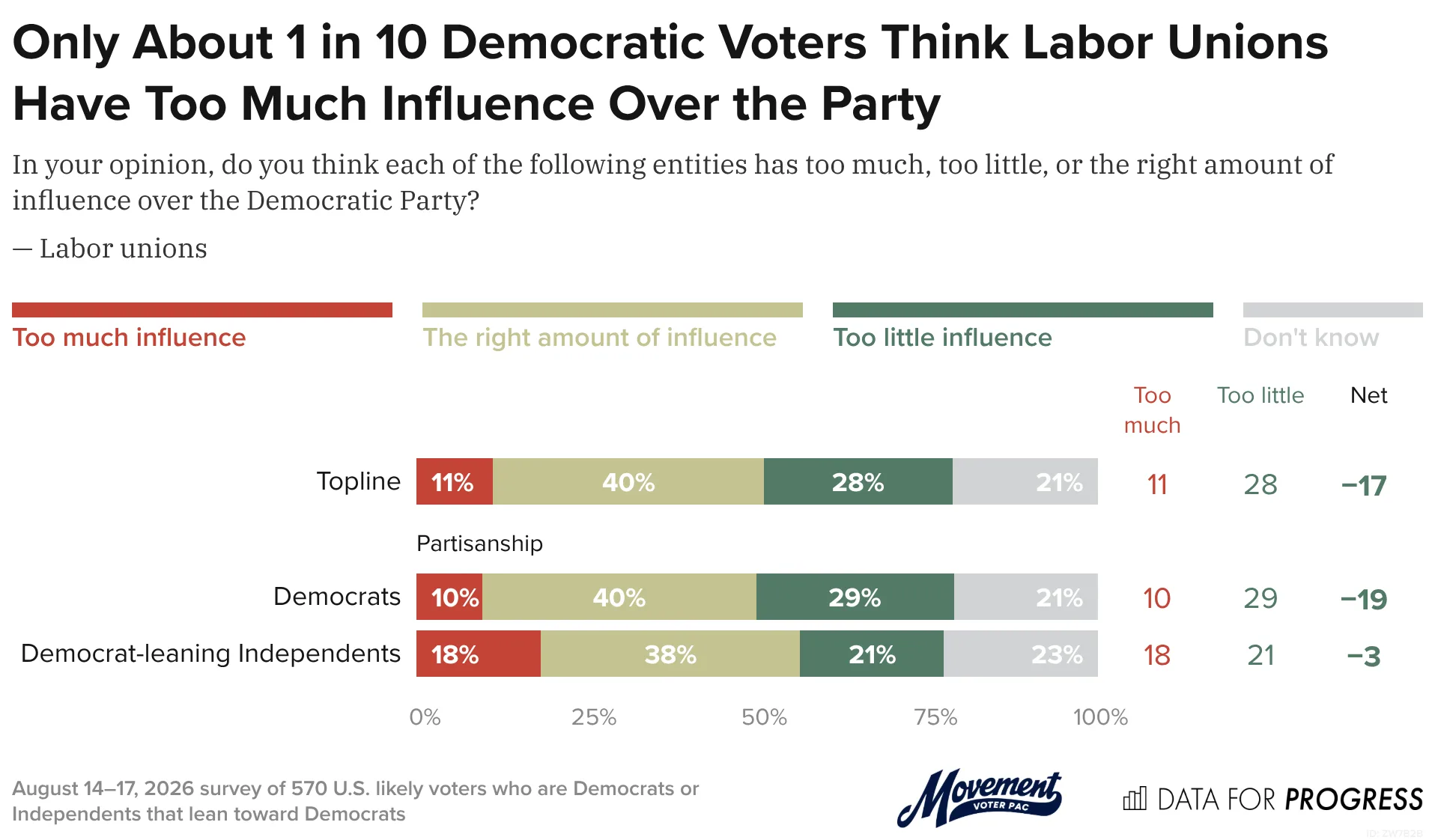
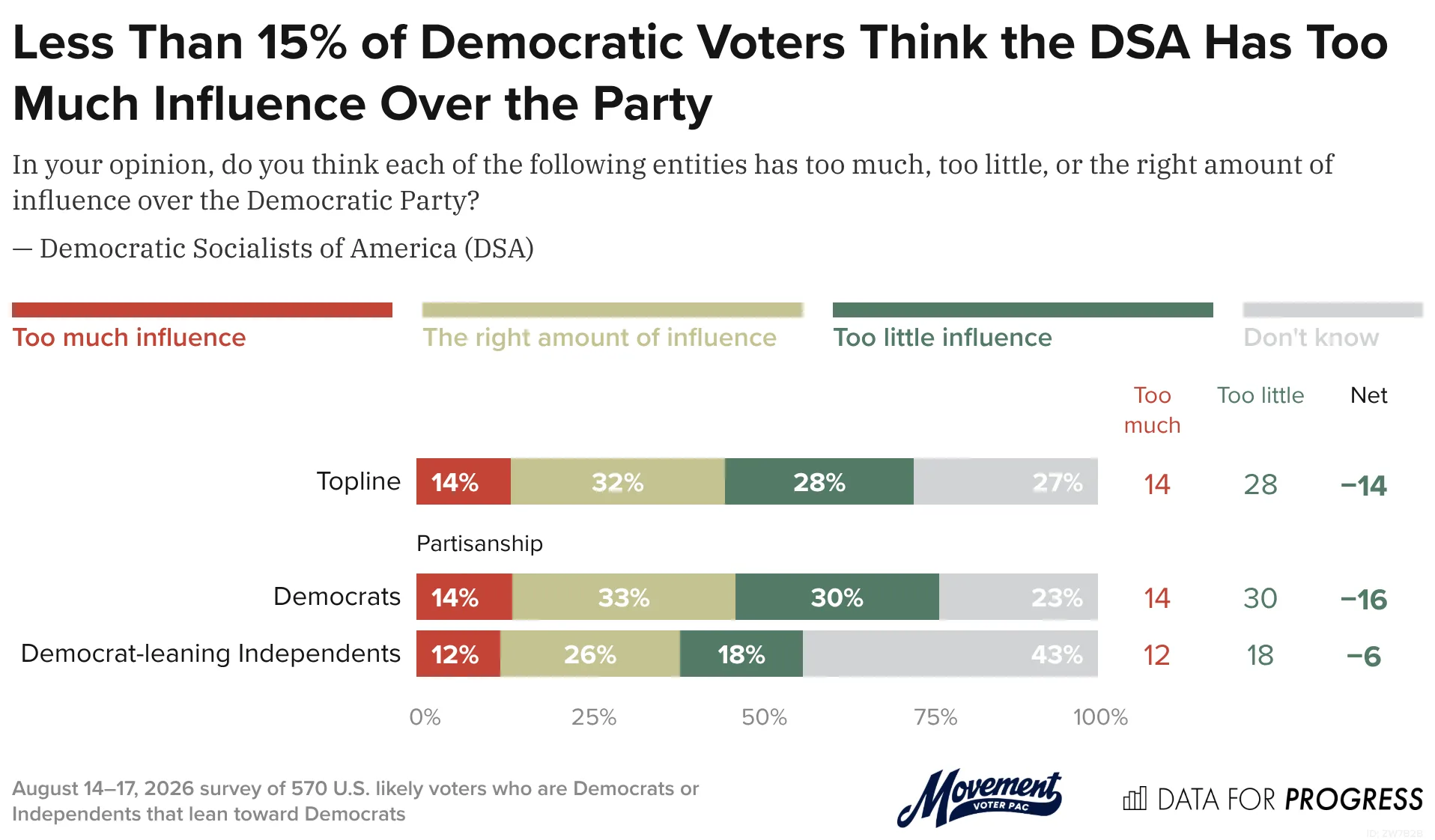
Interviewees across the spectrum described a need for Democrats to collaborate better with organizations, movements, and communities, to deliver tangible wins for working people. This is the strategy that ties the rest together; none of the other seven can succeed at scale without a genuine alignment between the party's formal structures and the independent organizations, unions, and movements operating alongside it. This is the theory of change in practice! Our polling shows why this matters: Democrats and Democratic-leaning independents say working-class Americans (net -51) and young people (net -44) have far too little influence over the party, while billionaires (net +43) and corporations (net +33) have far too much.
“Many Democratic leaders balk at bold policies under the best conditions, but Walz and the organizers who won the Minnesota Miracle did it despite the odds, turning a tight Democratic majority into concrete policy wins. Instead of going small, they seized the moment.
As Tim Walz himself said, ‘You don’t win elections to bank political capital. You win elections to burn political capital and improve lives.’ Imagine that approach on the federal level. Democrats can go big, opening the door to bold policies that meet the needs of this moment.”
— Sulma Arias and Analilia Mejia, “Democrats Must Go Big; the Minnesota Miracle Shows Them How”
And we have new opportunities to build this kind of collaborative approach. Interviewees pointed to the 2024 FEC opinion finding that literature and scripts for a paid door-to-door canvass are not “public communications,” so the costs of producing and distributing them are not coordinated communications or coordinated expenditures, even where the group consults federal candidates and party committees about the program. (Note: This report does not constitute legal advice. No campaign, committee, or organization should change its coordination practices based on this section without its own counsel's review of current law.)
Treat outside organizations as partners with standing, not threats to be managed.
Separately, in June 2026, the Supreme Court held in National Republican Senatorial Committee v. FEC that federal limits on political parties' coordinated spending with their own candidates are unconstitutional, opening the door to unlimited party-coordinated spending. The NRSC wasted no time folding up its independent expenditure arm to use NRSC itself as a centralized hub for GOP Senate coordinated spending. On the Democratic side, compliance experts are still parsing the decision and its full implications, but Rachel Jacobs, general counsel to the Democratic Congressional Campaign Committee, told Campaigns and Elections that “you’ll see some changes this cycle, but I think the full impact of this decision will truly be felt in 2028 and then in 2030.”
Republicans have already taken advantage of these narrow but important shifts in coordination rules, while Democrats largely have not. Now is the time.
Graphic: Data for Progress
Graphic: Data for Progress
Graphic: Data for Progress
Swing Left is a grassroots organization, founded in 2017, that has raised more than $40 million and mobilized tens of millions of voter contacts for competitive Democratic campaigns.
In 2025, it launched Ground Truth, a multimillion-dollar deep-canvassing program that expanded to 63 targeted House, Senate, and gubernatorial races by 2026 and pairs volunteer conversations with AI-assisted insight-sharing for campaigns.
In August 2026, Swing Left, the DNC, the Democratic Data Exchange, and the Association of State Democratic Committees struck a first-of-its-kind agreement to share voter-contact data in real time, building on a 2024 Federal Election Commission opinion that first allowed such coordination — a deal the DNC's chief technology officer credited as central to organizing “year-round.”
Credit is due to the DNC and Swing Left for forging this partnership — a blueprint we hope many more will follow.
States Win (formerly Sister District) was founded in 2017, at which time there were just six Democratic trifectas (states where Democrats control both legislative chambers and the governorship). Today, that number has more than doubled to 16. States Win is a national grassroots organization focused exclusively on building progressive power in state legislatures, getting bold Democrats elected to strategic state legislative seats that can shift the balance of power.
Every year, States Win’s deeply experienced political staff and robust network of volunteer teams become an extension of the local candidates’ campaigns, providing gold-standard political support, with guidance on a wide variety of specialties including field and fundraising plans, staff and consultant management, and communications and digital strategies — all free of charge.
Faith in Minnesota describes itself as a political home for people of faith working to create a new, people-centered politics in the state, operating as the 501(c)(4) electoral arm of the ISAIAH organizing federation. It is documented as an example of a legally structured division of labor, in which a 501(c)(3) organizing federation builds relationships and power while a 501(c)(4) arm organizes and advocates directly in elections.
We started this project because we believe this ecosystem — organizers, donors, elected officials, and party leaders alike — has real momentum to make change happen, and we wanted to help.
Everything in this report came from people already doing this work: state and county party chairs, campaign managers, organizers, pollsters, donors, consultants, and creators who took the time to talk with us honestly, often about things that were uncomfortable to say out loud. What they told us, again and again, is that this moment does not lack for good ideas. It has only lacked a clear, public commitment from leadership to act on the ideas already sitting on the table.
Each of us can change that, if we are willing.
“As we found in our first round of talking to voters who voted for Biden in 2020, then sat out 2024: fight, don't fold. Everything in these studies backs this up as the correct approach. Democrats don't need to move left or right. They need to learn the lessons and adopt some of the principles from the playbook Republicans and conservatives have been using for decades, and move towards strength.”
— Way to Win, Towards Strength, a post-2024 research summary
The theory of change we laid out at the start of this report is the thread running through all eight strategies presented: a more accountable party institution and durable, independent power are both necessary, and neither substitutes for the other. Party institutions, elected officials, donors, vendors and consultants, independent organizations, and voters and communities each carry a distinct piece of the work ahead. We are not under any illusion that these strategies are easy, or that the obstacles are not real. Some of this work is already underway and deserves to be accelerated, not restarted from scratch. Some of it will require political will that only sitting leadership can supply, and some of it will require donors and organizers to keep pushing, keep funding experiments, and keep showing up, even when it would be easier to disengage. Minnesota's experience, whatever its current strain, did not happen by accident, and no similar result will happen elsewhere by accident either.
A more accountable party institution and durable, independent power are both necessary.
This is the part where we ask you directly: Help us make this happen. If you are a donor, fund MVP's grantee partners and the organizations named in this report, and the hundreds more like them, doing the patient, year-round work of rebuilding trust from the ground up. If you are an organizer or a party official, tell us what we missed, and what you are already doing that deserves more attention than we gave it here. If you are a consultant or a vendor, help set the high-road standard this report calls for, rather than waiting to be forced into it. We are not claiming to speak for the whole Democratic Party, or for every organizer and organization in this ecosystem; we are one funder sharing what more than 100 conversations taught us, and asking you to test it against your own experience. Change will not make itself. It gets built, deliberately, by people who decide to act on the urgency of this moment, together, rather than waiting for someone else to go first.
We are ready to do that work with you. Let's work together to build the Democratic ecosystem we need, and that our country needs, starting now.
This report was prepared by Doyle Canning, Skyridge Strategies, with Nicole Derse, 50+1 Strategies, in close collaboration with the Movement Voter PAC team.
This report exists because more than 100 people across the Democratic ecosystem gave us their time, candor, and trust in sharing things that were not always easy to say. We are deeply grateful to every interviewee who spoke with our team — those named in this report and many more whose insights shaped our thinking even where we could not quote them directly, either because the conversation was off the record or because space did not allow us to include every voice.
Aaron Regunberg | Daniel Ramos | Julia Barnes | Reggie Bolding |
Aaron Strauss | Doran Schrantz | Kai Newkirk | Roger Lau |
Adam Green | Doyle Canning | Kate Catherall | Ross Morales Rocketto |
Adam Snipes | Eddy Morales | Kelly Byrne-Martin | Ruwa Romman |
Addisu Demissie | Eric Stern | Kiersten Iwai | Ryan O'Donnell |
Alana Mounce | Franco Caliz Aguilar | LaTosha Brown | Sam Cornale |
Alexandra Acker-Lyons | Gabe Tobias | Lauren Gepford | Sara El-Amine |
Alexis Acevedo | George Goehl | Lavora Barnes | Sara Schreiber |
Alison Zelman | Grecia Lima | Leah Greenberg | Sarah Flowers |
Amanda Litman | Greg Schultz | Leo Murrieta | Scott Anderson |
Amy Pritchard | Greg Speed | Linda Sarsour | Scott Goodstein |
Anathea Chino | Hans-Peter Beimann | Liz Walters | Shripal Shah |
Andrea Dew Steele | Heather Booth | Ludovic Blain | Shwetika Baijal |
Andrea Marta | Heidi Sieck | Maurice Mitchell | Stephanie Shriock |
Andrew Grossman | Hutch Hutchins | Melissa Morales | Stephanie Taylor |
Ben Reznik | Jamaa Bickley-King | Michael Frias | Susan Labandibar |
Ben Wikler | Jane Rayburn | Michael Gomez Daly | Teddy Landis |
Betsy Hoover | JB Poersch | Mike Lux | Terrance Woodbury |
Bob Fertik | Jen Fernandez Ancona | Mini Timmaraju | Tim Molina |
Brianna Brown | Jessica Floyd | Morgan Stahr | Wendi Wallace |
Carter Kalchik | Jessica Lovejoy | Nate Snyder | Yasmin Radjy |
Cathy Duvall | Joe Dinkin | Nick Guthman | Yoni Landau |
Celinda Lake | John Bisogano | Nicole Hensel | Zoe Stein |
Claire Sandberg | John Grabel | Quentin James | |
Cliff Albright | Josh Hendler | Rahna Epting | |
Dan Cantor | Joy Cushman | Rajan Narang |
We thank Nicole Derse of 50+1 Strategies, Doyle Canning of Skyridge Strategies, and members of the MVP team who conducted interviews, organized the survey process, and helped synthesize more than 150 ideas into this framework.
Finally, we thank the donors and community members across MVP's network who responded to our survey and made this listening process possible in the first place, and Chair Ken Martin and his team at the Democratic National Committee for engaging directly and in good faith with our findings.
Movement Voter Project funds local organizing and movement-building to shift culture, win power, and shape policy. Learn more at movement.vote.
If you ask 10 Democratic strategists what happened in 2024, you will hear several different, competing theories, each with valid evidence behind it. MVP does not claim to have found the single correct answer. This section draws on desk research and interviews MVP commissioned in 2025, in the immediate aftermath of the loss, and the internal memo we produced as part of our own internal “R&D year” devoted to understanding what happened and where we go from here.
“For every blue-collar Democrat we will lose in western Pennsylvania, we will pick up two or three moderate Republicans in the suburbs in Philadelphia, and you can repeat that in Ohio and Illinois and Wisconsin.” — Senator Chuck Schumer, 2016
“For Vice President Kamala Harris, the battleground picture is one of regression — a widespread failure to match Joe Biden’s 2020 performance, with her gains largely isolated to areas centered on the wealthier, college-educated white voters who increasingly make up her party’s backbone…The coalition that elected Trump in this election, it is younger, more blue collar, and more diverse than any Republican coalition in modern history…Trump is now winning incomes under 50 thousand dollars by 3 points.” — Steve Kornacki, 2024
In the aftermath of 2024, internal divisions in many cases felt more hardened than before, and the entire left-of-center political apparatus was still reckoning with the result. For progressive members of the MVP network, this reckoning was especially bitter: Many interviewees lamented that the party did not heed urgent calls for more investment in organizing and a laser-like focus on affordability and economic justice.
And, importantly, the elephant in the room: The party did not adequately address U.S. policy on unconditional military aid to Israel in worsening what many saw as a genocide in Gaza. The Uncommitted movement tried to bridge this divide by advocating for principled policy change, but was ultimately rebuffed — including in the DNC’s decision to reject even the most modest and symbolic of proposals to have a Palestinian-American Democratic activist speak at the Democratic National Convention in Chicago. Behind the scenes, organizers proposed a beautiful pairing of families of Israeli hostages alongside a Palestinian speaker, but this too was rejected, leaving Uncommitted leaders with little to persuade their constituents to vote for Kamala Harris.
Our research mapped at least seven prominent theories of the 2024 loss side by side, not because any one of them is proven, but because understanding this divided field is essential to building a common strategy across it. The table below presents these as named theories held by real constituencies in the party, not as MVP's own conclusions.
Theory | Narrative | Implied Strategy |
|---|---|---|
Bad Year, Global Headwinds | There was no big realignment, just bad luck. The United States was “part of a worldwide wave of anti-incumbent sentiment” that also unseated ruling parties after COVID-era inflation worldwide, and there was no way to beat those global headwinds. | Keep doing what we are doing; expect the pendulum to swing back. We are already overperforming again; do not worry. |
Class Re-Alignment | MAGA made real gains in multiracial and urban constituencies, eroding the coalition of working-class, youth, and affluent-liberal voters that used to hold together. The tables have turned. | Look to candidates who emphasized concrete cost-of-living concerns, who outperformed Harris in some swing states (e.g. AZ, MI). |
Original Sin | Biden's decision to run, and the Tapper-documented “cover-up” by his inner circle and the effective shutting down of a competitive primary, broke trust with voters. | Recruit younger candidates, challenge the party's gerontocracy, and run contested primaries with transparent processes and an even playing field. |
Skippers over Flippers | Lower-information 2020 voters stayed anti-Trump but were not motivated to vote for Harris, and thus stayed home. Gaza and cost of living were cited by some “Skippers” as primary reasons for tuning out. | Invest in persuasion, not just turnout, for Skipper-profile voters and give people a reason to show up. |
Cost of Living | Harris underperformed among lower-income voters; the campaign pivoted away from consistent focus on cost-of-living concerns toward abstract “democracy” messaging that didn’t land. | Build a concrete economic agenda that holds billionaires and special interests accountable. See Zohran Mamdani's NYC campaign, which won support in 2024 Trump precincts. |
New Media Ecosystem | Dems have allowed MAGA and conservatives to dominate the current algorithmic digital media environment, particularly the “manoverse.” We slept on YouTube and neglected the podcast circuit. | Invest in media properties, personalities, and digital persuasion; embrace new media and develop audiences beyond traditional news and politics; address the widening political gender gap through cultural interventions. |
Flawed Candidate | The 2024 nominee was an incumbent but also tried to represent change, so the message wasn’t clear, and the fact that she represented the status quo (e.g., “I wouldn’t change a thing”) was fatal. | Recruit a different kind of candidate — interpreted very differently by different factions within the party – but generally there is alignment that the candidate needs to represent change in 2028. |
Sexism, Racism, Homophobia, Transphobia | Underlying white supremacy, misogynoir, and transphobic panic were the reasons that people who voted for Biden did not vote for Harris. | Accept this as reality and run heteronormative/white/male candidates with moderated views on social issues; or - do not accept this as a fate accompli and do not back down on core values of race and gender equity and inclusion at all levels; or, some blend. |
MVP's position, stated plainly: We do not believe any single theory in this table fully explains 2024, and we are skeptical of any account that points to a singular silver bullet. What we can say with more confidence is that our interviewees, across every one of these camps, converged on several things the party could do differently, regardless of which theory is “correct.”
In the 2000s, there was a kind of gospel amongst progressives that by 2042, America would become a majority-minority country, and Millennials would rise and usher in a progressive golden age that would last forever. The story went that the Obama coalition would only harden in the future; 2016 was a moment of white supremacist backlash to progress that would inevitably be overcome by “the new electorate.” This rosy idea became orthodoxy. 2020 seemed to confirm it. All we had to do in 2024 was turn out our people to vote against the Trump they already know and loathe …
If only it were so simple.
To restate the obvious: MAGA also observed these trends, and made investments to venture into organizing youth and BIPOC constituencies we largely took for granted as “turnout” segments.
Importantly, distrust in Biden was massive, even amongst Democrats, and especially among youth. Blue Rose reported that, “Among voters under 26 years old, the only race-by-gender group to have majority support for Harris are women of color. White men, white women, and men of color under 20 all supported Trump at rates greater than 50%.” They targeted Gen Z, working-class men, and men of color especially, with effective persuasion programs using gender politics as a wedge, with a side of mobilized class resentment.
In 2025, Blue Rose also suggested that “Precinct-level election results points to Trump making considerable gains in Black, Hispanic, and Asian immigrant neighborhoods throughout the country. Our best estimate is that immigrant voters swung from a Biden+27 voting bloc in 2020 to a Trump+1 group in 2024.”
Digital media-verses that reinforced MAGA points of view were essential to the success of the Trump campaign, and niche communities were cultivated on the margins of our coalition with initiatives that featured former progressive surrogates: Tulsi Gabbard on foreign policy, RFK Jr. on environmental health, former Gen X Berner Joe Rogan in the manoverse, and countless lifestyle influencers selling an aspirational, ‘traditional’ gender identity as a lifestyle that could transcend the chaos of modernity.
Importantly, documented voter-access barriers, understood as part of an historical pattern of racism and voter suppression, are also part of the 2024 picture. For example, in Georgia, more than 347,000 Georgians who cast absentee ballots in 2020 did not vote in 2024 — after the state enacted voter ID laws for absentee ballots in 2024. (While not dispositive, this is an essential part of the context, particularly as we now examine the rollback of the Voting Rights Act going forward.)
At the highest level, our interviews and desk research confirm that Democrats lost ground from 2020 due to a combination of “Skippers” — voters who backed Biden in 2020 but did not vote at all in 2024 — and “Flippers” — Democrats who switched to Trump, or otherwise voted.
The strongest publicly available evidence on this comes from Pew Research Center. Pew followed many of the same people across 2020 and 2024 and validated whether they voted using official state turnout records. They found that among 2020 Biden voters, 5% reported voting for Trump in 2024, 79% reported voting for Harris, and 15% did not vote; and among 2020 Trump voters, 3% reported voting for Harris, 85% voted again for Trump, and 11% did not vote.
Pew validates turnout, not candidate choice (see methodology). Candidate choice is self-reported, and some panelists who joined after 2020 supplied their earlier vote retrospectively. We therefore treat the study as the clearest publicly available evidence of individual-level switching.
The donor collaborative, Way to Win, published research examining the Skippers specifically, pairing voter-file analysis of Arizona, Georgia, Nevada, and North Carolina, using data from Catalist, with four Lake Research Partners focus groups of 2020 Biden voters who sat out 2024. Way to Win reports that Black, Latine, and younger voters skipped at higher rates than white and older voters, and that registered and modeled Democrats skipped at higher rates than their Republican counterparts, though white voters were still 57.6% of skippers in those four states. Nationally, Way to Win estimates roughly 16 million Biden 2020 voters skipped 2024. Why?
“Frustration at perceptions of the economy and inflation was the most significant challenge Democrats faced. The context is important: it wasn’t just that prices suddenly increased, it was that this happened on top of decades of the affordability crisis that is a direct result of increasingly extreme right-wing ideas and governance: inequality, austerity, supply-side tax cuts, deregulation, predatory capitalism, risk shifted to individuals, and increased precarity … Voters generally want the kind of change Democrats endlessly refer to as kitchen-table issues, but they are profoundly cynical about Democrats’ ability to deliver on these promises and create change.”
— Way to Win, “Towards Strength”, 2026
Way to Win reads this pattern as a problem of fundamentals rather than turnout mechanics: “While some strategists view these skippers as a measure of failure in turnout and GOTV efforts, we view their absence at the polls in 2024 more as a failure in persuasion.” We find this account persuasive and consistent with what our own interviewees described, as well as what our grantee partners experienced in 2024; still, we present it here as one interpretation.
Michael Podhorzer and Anat Shenker Osorio argued that this persuasion-to-vote gap was mostly that voters were not convinced Trump would actually follow through, and a collapse in belief that Trump was a true threat. Shenker-Osorio coined the term “credulity chasm” to describe the consistent finding that what separated Harris voters from those who made a different choice — whether sitting out the election, selecting Trump, or voting third party — was an absence of alarm about a second Trump term, as Anat detailed in her post-election analysis.
As Podhorzer states, “A key to Biden’s victory was high turnout from less-engaged voters who believed they had something to lose under Trump. In 2024, however, about 15 million fewer votes were cast ‘against’ Trump than in 2020.” He argues that the undervotes for Harris in the blue states skewed the perception of a rightward tilt, which was actually a depressed enthusiasm from Democrats, not vote switching per se or a stunning overperformance by Trump with surge voters.
Blue Rose Research, however, projected that roughly two-thirds of the 2020-to-2024 change was attributable to vote switching, and one-third to changes in who voted. The Blue Rose Research 2024 Retrospective asserts that a key driver in 2024 was that “Politically disengaged [low information/surge] voters have become much more Republican” and notes as a corollary that these voters also consume more political news via social media platforms including TikTok — and through social networks on WhatsApp that are often rooted in immigrant communities.
Blue Rose asserts that “because less-engaged voters swung away from us, an expanded electorate meant a more Republican electorate.” Voter records likewise indicated that more voters would have meant a larger margin of victory for Trump, pointing again to deeper problems fundamentally than any one tactical choice on voter turnout.
Progressive data firm Catalist’s voter-file analysis holds firmly that the result rested on both who voted and how: “Shifts in turnout and shifts in voters’ partisan preferences both contributed to the final election outcome.” Catalist estimates that Democratic two-way support fell from 61% to 55% among voters under 30 between 2020 and 2024, a larger drop than for any other age group.
Over the same period, support fell 9 points among Latine voters, from 63% to 54%, and 3 points among Black voters, to 85%. The declines compounded among young men of color: support among young Black men fell from 85% to 75%, and among young Latine men from 63% to 47%.
One notable bright spot everyone can agree on: Movement towards Trump in state-level presidential elections was less pronounced in the seven 2024 battleground states than it was nationally. Brookings calculated a 6-point national swing toward Trump, compared with a 3.5-point average across Arizona, Georgia, Michigan, Nevada, North Carolina, Pennsylvania, and Wisconsin. Each of the seven states shifted less than the national figure. Why? Many of our interviewees agreed that the combination of persuasion and turnout tactics, and the hard work of both the hard side and soft sides in the battlegrounds, made that difference — but could not ultimately overcome these fundamentals.
Way to Win has produced voluminous research on the post-2024 landscape and convened an influential 2025 conference on the topic of persuasion. In their own words, “the skippers, along with voters who flipped from voting for Joe Biden in 2020 to Donald Trump in 2024, are hands down two of the most viable pools of gettable voters where Democrats can make up ground in the next few election cycles. Winning over some combination of them during the next several years holds the key to beating back MAGA's fascist power grab.”