We believe investing in year-round organizing is the most effective way to win elections, shape policy, and ultimately gain durable governing power.
A growing body of empirical evidence and research supports our approach. We’ve compiled a sampling of that research here.
Why Take a "Mutual Fund" Approach to Political Giving
The Number of Votes Needed to Change Everything Is Smaller Than You Think
July 2026 • Ben Wikler, chair emeritus of the Wisconsin Democratic Party
In this short piece, Ben Wikler shows how, in today's closely divided political environment, the balance of power has repeatedly come down to a handful of votes in a handful of places, both federally and downballot.
Which means that, as Wikler puts it (bold added for emphasis):
"If you can figure out a way to zero in on the most critical spots on the electoral map and then propel even a handful of people to vote who wouldn’t have voted otherwise or to switch their vote from one candidate to another, you can change everything."
MVP exists for precisely this purpose: To give donors a "one-stop shop" for investing in all the most competitive elections, up and down the ballot, year after year.
How Organizing Wins Elections and Shapes Governance
Understanding the Disaffected Electorate
June 2026 • Democracy & Power Innovation Fund (Katrina Gamble, Martina Smith, Richard Shafranek)
Web • PDF: Summary • Media Deck • Full Version
Description: Building on more than 5 years of research and learning, this report finds that across race, age, and geography, frustration with politics is rising. The disaffected are rejecting transactional engagement but respond to organizing approaches that offer a sense of belonging, develop agency, and show what’s possible through collective action.
Key takeaway:
Belonging is the strongest predictor of participation among the disaffected. People who feel a stronger sense of belonging are 25% more likely to vote in this year’s election.
"Civic Power" Report: Organizing Is How We Win Elections and Pass Bold Policies
December 2025 • Movement Voter PAC
Web • PDF: Summary • Full Version • Original Report by Joy Cushman and Elizabeth McKenna
A groundbreaking report examines the role of “independent political organizations” (IPOs) in influencing both elections and governance. Of the twenty-six IPOs studied over an 18-month period, twenty-five are MVP partners.
Topline findings:
- “IPO programs were more likely to target and reach racially diverse, young, and infrequent voters,” who are even more likely to vote Democratic, vs. party or candidate efforts (p. 11-12).
- “The IPOs reached 1.3 million voters that no other program contacted with live outreach, including the Harris-Walz campaign,” and with a far higher contact rate: 9.3% vs. 5.4% (p. 10).
Following the Voter Data: How the 2025 Elections Reversed 2024 Voter Shifts – and Show Our Path to Power
December 2025 • Movement Voter PAC
Web • PDF: Summary • Full Version
This memo analyzes key voter data from the 2024 and 2025 elections, showing that voter shifts in 2024 were temporary, not a permanent realignment. The memo asserts that because these irregular voters are the most persuadable, victory in future elections, especially the challenging 2028 cycle, requires a sustained, year-round organizing strategy by the kind of independent political groups that MVP funds and supports.
Evidence of MVP's Electoral Impact in 2024
November 2025 • Movement Voter PAC
This analysis details how MVP partners successfully reached over one million unique, likely Democratic voters missed by traditional campaigns, generating an estimated 220,635 total net votes across key battleground states.
The report confirms that MVP's strategy of prioritizing person-to-person outreach and year-round civic engagement was critical to four close U.S. Senate victories — and proved more effective at mobilizing racially diverse, young, and infrequent voters compared to the Harris-Walz campaign and other party and campaign efforts.
Evidence of MVP's Electoral Impact, 2020-2022
May 2024 • Movement Voter PAC
This piece presents a compelling, data-driven case for the effectiveness of MVP partners’ person-to-person voter engagement tactics in driving voter persuasion and turnout.
Drawing from extensive research, including meta-analyses and experiments, the piece shows the effectiveness of door-to-door canvassing, deep canvassing, and other relational outreach methods, especially among voters in marginalized communities.
“[Investing in locally-based voter engagement] is a brilliant strategy. You are reaching people who traditional campaigns have struggled to reach, and whose language they don’t speak – sometimes quite literally.” — Steve Grossman, former Chair of the Democratic National Committee
How Organizing Can Transform the Politics of a Whole State
Rather than only funding a few big-name organizations working in silos, MVP invests in a diversified “ecosystem” of groups within a state, working together to build lasting power.
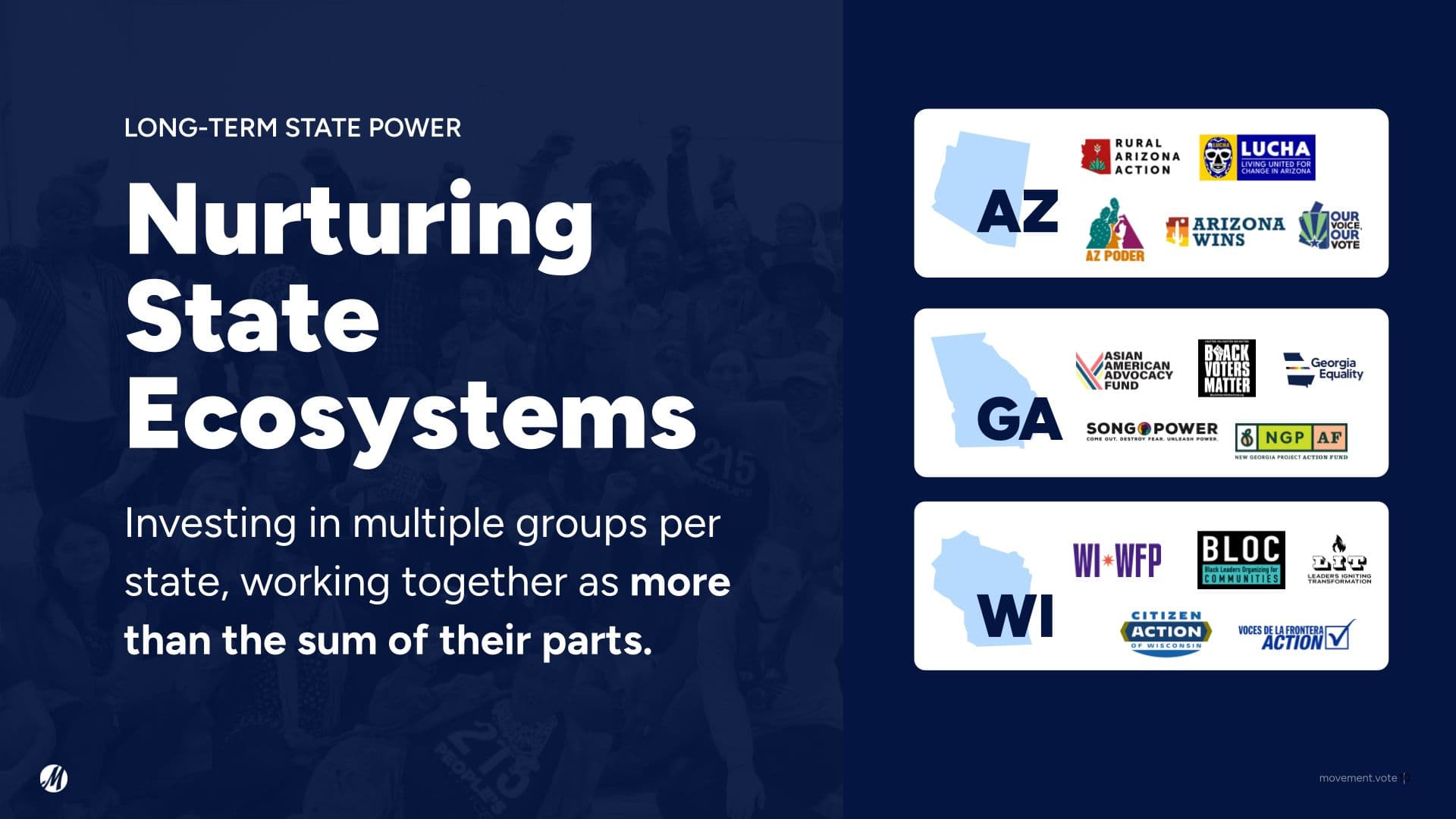
This approach has shown results in several states, most notably Minnesota:
Organizing Was the Heartbeat: The Ten-Year Path to Progressive Governance in Minnesota
2024 • Win the Midwest (Laura Flynn et al)
Description) In 2023, in a little over 100 days, Minnesota’s legislature passed a transformative progressive agenda on a scale not seen since national New Deal legislation of the 1930s. How did this happen? The short answer is: people organized for it. How did an ecosystem of organized people in Minnesota achieve enough scale, depth, cross-racial solidarity, alignment, maturity, and resilience to break through? This case study, based on conversations with a dozen Minnesota grassroots leaders, funders, and electeds, attempts to answer that question.
Aligning for Power: A Case Study of Bargaining for the Common Good in Minnesota
2024 • Georgetown University (James C. Benton, Patrick Dixon, and Joseph A. McCartin at the Kalmanovitz Initiative for Labor and the Working Poor)
These breakthroughs did not just happen overnight — they were the result of a coordinated, decade-long organizing strategy.
Context: In 2022, Democrats won a state trifecta for the first time in a decade, and became empowered to enact an almost-dizzyingly vast progressive agenda. But these breakthroughs did not just happen overnight — they were the result of a coordinated, decade-long organizing strategy by progressive grassroots groups.
In “Aligning for Power,” the authors at the Kalmanovitz Initiative lay out how this came to pass thanks to over a decade of coordinated work by labor and community organizations, including MVP partners TakeAction Minnesota and Unidos Minnesota.
Key excerpts:
“A foundational insight… was that they were not constructing a transitory coalition, they were building an enduring alignment.” (p.12)
“The issues that the Minnesota alignment had been campaigning on for years helped to shape political debate in 2022. Having helped the DFL win the “trifecta,” the social and political ecosystem that had emerged … then helped shape a governing agenda that came to dramatic fruition in 2023.” (p.27)
Investing in New Media
To defeat autocracy and shift the trajectory of our country, we need to win hearts and minds en masse by pairing local organizing with new-media engagement. In short, we must organize the internet. View MVP's new-media strategy.
The right dominates the online media ecosystem
2025 • Media Matters for America
In this study, Media Matters assessed the audience size of popular online shows — podcasts, streams, and other long-form audio and video content regularly posted online. They found that right-leaning online shows dominate the ecosystem, with substantially larger audiences on both politics/news shows and supposedly nonpolitical shows that they determined often platformed ideological content or guests.
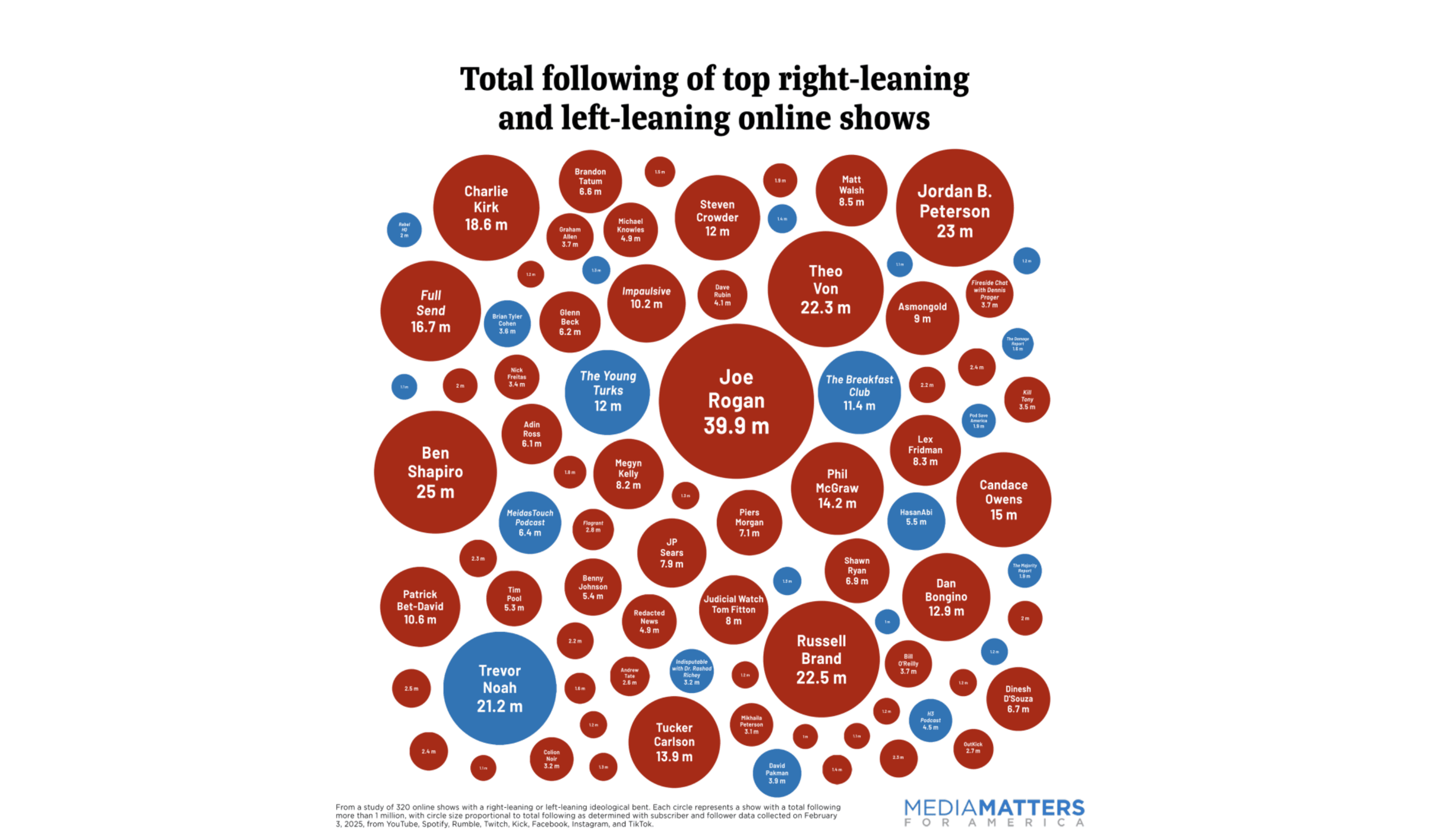
Graphic: Media Matters, 3/14/2025.
Investing Based on Holistic Power Metrics vs. "Cost Per Vote"
Power Metrics: Measuring What Matters to Build a Multiracial Democracy
2023 • Democracy & Power Innovation Fund and Harvard Kennedy School
Narrow, funder-driven metrics like “Cost Per Vote” (CPV) incentivize:
- Short-term voter turnout outcomes over long-term power building;
- Transactional voter-mobilization tactics over deeper organizing strategies; and
- Programs that contact higher-propensity voters but neglect the harder-to-reach voters we ultimately want to engage.
Power Metrics is a groundbreaking report — the research for which was done in partnership with many MVP local grantee partners — that seeks to measure and visualize the work of year-round grassroots power building, and to lay out a framework for advancing these "power metrics" across the organizing sector.
From the abstract:
When we seek out the drivers of progressive change in almost any state, we find a handful of entities that organize bases of people who deliver that power over and over again in legislative and electoral campaigns to win change across issues. The problem is that the work it takes to build and continue growing such an organization’s power over time has been largely invisible.
(...) For the last three years, we have been invested in building a culture of measurement that actually tracks advancement on what matters most in our sector.... in a word: POWER. This memo covers our progress and key findings in this work so far.
The Limited Impact of Political Advertising
While candidate-based giving often funds ad spending (typically 45% of a Congressional campaign budget), MVP invests in locally-rooted organizing that can mobilize voters that ads cannot easily reach.
For contrast: $100,000 will roughly pay for a thirty-second national TV ad, or two on-the-ground canvassers for an entire year.
How Democrats Can Optimize Media Spending And Stop Wasting Millions
April 2021 • Priorities USA
Context: After the 2020 election, Priorities USA analyzed the $5.4 billion in Democratic and Republican ad spending by candidate campaigns and outside groups.
Findings:
- Democrats likely spent 10% of their ad budgets on voters who’d already voted.
- “Roughly $334 million was wasted on people who had cast their ballot.”
- 75% of TV ads for U.S. House races were shown to voters in other districts.
- “Meanwhile, too little is spent on mobilizing voters, especially down ballot.”
Key takeaway:
“If we took just 1% of the late spending and invested it in additional organizing infrastructure on the ground, we could generate an immensely higher longer-term return on investment.”
The Effect of Television Advertising in United States Elections
November 2021 • Cambridge University (John Sides, Lynn Vavreck, and Christopher Warshaw)
Context: This comprehensive Cambridge University study examined 4,500 federal and state-level races from 2000-2018 to assess the influence of TV ads on election results. The study provides “the most comprehensive analysis of advertising effects to date.”
Findings:
- TV ads do have an impact, but much less in presidential vs. downballot races — and mostly for persuasion (changing undecided voters’ attitudes on candidates), not mobilization (getting partisan voters to vote).
- TV ads only likely sway outcomes “in close races where one party is able to muster a substantial advertising advantage. But we do not claim that this is a common occurrence.”
- The trend of increased partisan polarization and decreased split-ticket voting could “lead to a decrease in the effect of television advertising on elections.”
Downballot Focus, National Impacts
MVP invests in local organizations that focus not only on federal races but also on the state, county, and local elections that have a direct impact on voters’ daily lives.
MVP partners get out the vote for these races, as well as identify, recruit, and develop candidates to run in them.
When we invest in local races, we create a “multiplier effect.”
Credit: Run for Something
Reverse Coattails Effect 2016-2020
November 2021 • For Our Future, Run for Something, BlueLabs Analytics
Context: Run for Something and For Our Future commissioned BlueLabs to study whether Democrats contesting state legislative races could increase vote-share at the top of the ticket in battleground states.
Findings:
- “Folks running for state and local offices were responsible for increasing turnout for statewide or national candidates.”
- “Across states and cycles, we found an estimated 0.4% – 2.3% bump in top-of-ticket vote share when every local state legislature seat within a precinct is challenged.”
- “While Democratic candidates running in districts that would be otherwise uncontested Republican races may not win those seats, they may provide an important vote share bump in close statewide contests”.
Key takeaway:
The dollars spent locally go further because they directly reach and educate voters through community based organizing in ways ad-buys and big campaigns can’t. They also build political infrastructure and talent, allowing for us to take a deep red district and over many years, turn it competitive. No race goes from 70/30 to 50/50 overnight!